Somewhere out there, a city council meeting is happening. And you're not watching it. But I am. Each week, I bring you the highlights, lowlights, and weirdlights from places you don't live.
“I usually don’t use this platform to make a political statement. But I feel like I have to tonight.”
Councilmember Rick Vaccaro seemed to be winding up to drop a rhetorical bombshell. Who would be the subject of his grievance? The mayor? The other council members? The shadowy and pugnacious Fairfield Main Street Association?
“I see what’s been going on in our country and it’s been breaking my heart, just like everybody else. The zero tolerance. Seeing families split apart. Seeing kids in cages. I think it’s a horrible thing.”
Frowning partly at the situation and partly at his own admission, he added, “like I said, I usually don’t make this kind of a statement. It’s just been what I’ve seen.”
To be fair, no one “usually” makes the statement that putting children in cages is bad. And that’s because it “usually” goes without saying. But if you told me two years ago that caged children would be topics of conversation at city council meetings, I would have said, “in America?! Sounds about right.”
Speaking of cages, those brick walls look awfully claustrophobic.
Councilmember Catherine Moy, booming through the speakers via telephone, had a more conventional pre-Independence Day announcement that did not touch in the slightest on human rights atrocities.
“We’re looking forward to a real good Fourth of July. And that means NO fireworks in Fairfield!” she bellowed. “We have a great parade, and then we can go to Suisun City to watch the LEGAL fireworks.”
Mayor Harry Price took it a step further by announcing a zero tolerance policy of his own. “If someone is using an illegal firework,” he glowered, “do not simply close the doors and windows and ignore it. Call the police.”
“And then we will put them in the cages.”
But suddenly, the meeting took an abrupt turn. Not because of what they said. But because of what they heard.
“THANK YOUUuuuuUUuu MISTER MAYORRrrrRRR,” Councilmember Moy echoed as if she was talking into a haunted house intercom. “UMMmmmM, I’Mmmmm–”
“Catherine, can you speak closer to the phone?” the mayor’s warped voice responded, reverberating through his own microphone. “And if you close the door, that could help.”
People on the dais exchanged glances as the distorted Councilmember Moy continued, growing fainter and fainter until her voice disappeared into the ceiling entirely.
“We’re having a terrible time hearing you,” Mayor Price announced. Everyone sat quietly as if this were Mission Control waiting to hear any sign of life from a recently-exploded shuttle.
“We cannot hear you.”
“Ground control to Major Moy?”
After a long pause there came one final sound from the walls.
“Hello?” Councilmember Moy asked faintly. The line went dead. Without warning, a thunderous warbling feedback noise burst from the speakers, causing the clerk to jump back and one of the city employees to wander to another room to fiddle with the dials.
Maybe this is a word of caution for the Fourth of July: if you hear loud booming and crackling, perhaps it’s not illegal fireworks. Instead, maybe it’s the faulty speakers in the council chamber and the haunted voice of the council member trapped inside.
But, as the mayor said, definitely call the police.
The Meriden city council is not short on bad behavior–including comments that skirt the border of sexual harassment, multiple censures against councilors, and an effort to delete council meeting footage by this week’s guest, Miguel Castro.
—
Q: On December 18 of last year, the council was discussing whether to fire your city manager. People brought up his performance and the performance of other city employees. But Councilor Bob Williams, Jr. said:
We have some department heads that you gotta handle with kid gloves. Some people you can have an honest conversation….There’s some people you can’t. You gotta basically pat ’em on the ass a little bit.
I realize Councilor Williams was probably just using some locker room talk, which is completely acceptable in the year 2018. Unless, of course, you’re a female comedian. How did you feel?
A: For anyone to go on the council floor and make a statement like this is really unfortunate. It’s a complete insult. It is unnecessary. It’s uncalled for. The department heads deserve a public apology. People are referring to this as “locker room talk.” Nonsense. I’ve been in many locker rooms and my friends in the locker room do not talk like that.
Q: Here at the City Council Chronicles studio, no one is allowed to talk in our locker room. And it really starts the day off on the right note for me. The next month, there was a resolution to censure Councilor Williams. The mayor ruled you could not vote on the resolution. So who then polices your council, Miguel?
A: It certainly deserves serious discussion and conversations that talk like this should not be allowed anywhere. It should be subject to a much further discussion which should start within our city leaders.
Meriden, CT councilor Miguel Castro
Q: Coincidentally at that same meeting, there was a censure against you that called you out for political retaliation against your former election opponent. And the mayor again ruled you cannot vote on it. You just said these issues should be discussed openly, so were you disappointed that the mayor denied a vote on both of these resolutions?
A: Well, I appreciate your thoughts but the comparison–it’s not a fair comparison. With regards to the manner you have brought now to our discussion, [it] was something that was referred to a confidential process.
Q: On March 29, there was a finance committee meeting. Apparently there were some councilors having a side conversation near you because the chair told them to be quiet. After that meeting, you contacted the video recording company for the city and asked if that exchange could be deleted from the footage. Did you at all think that a mere inquiry about deleting footage would be construed as a request to delete footage and therefore be records tampering?
A: Well, I appreciate your thoughts on the matter. My approach was posing a question whether that portion of the meeting could have been edited. That was the end of it. I did not wake up one morning to purposely commit something nefarious. If for some reason, for lack of information, I have brought a small level of disruption that could create that kind of perception, I personally apologize. I am sorry for how I approached it. Could I have known there was a right way or a different way to address my concern, I would have relied on that.
—
Editor’s note: After publication, Councilor Castro sent multiple messages to City Council Chronicles asking for this interview to be deleted. It is not the policy of City Council Chronicles to acquiesce to the pressure of elected officials seeking to set the terms of their own coverage. Councilor Castro was given the opportunity to request correction of any factual errors he found in the interview. He provided none.
Sometimes you vote the wrong way and need a do-over. Janet Diaz talks about the meeting where she was allowed to re-vote, plus she gives advice on how to handle public commenters who suddenly explode at the council.
—
Q: Lancaster does not record its council meetings, but there is an individual who runs See-thru City where he live streams all of your meetings. How much of what he was doing contributed to your decision to explore putting cameras in the council chamber?
A: He was the one that actually proposed it. People have made comments that it will be good for them to see it and hear it better. It’s actually the mayor I think that made that decision too.
Q: So it was this citizen-videographer who catalyzed the impending streaming of meetings?
A: Yes. Basically he is videotaping it, so other people are very happy. They appreciate him doing that. What the city wants to do is go further.
Q: Is there a way to incorporate the comments of people watching on Facebook Live into the meetings? Would you support someone representing the Facebook feed being able to come up at the very end of an item and list the comments they got from people watching?
A: Personally, sure. I feel that shouldn’t be a problem. But I can’t make those decisions–it has to be everyone on a whole.
Q: A couple of weeks ago, the council held a special meeting to reconsider a decision to tear down a historic building. Can you think of any vote you’ve made that you would like to cast differently now?
A: The problem on the day that I actually cast my vote–I think it got confusing. There was a person that–the police stopped her and her daughter and there was a yelling and screaming match. I was not thinking completely straight. I was still thinking of the trauma this woman had gone through. I voted incorrectly. I’m honest, I made a mistake. That’s why I called for a special meeting to recant my vote.
Q: Were people pretty understanding of that or do they hold you to a higher standard?
A: I think people understood that there was a lot of chaos. There was actually someone that caused an arson. I don’t see that anybody judged me. I’m just as human as anyone else.
Lancaster, PA Councilwoman Janet Diaz
Q: At the May 22 meeting, a woman came in to share her story about her interaction with the Lancaster police. But it escalated into screaming. How should a council president have handled that?
A: I have helped people in the past [as] a sexual assault counselor. Sometimes you just got to let them vent. You have to let them speak and get that out of their system because they’re hurting. You’re not gonna fix a problem if there’s so much chaos.
Q: She kept saying she wanted an apology. How appropriate would it have been for the council president to say, “you know what? You walked away from an interaction with the police feeling violated and betrayed. And that should never happen in our city. We let you down and I apologize.”
A: Yeah, that would be something that could’ve been handled that way. Yes, I agree with you. If there’s an apology to give to a constituent because somewhere along the line the system failed them, why should we feel guilty?
Follow Councilwoman Janet Diaz on Twitter: @JanetDiaz1966
The theme of this week’s Corpus Christi council meeting was simple. Straightforward. Short enough to fit on a baseball cap.
Make Corpus Christi Clean Again.
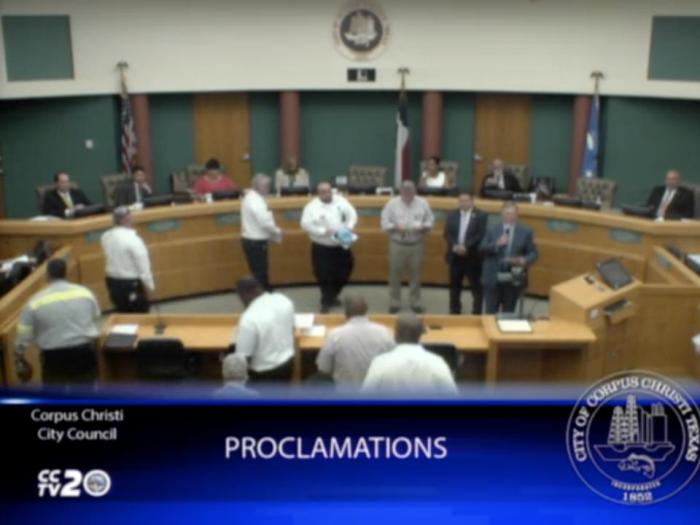
“All right, it’s party time!” Mayor Joe McComb murmured excitedly, cradling a handful of honorary proclamations. Most of them were “feel-goods,” celebrating Juneteenth and women veterans. But the mayor frowned after scanning the page marked “National Garbage Worker Week.”
“We oughta quit trashing our city,” he blurted out unprompted. “Put a bag in your car and put your trash in there and empty it when you go to the gas station.”
As the sanitation workers filed down to the front for a group photo, the mayor was rolling with the cadence of a Baptist preacher. “These people do a great job, but there’s a whole lot more of us than there are of them. So you can figure if we’re in a battle, we’re gonna win if we wanna be trashy. And we don’t need to be trashy.”
Don’t mess with Texas? More like, “don’t mess with Mayor Joe McComb.”
After the photo op, the applause, and the obligatory handshaking, Mayor McComb again grabbed the mic, worried that he hadn’t sufficiently put the fear of god in the viewing audience.
“I wasn’t being facetious when I was making my comments about the citizens need to not trash the place,” he yelled slightly above the din.
“Let me just ask you: when you go to a city and it’s nice and clean and looking good,” he began riffing as if he were the first person to put forth the proposition that garbage is bad, “you say, ‘man, that’s a pretty nice, clean city. I wouldn’t mind living or working here.’ We want that to be the reputation of Corpus Christi.”
Having littered the meeting with his anti-litter propaganda, the mayor opened public comment, with the disclaimer that “we’re here to listen. We can’t respond.”
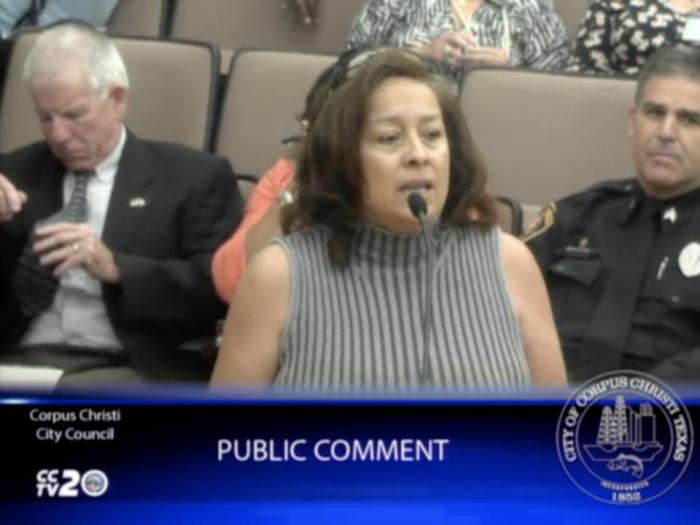
The policy was unfortunate, because he almost certainly would have had something to say about the woman who sauntered up to the dais, dropped her purse on the lectern, and immediately produced from it a plastic bag.
“I would like to present to you something that belongs more to you than to us,” she announced indignantly, handing off the bag to the city manager.
“I hope you feel the same repulsiveness that we feel,” she glowered. “Those are roaches.”
So are those roaches up for adoption or…?
If council members felt any repulsion, they legally couldn’t show it. The commenter barreled ahead.
“You are forcing us to live with this nuisance! Why are you imposing roaches and rodents on the neighbors of Ocean Drive?” she cried out, her voice rising as she railed against the dozens of new palm trees and their creepy-crawly inhabitants.
“Why do you wanna have Corpus Christi full of roaches? You cannot sit outside at night because you have all those roaches coming onto you. Please help us!”
I seem to remember someone else talking about having a good-looking city….
After everyone had spoken, Mayor McComb could no longer contain his irritation.
“There were just misstatement after misstatement after misstatement,” he grumbled. “There ought to be something in there that we’ve got a correction statement period after the public comments. It’s a privilege, not an obligation that we have public comment.”
Although this fresh outrage didn’t appear to be cockroach-specific, it was alarming that the mayor was mulling the nuclear option. (The nuclear option, ironically, being something those cockroaches would survive.) But he stopped, then reconsidered how a lesser, more Pavlovian solution may be needed.
“Or we’re gonna have to devise some method that says either a big bell’s gonna come down or somebody with a water gun’s gonna squirt ’em when they knowingly make misstatement of facts. So I’m gonna work on that.”
Ah, maybe go after the cockroaches first? Then work on the dais-mounted squirt gun.
Sometimes it feels like everyone’s a critic. But in the Scranton council chamber, literally everyone who showed up had some beef with the five councilmen.
“I actually have to grab the speaker list,” Council President Pat Rogan admitted with a sly grin, excusing himself from the dais while a dozen pairs of eyes followed him out of the room.
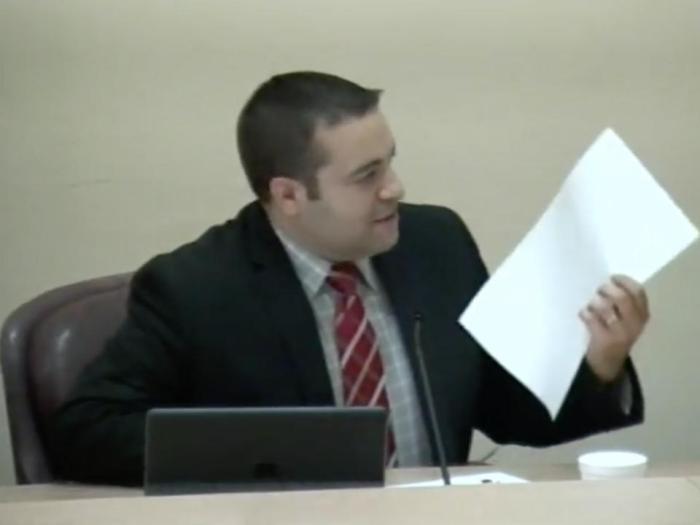
Sitting down with the paper, he brandished it with feigned surprise. “So there’s nobody on the speaker list–” Rogan deadpanned before calling up the first in a series of aggrieved complainants.
Is that Dunder Mifflin paper?
“Comcast, okay? They are a monopoly. In the United States of America, a monopoly is illegal,” ranted a man in a black “Brooklyn” baseball cap and thick New York accent.
“They don’t want to give a senior citizen’s discount! I come from New York City, okay? Five boroughs–not anywhere in the five boroughs will you find that they will not recognize what senior citizens have done for this country,” he pounded on the lectern. “I have five major credit cards! I have seven different department stores!”
He waved his arms. “How can any one of youse here allow this to happen?”
“We don’t set the rates for Comcast,” President Rogan responded plainly. “Comcast is a private corporation.”
“So, no discount?”
The commenter was replaced by another middle aged man with a pair of reading glasses on his nose and sunglasses on his forehead. He emitted a deafening sigh into the microphone.
“I don’t even have a computer and I apparently know more about what’s going on in the city than you five, the mayor’s two hacks, and the mayor.”
Okay, let me stop you there. In the interest of time, let me annotate this testosterone-fueled grudge-fest to just the most cantankerous of grief mongering. The three wordsmiths here are:
-A strident elderly man in a yellow Polo (Y)
-An affable college student with half a mohawk (M)
-A woman with pinkish curly hair (C)
Ready? And go:
Y: You’re an elected official and the forum here is for the issue of debate. And if you can’t answer, then I ask you to resign.
M: The reason that people my age leave this area is because we don’t have faith in you guys.
C: Mr. Donahue, when speakers are up here, you have your head down and you are writing what they are saying? You could look on YouTube.
Y: You are a liar and should have resigned and maybe there’s litigation that will remove you.
M: Two of you keep looking down–aren’t even looking at me.
C: When speakers are speaking, you should–okay, you’re shaking your head.
Y: When I brought up the word “despicable” last week, it was mild terminology for what’s going on here. I’d like to put it in real words, but I might burn this microphone.
C: I’m disappointed. I voted for you.
M: This city council has lacked the competence needed to bring Scranton back on the map like it used to be. (A siren goes by in the background, as if on cue.)
I’m sure the councilmen on the wall had a similar experience.
As yellow-Polo-shirt man walked away from the microphone bellowing for Council Member William Gaughan to “resign, you don’t belong here,” Mr. Brooklyn Hat began yelling from the gallery. That, in turn, prompted others to start yelling.
“You’re both out of order!” pleaded President Rogan.
“This is a sideshow,” murmured the next commenter at the mic.
It was. Although I sense it’s also a regular Monday night in Scranton.
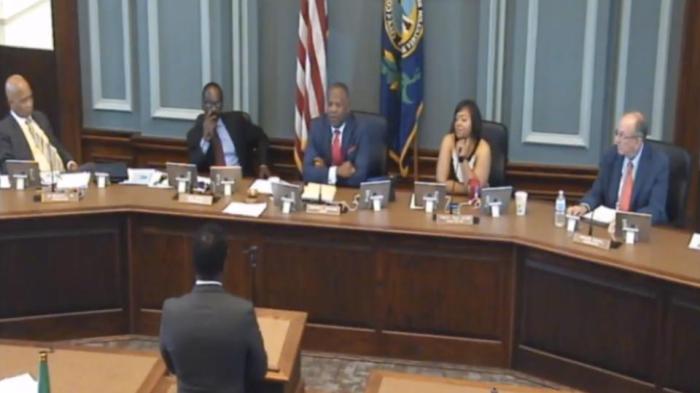
“It’s amazing. You referenced the prophet Isaiah–‘come let us reason together’,” Mayor Steven Benjamin mused after a pastor wrapped up his invocation and the audience lifted their heads.
“We’re gonna move to defer item 41 for two weeks in the interest of everyone talking together again. Let’s see if we can get some good discussion.”
Eying the standing room-only crowd–some wearing color-coordinated t-shirts–the mayor added, “we’re not gonna be voting on the healthcare plan tonight. Some of you obviously have other things that you need to be doing.”
A cacophony of disgruntled murmuring arose as a mob of people lined up for the door. Council members sat stiffly and Mayor Benjamin fingered the gavel just in case.
“Please keep it down just a tad bit!” he hollered.
“See you in two weeks, everyone!”
The crowd may have left, but the fireworks were just getting started.
“Mr. Mayor, I am opposed to this because this is another start of tax breaks for student housing in the city of Columbia,” insisted Councilman Howard Duvall indignantly.
“I respectfully disagree,” Mayor Benjamin replied calmly. “We’re gonna be able to disagree on policy and respectfully disagree.”
For the third time in under a minute, he clarified, respectfully: “But I respect your ability to disagree.”
With that, the fury fizzled. Everyone got on the same page and with rocket speed approved one item after the other–only pausing long enough for Councilman Duvall to exclaim:
“Those were the most detailed plans I’ve ever seen for a bicycle repair rack! About 16 pages!”
All of a sudden, as the clerk prepared to call the roll, Mayor Benjamin stood up and wandered over to Duvall, deliberately switching off the councilman’s microphone and whispering in his ear.
“Mr. Duvall?” the clerk prompted.
With the two men gossiping off mic, Councilwoman Tameika Isaac Devine glanced over. “Howard, say ‘aye’,” she coached.
Duvall whipped around and blinked. “Aye!” he declared, spinning back to continue with the mayor.
Apparently, Mayor Benjamin is a master of keeping secrets. Not five minutes later, he again sprung up to have a side chat with Councilman Edward McDowell, all the while keeping far away from the microphones.
What was he plotting? A surprise party for someone’s birthday? A legislative coup? A strategic ploy to make the front page of City Council Chronicles?
Mission accomplished, chief.
Councilwoman Devine raised her hand. “I would just say, regarding mainly our land use boards, the new members will have to go through training.”
She fired a warning shot to the newest crop of board members. “They are sitting and representing the city. They need to hear people out. They need to be respectful. And they need to follow the law.”
I would add a final commandment: they need to avoid having side chatter in a business meeting. (Not directed to anyone in particular!)
Moving on to public comment, a man with a striped tie sternly informed council members, “I myself on May 27 was the victim of racial profiling. I wasn’t pleased.”
Then, in a possible attempt at intimidation, he cautioned: “I told your chief, once my people come from Seattle, we will be organizing protests.”
Seattle knows how to protest, Your Honor.
It didn’t work on Mayor Benjamin. “They’re welcome to come from Seattle, my friend,” he nodded. “We have porous borders. If you are in the borders of the United States of America, you’re welcome to have your positions heard. Happy to talk with you.”
Who would have thought that Oklahoma would be such an emotional hotbed for council meetings? In Norman, first-term council member Breea Clark has seen tensions run high over an obscure procedure, a street with an offensive name, and even a minor cultural proclamation.
—
Q: What is the Norman city council “rule of three?”
A: [sigh] Oh, the rule of three. It’s when three council members can choose an issue and force it on the agenda.
Q: Council members have some differing opinions on whether it is a good thing or, as someone else put it, a “bastardized” procedure.
A: I think you use the rule of three when you reach out to fellow council members and say, “hey, let’s talk about this” and they all tell you “no.” Having seen that process and the lack of communication when [other council members] used the rule, I personally will do everything in my power to never use that rule because it is so divisive.
Q: When I say the name “Edwin DeBarr,” what can you tell me about him?
A: I can tell you that he was one of the first four professors at the University of Oklahoma. He was a very knowledgeable man who spoke many languages. And I can then tell you that he went on to be a grand dragon of the Oklahoma KKK at the height of the brutality.
Q: People started showing up in your meetings and told council, “we have a street named after Edwin DeBarr and that is racist. Please change the street name.” The fact that it wasn’t happening immediately rubbed a lot of people the wrong way. At the October 24, 2017 meeting, the mood was tense. You’re sitting up there as a white woman with an all-white council–there was some shaming going on. How did you sense that the others felt when people were accusing you of being tone-deaf white people?
A: I don’t think any of my colleagues intended to be tone deaf, but it was uncomfortable. I think those comments hurt a lot of feelings, but they shouldn’t have.
Norman, OK Councilmember Breea Clark
Q: Some of the commenters called you out in a complimentary way to thank you for being a leader on the name change. Did any other council members come up to you and say, “I didn’t appreciate being called racist. I wish you might have told people to tone it down.” Did anyone lay that at your feet?
A: They did not lay that at my feet directly. I don’t think it’s my position to be the tone police. But how that all went down has created some very tense relationships with some of my colleagues. It changed everything. I will always regret the outcome of that. How they got a little beat up on the dais–I am the face of blame for that. We do not have the same relationship that we had before.
Q: Does that bother you?
A: Of course it does.
Q: Before you were a council member, there was a meeting the night of September 28, 2010. The council was considering a proclamation for GLBT history month. Have you ever listened to that meeting before?
A: I will be honest and say no, because I know what happened. I have seen pieces of the ugliness of our community since then and I couldn’t bring myself to listen to it.
Q: A week after that meeting, a 19-year-old gay man who had been in the audience and heard some of the anti-GLBT comments killed himself. Do you feel that the council, by allowing hate speech, might bear some responsibility?
A: [pause] That is a slippery slope. I wasn’t there that night. I’m glad I wasn’t there that night. But I wish somebody would’ve spoken up.
Follow Councilmember Breea Clark on Twitter: @clarkfornorman
“A council meeting in Brooklyn?” you’re thinking. “Surely it was chock full of complaints about hipsters, the L train, and the smell off the East River.”
Well, I have some bad news for you: this is Brooklyn, Ohio. And the topic today was less about subway delays and more about the equally compelling question of how to spend all this federal money.
“To qualify for this grant funding, cities are required to hold a public session,” boomed President Ron Van Kirk.
“At this time, I would ask members of the audience to come up to the podium if they wish to make a suggestion on ways this funding should be allocated.”
Van Kirk warned the ravenous crowd that they ought to get to the point, and get to it quickly. “Please limit your remarks to five minutes or fewer.”
Not a soul stirred at his invitation.
“All right,” the president murmured, “then there is no one.”
No one has an idea for spending the money?! Repaint the fields at Marquardt Park! Put a streetcar on Biddulph Avenue! Get a better sound system for the council meetings!
Maybe fix up that tattered George Washington portrait?
This being the first meeting after Memorial Day, the council was obliged to mention the solemn occasion. The perfect spokesperson appeared in the form of Council Member Mary Balbier–the wife of a Vietnam veteran.
“I’m not very fond of the hat he wears–the baseball hat that has the 25th Division and some sort of lightning rod on it,” she admitted with a wave of her hand.
“But I will tell you: everytime we walk through an airport and he’s wearing that, people salute him. People make a comment. And it’s quite heartwarming for him and I think he enjoys it. So I don’t say too much.”
With a slight grin, she let slip her true feelings about her husband’s headgear. “Also, he is TSA approved, so we just walk up and go through the line. I always say to my husband, ‘whatever happens, keep that hat. I may need to wear it!'”
The master strategist
President Van Kirk steered back to council business with an admission of his own. “I wanna let residents know that I will be absent for our next meeting,” he said regretfully.
“Our first meeting in June falls on the same week that our church has their annual youth camp. Seventeen years, and I’ll be serving there once again as a camp counselor.”
(If he runs his youth camp as efficiently as he runs the council meetings, those kids won’t even need the full week–they’ll be outta there in a matter of days!)
The remainder of the meeting was virtually on autopilot, as the building commissioner rattled off the changes–big, small, and alcoholic–happening around town:
“Aldi’s is getting an addition put on there….Hampton Inn, raising the roof on their building….La Casa Tequila just recently opened up behind Cracker Barrel.”
Casa Tequila AND Cracker Barrel? Maybe the U.S. and Mexico CAN work things out.
Racing through the final five minutes, the council approved a raft of legislation assembly line-style. This included one agreement for the city to order a whole bunch of salt.
“We could order no more than 3,920 tons.” President Van Kirk paused. “The city has never ordered that much salt in one year.”
Be careful, sir: now that La Casa Tequila is in town, the demand for salted margarita glasses has never been higher.
Hello, councilheads! Next week, City Council Chronicles will be off its hiatus and back with new profiles of city council meetings from around the globe.
But until then, I have gotten many questions about “Tear It Down.” I recommend that if you would like to know about some of the work that went into preparing the story, take a listen to today’s special episode of the City Council Chronicles podcast or click play below:
(If you have not yet heard the story, all eight parts are at http://www.tearitdownpodcast.com and you can even read along if you’d like. Route Fifty also did a terrific write-up here.)
On the amount of time put into the story:
Amber Bailey contacted me on July 10, 2017 and the story came out on May 10, 2018. So doing the math, that’s ten months. I would say I spent over 1,000 hours on this, which works out to about 25 hours a week. It was a pretty time-intensive hobby.
Probably the biggest single category of work was watching the council meetings. The footage is archived with the local public access entity, which is called ICRC. The very first video is actually from the last meeting in 2014, so there are only 3.5 years of council meetings online. That was still nice, but there are some caveats to that. First, committee meetings did not start to be recorded until the last year or so. And there were several meetings that went untaped.
Watching the meetings, I took detailed notes about what was going on, which included time stamps so I could pull clips to use in the story. (I never counted up how many pages of notes, but my guess is over 200 typed pages just about the council meetings.)
Then probably the second biggest amount of time was spent on transcribing the interviews. I did about 60 hours of interviews and for every hour recorded, I spent maybe two hours transcribing everything. It was very time consuming, but I think it saved me time when writing the story.
On some of the challenges:
One thing I did encounter was that the set of characters in the beginning of the story was somewhat different from the characters who were there at the end. And generally, the people who had a lot to say weren’t around for too long, and the people who were around for long couldn’t remember a lot of things.
The main example of that is in Chapter 4, when the Change*nch co-founder, Nick Link, talks about city administrator Mark Fitzgerald taking him aside and calling him a “puppet master.” In Link’s telling, it was very dramatic and angry. And some people did remember the word “puppet master” being used. But other people could hardly remember what time of year it was or even what year it was. And the only reason I know is because the O’Shea lawsuit mentioned when it happened.
On fact checking:
Fact checking was a big deal for me. I read an article about the fact checker for “S-Town” and how he spent several months verifying the information in that story. One example he quoted was they needed to figure out whether something was “shellacked” or “lacquered” or “expoxied.” And no one could really remember or cared what the distinction was. But he had to eventually call an expert who recommended what word they should use in the story.
And I hold myself to a high standard, but that seemed a little too much for me!
I definitely got corroboration on a whole range of events and assertions. The best sources were obviously the council meeting videos because then I could see for myself what was going on. I did want to be very fair to people. I took out some lines near the end where I just could not get corroboration.
One example that came close to the “S-Town”-style fact checking was that at one point, Al Long in Chapter 7 says that Renee Stiles, when she was on the recreation commission, had a “binder” of plans for community events. I wanted to be accurate and find out if she really did have a binder. So I tried to find out if there was anyone else from 2009 or earlier who remembered this binder. The answer appeared to be no.
So I sent Renee Stiles a Facebook message. And she said months earlier that she was not really interested in speaking to me for the story, but I hoped she might be able to confirm this fact. And sure enough she wrote back and said what she actually had was “file folders” of plans, not a “binder.” So that is why in Chapter 7, you will hear Al Long speaking to the preparation of Renee Stiles in putting on these events, and then I interject to clarify the container in which she kept these plans was file folders.
On the schedule:
It was in early February that I began writing the episodes. That was a hectic time because around then, I set the date of May 10 to release the story. So I needed to write one episode per week beginning in February.
I was aiming for all of the episodes to be between 40 and 50 minutes, which, as you can see, did not happen. I spent a lot of time agonizing over what things to cut, what to include. But at the beginning of April, I had eight scripts that were written out–exactly what my voiceover would be, what the interviews were saying, whatever was in the council meeting clips. And I annotated everything so I knew where to pull the clips from and what part of the interview needed to be pasted into the episode.
In April, I started editing everything together. I finished each episode in about four days, which I consider fast. And again, that’s due to me knowing in advance what day and hour and minute to go to when pulling clips.
The part I hated the most was putting music underneath everything. It is so much pressure to pick the right song! And when you don’t have someone custom composing the music, whatever you choose may be perfect for the first 45 seconds and then it switches to a mood that is entirely different from what the story is trying to communicate.
Or I might have something that’s two minutes long, but I need something for 3.5 minutes. Or there’s the fact that I had a lot of sinister-sounding music and there just weren’t that many different sinister songs to choose from. So that was probably the part I hated the most, even more than transcribing the interviews, was picking the music.








 City Council Chronicles