#127: Council Bluffs, IA 8/28/17

It took astonishingly little time for the Council Bluffs council meeting to go from zero to 11.

“I need to know what kind of right-of-way you guys are going to take,” the owner of a tire store fretted.

“Jack, I believe it would be just enough to do the sidewalks on the corner,” Mayor Matt Walsh informed him in a low, gravelly tone.

This upset the tire man even more. “They wanna come 25-foot into my parking lot to put the signs, street lights…I cannot afford to lose that kind of parking!”

“I don’t believe we’re talking about 25 feet into your parking lot–” the mayor tried to reassure him.

“I just cannot afford to lose any more parking,” repeated the man.

The mayor nodded, unmoved. “Perfectly understandable.”

“I’m not trying to be the bad guy. But I cannot afford to lose any more parking.”

cb1
I think he’s got it.

Mayor Walsh hunched over and calculated how to end the interaction. “I can’t answer you with any specificity tonight. I can get your phone number out of the phone book.”

The man thanked him, adding, “I cannot afford to lose any more parking.”

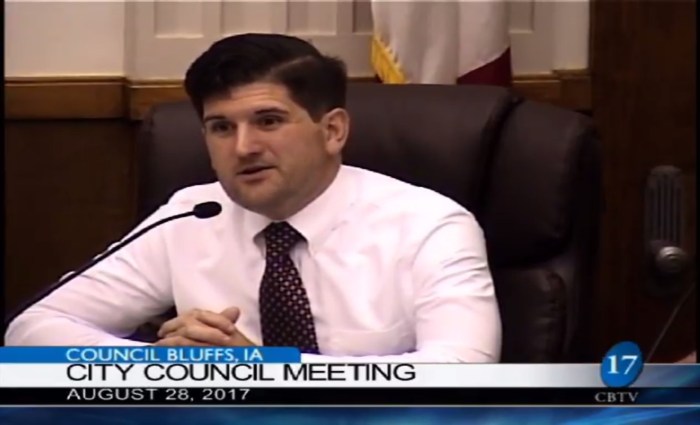
Councilmember Nate Watson flattened out his notes and mused about the dilemma. “I think there are a lot of competing interests, though I’d remind all of us that any further alterations to the master plan may test the patience of the funder of such improvements.”

The Funder? Who is this mysterious and impatient funder-who-must-not-be-named? And if he gets angry, how many virgins must the city sacrifice to appease him?
cb2.jpg
“Prepare the goat’s blood, madam clerk.”

“It’s primarily geared to making sure there’s enough space on the corner so we can meet the Americans with Disabilities Act,” Watson explained.

Abruptly, the tire store owner moved toward the front and began arguing back from the gallery.

The mayor remained placid. “It’s NOT authorizing them to take your property,” he said firmly. The man continued to protest.

Councilmember Watson nodded sympathetically. However, his sympathy was seemingly at its breaking point. “Your opinion matters a great deal, but it’s not the only one,” he replied gently.

The council moved on to talking about a parking garage. But Councilmember Al Ringgenberg ringgen-berated the whole concept.

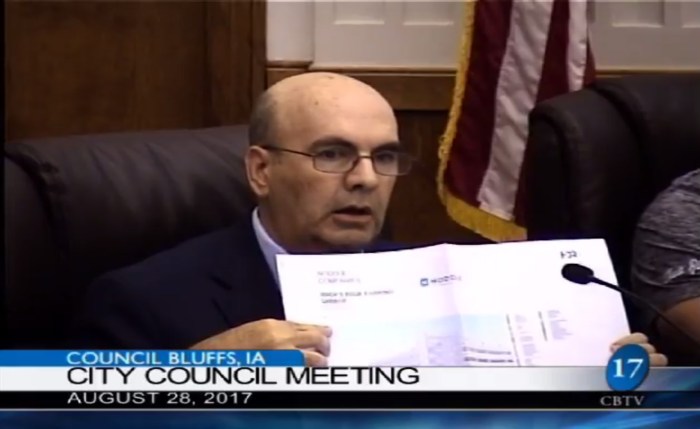
“I question whether this is in the best interest of the city,” he frowned. “Not long ago we were provided documents and included is $2 million for [a] parking ramp down payment.”

He appeared deeply frustrated. “What I have a problem with is using general obligation funds that should be used to repair crumbling streets and sewers.”
cb3.jpg
Ah, yes. I see the design flaw.

Mayor Walsh grew visibly irritated, raising his voice. “So this is an ongoing diatribe of false statements–”

“Mr. Mayor, point of order!” Ringgenberg interjected in surprise.

“It’s my turn to talk, Mr. Ringgenberg,” the mayor thundered. “It’s my turn to talk!”

“First of all, the $2 million was NOT general obligation money. Second of all, we are the SECOND LOWEST city in Iowa with debt!”

Council members looked uneasily around the dais after the mayor concluded his angry rebuke.

Watson stared out to the audience. “There are a good number of young men here today for their communications merit badge.”

His face was expressionless as he added, “that’s what makes our country great. Stay involved.”

Final thoughts: I can’t imagine what kind of communications lessons were learned here, but 10 out of 10 stars to The Funder, if He’s watching. (He always is.)

#97: Caribou, ME 4/10/17

“Before we start, I just wanna announce: a public hearing on marijuana usage was scheduled for tonight. That won’t be tonight–it wasn’t in the paper, I guess,” a contrite Mayor Gary Aiken warned as councilors stared stone-faced (no pun intended) ahead.

And thus, the Caribou city council meeting started off innocently–and amusingly–enough. However, as citizens lined up to speak, the meeting slowly morphed into an increasingly depressing debtors court.

“We’ve had back taxes for quite some time since my dad took ill. He’s been a couple years passed away,” a man admitted earnestly off-camera. One councilor leaned back. Another crossed his arms.

“So are you prepared to pay the $11,960.76?” the mayor quizzed him.

“Today? No,” the man flatly replied.

Councilor Joan Theriault scrutinized his case file like a sympathetic magistrate judge. “In 2018, you would get a $20,000 homestead exemption,” she finally looked up to inform him. “Make sure you apply.”

“It’s been on my mind for quite some time now. But…I can only do what I can only do,” he inexplicably shrugged off her advice.

As he left the podium, another citizen in dire straits took his place. The mayor massaged his forehead as the desperate plea began.

“We have approximately $2,000 to give,” the man sniffed. “My family’s gonna help us to clear that bill up.”

His wife chimed in unprompted. “You know what my grandmother used to say? ‘Experience is good if you don’t pay too dearly for it.'”

The panel of councilors remained expressionless.

caribou.jpg
The people’s court

She continued, “You guys have been really, really good and leaned over backwards for him–”

“I’m glad you understand that because I don’t think he understands that,” Mayor Aiken sharply retorted.

Her husband shot back, “I understand that.”

The mayor ignored him. “As of right now, the property is gonna go up for sale–”

“PLEASE take that out of the equation,” interjected the man acidly.

“Take what out of the equation?” the mayor leaned forward, genuinely confused.

“What you just said,” he spat. “Don’t say that to me.”

His wife was horrified.  “Knock it off. KNOCK. IT. OFF.”

As her husband protested, councilors sat motionless with their hands clamped in their laps. Picking a fight in front of the people who might sell your house is probably not in “The Art of the Deal.”

“So, it’s part of the equation,” the mayor repeated. Husband and wife did not reply. The council dictated the terms: the man would pay $500 in the next 21 days, plus another $350 by May 5.

There was an uncomfortable pause as councilors watched the feuding spouses shuffle out of the room.

A third man stepped forward to spin a long story about dutifully paying his taxes–sighing the whole time.

“Do you have your receipts?” Councilor Theriault peered over her glasses.

“No,” he breathed another baritone sigh. “I wasn’t very good at keeping receipts. My father’s name is the same, so things kinda get opened that shouldn’t. Uh, it’s hard to explain when you live with the same name.”

Councilor Philip McDonough was done with excuses. “Every time the situation comes up, it’s a different subject for each person! You bring in what you owe and we’ll turn your deed back to you.”

He slapped the table angrily. “Yes, it’s hard to sit here and say that. And it’s hard listening to them.  But the rest of our citizens have an obligation and they all meet it.”

Sighing Man turned away disgustedly. “I’m sorry, but you’ve offended me, sir.” He stepped out the door, closing it behind him.

The council stared silently.