Interview #114: Toronto, ON Former Councillor Joe Mihevc (with podcast)

This podcast interview is available on iTunesStitcherPlayer FM, and right here:

Joe Mihevc was a councillor for over 20 years when Ontario’s premier suddenly announced in the middle of this year’s election that he was cutting the size of Toronto’s city council from 47 wards to 25. This prompted several chaotic council meetings and even more chaotic provincial legislative sessions.

Q: Where were you on the night of July 26, 2018?

A: All councillors were in council session. That’s when we heard rumor on the second floor during the council meeting that something big was happening. We very quickly understood that the premier was going to be making an announcement the very next day that he was going to reduce our council.

Q: You said the word “premier.” For our American listeners, you’ll have to explain what that is. I’m assuming the premier is some sort of demigod? An authoritative mystic with the magic of Dumbledore and the charisma of Barack Obama?

A: Well, the equivalent to premier is “governor.” Here if you win the premiership, you also run the political party that has charge of the legislature. So it’s a pretty neat gig if you can get it.

Q: Councillor Paula Fletcher used the term “Trump tactics” to describe Premier Doug Ford’s council cuts. Do you agree with her description?

A: Absolutely. When we use those words in Canada, in this context it meant that the premier was acting in an authoritarian way. He was not consulting the folks that were impacted. It basically came from his head and he felt he needed to act, which is our perception of how things flow these days at the presidential level.

Q: During the July 27 meeting, you took a dinner break. And after councillors came back, the tone was completely different and more confrontational. What changed during that break?

A: As the day went on it became clear that the threat was real. I would suggest that what Doug–a part of him wanted us to fight it out. He actually provoked a “Hunger Games” at the city. Forty-four councillors recognized that if we did go to 25, there would be a fight for many a seat. Every councillor positioned himself to be active on the issue partly to show the community how strong they were going to be opposing Doug Ford.

b2yZpibO_400x400
Toronto, ON former Councillor Joe Mihevc

Q: Help me understand the types of councillors who were in favor of the province’s action. You mentioned there were Doug Ford’s allies, but were there also people who really could not stand the way your council operates?

A: I think the people who were supportive of Doug Ford’s actions–all of them were on the right-wing side of council.

Q: What do you make of the notion that as a councillor, you don’t have to have 12-hour days and do everything for everyone. With fewer councillors, your focus should be on taking votes in meetings, legislating, and not micromanaging everything that goes on in your neighborhoods?

A: That’s a very good point. It depends on your philosophy. If you want to put it on a spectrum, you can say on one side you are the board members of this $12 billion corporation called the city of Toronto and you are there to make decisions. That’s your job and that’s it. Others feel–and I would be one of them–that you have face time with residents. To double the size [of wards] means to get half the amount of face time.

Q: You knew Doug Ford when he was a city councillor. I take it he was a stickler for efficiency, effective governance, and moral rectitude?

A: [chuckles] Doug Ford was a stickler for trying to grab the limelight and score political points on how he hated all government. The word “dysfunction” that Doug Ford labeled city council–it was dysfunctional for many years when he and his brother [Rob Ford] were here. He was willing to go up into the audience. There was once when he was taunting them to come down and take him on. I remember those times as really tumultuous. Once they left, guess what? A new calm. I would suggest right now that provincial parliament is highly dysfunctional, and he’s at the center of that dysfunction.


Follow former Councillor Joe Mihevc on Twitter: @joemihevc

#176: Temecula, CA 11/27/18

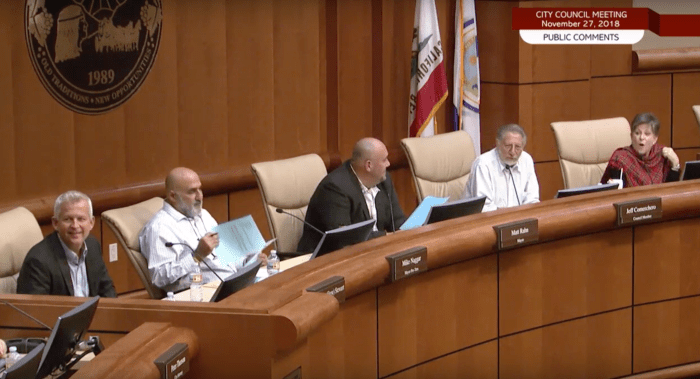
“Are you in the audience this evening?” Mayor Matt Rahn scanned the room for one particular Boy Scout, which should not have been difficult given the scarcity of badges and uniforms in the crowd.

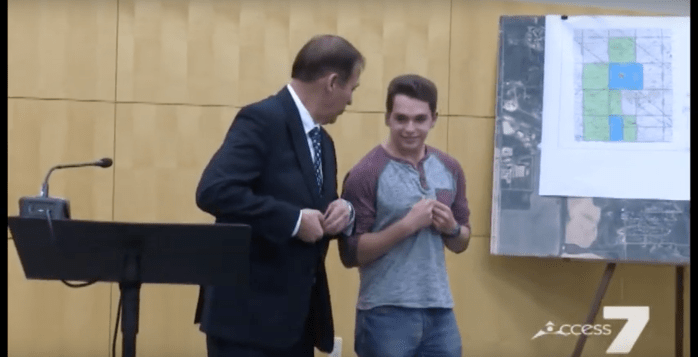
“We wanted to congratulate you on receiving the rank of Eagle Scout, which is the highest achievement in scouting. Let’s hear about your project!”

The scout stood uneasily behind the microphone and softly described his community service. “For my project, I decided to go with Rancho Damacitas [Children & Family Services]. I decided to go with a garden box and benches. But then they decided they didn’t want that anymore. They wanted to build a shed. So I agreed to make a shed for them.”

“God, you started off with a bench and made it all the way to shed,” the mayor exclaimed. “It’s a good thing they didn’t have an annex wing put on!” A group of teenagers grinned and snickered in the second row–although it was less a reaction to the mayor’s joke than to something they were doodling in their notebooks.

Screen Shot 2018-11-29 at 10.20.37 AM.png
I see you, kids.

Fortunately, they picked the right night to observe a council meeting, as the Temecula Valley Museum’s director stood to introduce visiting dignitaries from Daisen, Temecula’s sister city in Japan.

“They will be enjoying many of the amenities, including the duck pond, the Pechanga Great Oak Tree, and also San Diego,” she said. “They will also be our special guests in Santa’s Electric Light Parade.

“Please forgive me if I mispronounce their names.” She proceeded strenuously to sound out each name, but none of them appeared to mind as they strode to the front of the room for a group picture.

There was minor confusion as the mayor attempted to pass out certificates, but had no idea who was who. Thinking quickly, he flashed the papers to one of the visitors, who pointed him towards the correct recipient.

Screen Shot 2018-11-29 at 10.20.19 AM.png
Temecula council goal: learn Japanese

“Have you taken them to In-N-Out Burger?” Mayor Pro Tem Michael Naggar grilled the museum manager. “Not yet? And the Cheesecake Factory?”

“Where do we get those jackets like they have on?” quizzed Council Member Maryann Edwards, pointing to the branded jacket of one of the visitors.

“That’s a good question,” Mayor Rahn echoed. “Where did you get the Temecula jacket?”

“You can get those in the visitor’s center around the corner,” replied the city manager, to the pleasant surprise of the whole council.

Screen Shot 2018-11-29 at 10.24.27 AM.png
I predict five purchases in the near future.

The last large order of business–other than the teens’ excited whispering about something on one of their phones–was the dry but important matter of extending a construction permit for the Temecula Valley Hospital.

“I can personally vouch that because of the hospital–no exaggeration–it has saved the life of my father-in-law, it saved the life of my wife,” Mayor Pro Tem Naggar testified. “There is an impact of the helicopter flying over–it flies about 300 feet over my house. At first, it’s annoying until you think about who’s in that helicopter. Then you find out a little annoyance is meaningless based on what’s going on up there.”

“None of us could have dreamt that it would be this good,” echoed Council Member Edwards. “My husband has been a ‘customer’ on several occasions. How we ever got along without you, we will never know.”

With praise like that, I hope the Japanese delegation gets to visit the hospital–a far, far healthier alternative to the Cheesecake Factory.

Interview #113: West Hollywood, CA Mayor Pro Tem John D’Amico (with podcast)

This podcast interview is available on iTunesStitcherPlayer FM, and right here:

John D’Amico is in his seventh year on the WeHo council and he is not afraid of wading into controversies. From Donald Trump’s Hollywood star to bad behavior by council members, he discusses the importance of speaking up when necessary.

Q: When did the idea enter your mind that Donald Trump should no longer have a star on the Hollywood Walk of Fame and that you should do something about it?

A: When that star was vandalized again, it occurred to me that we were spending our time thinking about it and more importantly, the city of Los Angeles was spending tax dollars to replace it. And I was just thinking, why are we doing that? Why are we not speaking out? Why am I not speaking out? What very quickly occurred to me next was, why does this person–this sexist, quasi-fascist actor–have a star on the Walk of Fame?

Q: Yeah.

A: I received hundreds and hundreds and hundreds of emails. I responded to every single one with an email back that had my phone number at the bottom. Only two people called me. They were truly amazing people living in the middle of the country. We agreed that we were not gonna see this in the same way.

Q: On August 6, you introduced an actual resolution asking the Los Angeles city council and the chamber of commerce to remove the Trump star. As you might imagine, there were some strong opinions. One man even called you a “bad strategist” for not waiting until after the primary elections to send the letter. How worried were you that your actions may have affected the Wyoming governor’s race or the Alaska state senate primaries?

A: Well, not at all. I’m fairly certain that what we did here in West Hollywood had zero effect on elections across the country. That effect was generated by this president. He earned this “blue wave.”

Q: I can see that commenter’s point, though. This president loves to take legitimate criticism of him and convert it into fuel for immigrant bashers and media haters and mail bombers. Did you consider what might have happened if he had tweeted about you and what that might have meant for your safety or your city’s image?

A: Here’s what I thought: I’m not gonna live in an America where the president targets people. We can’t live in a country where you can say, “well, if the president tweets at you, you might be harmed.” That is not okay!

193570_119607551448362_7705342_o
West Hollywood, CA Mayor Pro Tem John D’Amico

Q: You do have a reputation for bringing matters out into the open. I’m thinking especially of the meeting of March 7, 2016, when you called out Councilmember John Duran for his inappropriate behavior in council meetings. What prompted you to go public with that information?

A: I’m not always the most eloquent speaker. I don’t always get it right. But I will say that I do think that silence is often tantamount to complicity. I will say that Mayor Duran and I have very much repaired our relationship. He has changed dramatically as a council member and now mayor of our city. But my side of that was that I wanted our residents to know that I am paying attention and I am not afraid of speaking my truth on their behalf.

Q: Do council members need to be trained to recognize when something is out of whack? If they see something, to bring it up right away and not let it loose in a council meeting two years after the fact?

A: Sure, I guess that would make sense. But council members have bosses. That’s the public. We do not report to each other.

Q: Well, the constituents rely on someone to sound the alarm, though. Would you not agree?

A: Fair enough. Absolutely.


Follow Mayor Pro Tem John D’Amico on Twitter: @ourWEHO

Month in Review: October 2018

Even though it was Halloween season, October’s city council meetings were hardly frightening. In fact, they were downright suspenseful.

For starters, there was the whodunnit involving a city council member who leaked a confidential document.

Then there was the mayor who claimed that his council was just waiting for him to slip up.

And we all got enraged at the city that deletes council meeting videos after a year.

But if you read this website for all things whimsical, we also covered the Canadian council discussing marijuana and the reporter who bought a special council meeting tie.

To see what you missed while you were designing your Halloween costume, visit the October Month in Review.

And if you ever fantasized about being a youth councilor mimicking the mayor, this guy is living the dream:

Screen Shot 2018-10-25 at 12.17.25 PM

Interview #112: Minneapolis, MN Council Vice President Andrea Jenkins (with podcast)

This podcast interview is available on iTunesStitcherPlayer FM, and right here:

The Minneapolis council has been proactive about addressing racial inequity, despite outside events making it a challenge. Andrea Jenkins describes how she felt about council members’ reactions to an equity training earlier this year.

Q: On August 1 of this year, there was a committee of the whole meeting in which you all sat through a racial equity training. Would you be surprised if I told you that I’ve been hosting this program for two years and this is the first racial equity training I’ve seen a city council do?

A: Yes, I thought every city council in America was doing racial equity training. That’s not true?

Q: No! I hate to let you down because that is wildly off-base, but what did you hope to accomplish with this training?

A: Well, we’re trying to get the council members woke. The main thing we wanted to accomplish was to have a common understanding and common language that everybody can start with. It dispels the opportunities for people to come in with their own perspective. If we can lay the groundwork for one common understanding, that was the purpose.

Q: I’m glad you brought that up because that was actually the part of the training that hit a roadblock. Council President Lisa Bender said she was uncomfortable participating in an exercise in which council members’ discussions about their early experiences with race would be televised. What did you make of that?

A: Boy, I was really–I was disappointed. We ask people to support us in being representatives. And then we are not willing to share details about our own experiences, our own lives, that could help bring understanding to why we make some of the decisions we make. I know that council President Bender is very open about some really vulnerable parts of her life. It would be really eye opening and compelling for people to understand some of her experiences around race. It wasn’t just council President Bender–I mean, if you watched the meeting, there were a number of council members who were reluctant to share that information. Sometimes there’s really powerful strength in being vulnerable.

DoDPlYzU8AEfI9i.jpg-large
Minneapolis, MN Council Vice President Andrea Jenkins

Q: There is another event we need to discuss that happened before the racial equity training. Can you explain what precipitated your June 27 committee of the whole meeting?

A: A week prior to that meeting, there had been a police-involved shooting of a young, black man who–it was under dispute whether or not he was armed, whether or not he was fleeing and was shot in the back. And so tensions in our community was really, really, really high.

Q: In that meeting, Council Member Cam Gordon wondered whether the city council needed more of a role in the police department. He proceeded to draft that exact charter amendment–which did not sit well with a number of people, including the public safety committee chair, Alondra Cano, who said she was “disgusted by the privilege” of the motion. What did you make of that?

A: I interpreted her use of the term “privilege” to suggest that it would’ve potentially been more appropriate for her to have made that–or someone who had those kinds of experiences–as opposed to Mr. Gordon, who has not lived those kinds of experiences.

Q: So speaking with terms of racial equity, it’s easier for someone who has benefited from the system to look at it and say, “something’s wrong. We need to fix it,” and to have people listen to him, than it might be for someone who belongs to a historically-oppressed group to say the same thing and perhaps get ignored when they say it.

A: I think that is absolutely true. Yes, I agree with that.


Follow Council Vice President Andrea Jenkins on Twitter: @annapoetic

#175: Beavercreek, OH 11/12/18

Nothing seemed amiss at the start of the Beavercreek council meeting.

“This is the second reading of an ordinance making certain additions, deletions, and changes to various sections of the zoning code,” read the clerk.

“Is there anyone present tonight that would like to address council on this?” Mayor Bob Stone called to the audience as a balding man stepped forward.

“I didn’t catch this until today, but this thing is effective last week,” the man waved his paper in disbelief. “Did you all catch that?”

Screen Shot 2018-11-15 at 9.10.37 AM.png
Super sleuth

People on the dais stared down at their copies while he added, “it says this ordinance shall take effect November 1. That’s last week.”

“It’s been a standard practice,” reassured city manager Pete Landrum. “We begin at the beginning of the month.”

“But let’s go by the city charter,” shot back the commenter. “City charter says 30 days after passage. NOT postdated. Change it.”

He again thrust the paper in the air. “This one is showing up as an ’emergency’ ordinance. That’s wrong. It’s not an ’emergency.’ Now let’s get into the meat of it–”

Mayor Stone halted him before the meat. “We’re not showing this as an emergency anywhere.”

The man reached out holding his papers. “Can I approach?”

Screen Shot 2018-11-15 at 9.12.16 AM.png
The prosecution came prepared

There was a small conference at the dais. “This is an emergency…effective immediately…” mumbled the mayor as he read off the page.

“That’s from the previous time,” explained the city manager, “but in the current packet–”

“No, that’s what I got off the website,” insisted the man.

More muttering about whose packet said what. Chaos was beginning to unfold. Luckily, the commenter cut off the crosstalk by getting back to his original point: this ordinance is awful.

“We have enough problem with our zoning code. This is a beautiful one,” he said sarcastically, donning his glasses and reading from the passage prohibiting trucks from parking in front of commercial buildings.

“Every business around has a truck! What have we done here?”

“Not at a business. [Parking] at a residence,” interrupted Mayor Stone.

“No, sir. Disagree,” retorted the man.

“Oh…” the mayor whispered as council members gently indicated that he was wrong and the commenter (again) knew the ordinance better than some.

The man closed in the plainest way possible. “This is a disaster waiting to happen. This is too much. Stop this tonight.”

With such an intense airing of grievances, eyes were on the mayor to clear the air and lighten the mood with his report.

“I know everybody else is gonna mention it too and I hope we all repeat it,” he grinned. “The girl’s soccer state champs–”

“And cross country,” interjected Council Member Julie Vann. “State champs! Yaaaay, women!”

Screen Shot 2018-11-15 at 9.13.27 AM.png
Let’s-go la-dies. Clap. Clap. Clap-clap-clap.

“Are we gonna have enough sign space coming into the city” to list the new championships, mused the city manager.

Council Member Vann nodded. “The signs at the entryway of the city that have all the sports winnings on them–when we started that program, we didn’t expect it to be–”

“That good?” chuckled the manager.

“We were gonna post the teams within the last five years,” she explained. “We wanted to celebrate the recent ones but not every single one for eternity!”

“We will have to revisit that,” the city manager agreed, “because when we squeezed the boys’ [championship] the last time, it was like, okay, the next one we’re gonna have to have some decisions!”

I suppose this answers the question: is there such a thing as too much winning? When it comes to sign space, the answer is “yes.”

Podcast Recap: Election Day 2018

This past Tuesday was Election Day in the United States, which means there were plenty of city council races to keep track of. We provide you with some updates on a handful of city councils profiled on previous podcast episodes.

You can listen to the Election Day recap on iTunesStitcherPlayer FM, and right here:

CCC_Logo

On this episode, you will hear excerpts from these full interviews:

1. Interview #106: Milpitas, CA Mayor Rich Tran (with podcast)

2. Interview #105: Fremont, CA Councilmember Raj Salwan (with podcast)

3. Interview #110: Montpelier, VT Mayor Anne Watson (with podcast)

4. Interview #47: Crystal, MN Council Member Nancy LaRoche (with podcast)

5. Interview #104: Prairie Village, KS Council Member Tucker Poling (with podcast)

As always, the podcast’s sponsor is Dig Deep Research. They assist local governments in obtaining grant money and are eager to hear from potential new clients. Find out how they can help you today:

DigDeepLogo-1

#174: Monroe, NC 11/6/18

Things were looking optimistic for the developers of the quaintly-named Veronica Springs subdivision.

“I’m that odd-shaped square in the middle of this project,” the pastor of the Community Church of the Nazarene announced at the lectern while looking very pastoral in glasses and a sweater vest. “At first I wasn’t sure that I wanted 200 homes built around us like that.”

However, he continued, “we’re in support of it. We decided that it was a good thing for this community. Affordable housing is something we need, and we’ll try to be a good neighbor.”

It was a compelling endorsement to have the lord’s representative on the project’s side. But I wonder, could god possibly send a mixed message through another messenger?

“I ran across an interesting article on Cain and Abel,” began a white-haired man now standing at the microphone. “The practice in ancient time was the father left everything to the oldest son. The reason for that? So it didn’t constantly get subdivided. It would get to the point where people couldn’t sustain themselves on that little land. I think that’s a real important point to consider.”

Screen Shot 2018-11-08 at 9.29.31 AM.png
Amen

It would be an important point if the future homeowners were grazing cattle and not driving down the road to the Walmart Supercenter for groceries. But there was a more insidious, moral implication to the subdivision.

“We have moved from a predominantly rural to a predominantly urban society,” he continued. “Like with the Tower of Babel, people were supposed to disperse and multiply and they tried to exalt themselves with the tower.”

“Well, there is the war, and the good and evil is done by self-centeredness. That’s what takes us away from god. Urban settings tend to push people toward the self-centeredness–”

“Thank you. We’re gonna stay on track with the public hearing,” Mayor Bobby Kilgore gently nudged the speaker away from the microphone at the end of his three rambling minutes. With no further communications from god, the council moved on.

“Here comes ducky,” council members heckled an employee as he approached the lectern. “Quack, quack!”

Screen Shot 2018-11-08 at 9.28.47 AM.png
Is this hazing?

The man grinned at the apparent inside joke and proceeded. “We request that the industrial parks owned and developed by the city of Monroe be exempt from the ‘naming of public facilities and lands in recognition of individuals’ policy.”

He added, “the industrial park’s name is significant and needs to be really a brand, not attached to a person.”

“I don’t think it’s good to exclude us from naming,” countered Council Member Surluta Anthony.

“It’s not excluding you. You’re the naming entity.”

“We just don’t have a part in giving the suggestion of names?” she asked.

“You can,” was the reply. “The name can be whatever city council decides.”

Council Member Lynn Keziah was satisfied with this names-but-not-names suggestion. “Motion to approve the amendment to exempt city-owned industrial parks from the naming policy.”

Screen Shot 2018-11-08 at 9.27.23 AM.png
“City Council Chronicles Industrial Park” is still on the table.

“This is only going to be for industrial parks?” Anthony clarified.

“What I just read,” Keziah replied resolutely.

In case anyone was not 100 percent clear on the new policy, they would have to figure it out on their own time because the council promptly approved it and breezed on to more important matters.

“Thanksgiving is coming up. We give our employees Thursday and Friday,” pointed out Keziah. “I think we should give them Wednesday. Traveling time to get to where they’re going.”

“They’re already smiling in the audience!” Mayor Kilgore exclaimed. The employees had good reason to, for the council voted to make the five-day weekend a reality.

Interview #110: Montpelier, VT Mayor Anne Watson (with podcast)

This podcast interview is available on iTunesStitcherPlayer FM, and right here:

Anne Watson is a high school teacher and first-term mayor who made a few tweaks to the council meetings when she took the gavel this year. She explains why high school students come into the council chamber regularly and we discuss a contentious meeting about a vacancy this spring.

Q: I noticed that your council does not say the Pledge of Allegiance in your meetings. Mayor Watson, simple question: how dare you?

A: You know, I think it’s sort of assumed that we’re all on board with loving America. So we just use our time well and want to just keep moving forward!

Q: Please tell me that you at least have Judeo-Christian prayer before the meetings.

A: No, we don’t pray before the meetings either!

Q: Oh, my god. If the French Canadians want to invade you people, I could care less at this point. I notice that you have been cursed with a finicky sound system. What is the problem with the microphones in your council chamber?

A: The microphones were a little bit far away from the edge of the desks and so for a long time, we had to lean over the desks to get close enough to actually be heard. We could look into getting some better mics that might actually pick us up, but they were just recently moved to be closer. And actually, since that meeting happened, we’ve had some better sound.

Q: I want to talk about some of the aspects of the meetings that changed since you became mayor earlier this year. Do I understand that you instituted a two-minute limit on public comment?

A: That’s correct. We actually have a card that one of our councilors holds up. The one side says you’ve got one minute left and the other side says you’ve got to stop.

Q: I love low-tech solutions. Perhaps for the sound system you could just roll up a piece of paper and talk through it like a megaphone instead!

A: There we go!

DVcMfMUUQAAiPCD.jpg-large.jpeg
Montpelier, VT Mayor Anne Watson

Q: Is there now in your council chamber a white board with future agenda items?

A: There is an agenda board and that was something that I asked for. I think it’s really helpful for planning our time. When we’re in the council meetings and we’re thinking about if we are going to table this topic or somebody raises an issue that’s worth talking about further, then we can right there have a visual representation of when it might fit in our future agendas.

Q: Tell me about the kids who come into your meetings to drop policy on you.

A: So every year, there’s a class at the high school that does a project around civics and whatever topics are going on in the city. They come to the council and make a pitch. There was one we had about possibly banning plastic bags in the city of Montpelier. We have an item on the ballot on November 6 coming up as to whether we should be asking the legislature for permission to enact some kind of ban on plastic bags. The kids were definitely a part of that.

Q: You are actually a teacher at the high school there. If a student said to you, “Ms. Watson, I didn’t do my homework for your class because I was working on my policy project for the city council,” would you be mad?

A: Oh, of course I would! Well, I probably wouldn’t be mad, but I would probably say something like, “listen, you need to manage your time.”


Follow Mayor Anne Watson on Twitter: @anneofvermont