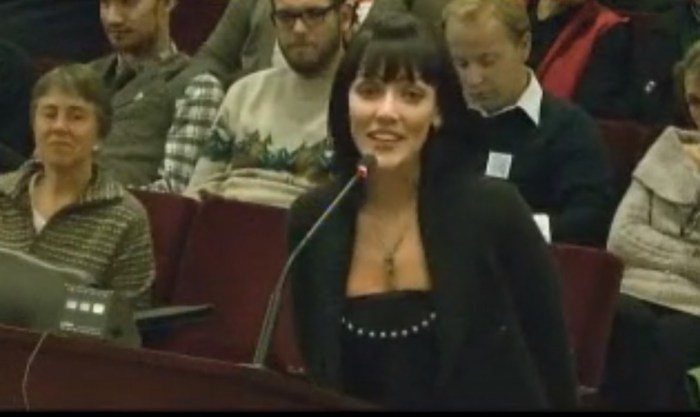
Interview #76: Fairfax, VA Councilmember Jennifer Passey (with podcast)

This podcast interview is available on iTunesStitcherPlayer FM, and right here:

When Jennifer Passey became a council member three months ago, she had already witnessed as a citizen the chaos of 2016 when Fairfax’s mayor resigned abruptly. We talked about the reasons for not having a vice mayor as well as the important topic of guns in meetings.

Q: I actually grew up down the street from Fairfax and am HIGHLY familiar with your city. Which means, unfortunately for you, I can play hardball. So get ready to get grilled about the 703. Question numero uno: how’s my dog doing? Is she okay?

A: [Laughs] As far as I know. I haven’t heard anything otherwise.

Q: Oh, thank god. Question numero dos: does Chelsea Licklider still have a crush on me?

A: You know, let me look into that. Isn’t that a good city council answer?!

Q: Yes, very speedy constituent service! Before city council, you were on the planning commission. Was that any less pressure because fewer people were watching?

A: I think the pressure comes from within of wanting to do a good job, for me. It’s a little more public [on council]. Planning commission, it was a little more candid because you knew not a lot of people were watching. People will look at those every once in a while when it was a heated topic.

Q: Being from Virginia, it didn’t come as a surprise to me at your November 7 work session when the city’s lobbyist casually suggested that you join the city of Falls Church in requesting a weapons ban in public buildings from the Virginia legislature. Do you see any harm in tagging along and requesting to keep firearms at least in the parking lot?

A: It’s not an example of something that’s happened where we feel threatened. I’m not really concerned either way. I don’t feel threatened that there are a lot of people that carry guns. But at the same time, you never know what’s happening around the country. We’ve seen it before in city council meetings in other places. I’m torn: I see the issues of infringement, but I’m not sure if I have a full-on stance.

passey.jpg
Fairfax, VA Councilmember Jennifer Passey

Q: If someone were to carry inside the council meeting and was sitting there politely watching with a gun on their hip, how would that make you feel?

A: I grew up in Minnesota. I don’t want to say people carry guns all the time there, but I guess it depends on whether they come in disgruntled or not.

Q: Would it help to outlaw disgruntlement at city hall instead?

A: Disgruntlement with a weapon!

Q: Well Jennifer, since you’ve only been a council member for three months, we don’t have that much to talk about. So thank you for–HOLD ON, SIT BACK DOWN! Obviously, we need to talk about the hugely controversial Vice Mayor-gate. Last summer, your previous mayor resigned. Fairfax had no vice mayor to take over. What was your take on the problem?

A: Residents and city staff during that time were really angry at [the mayor]. I think a lot of the issue was that city council was figuring out the legalities–from my perception–and we don’t have a spokesperson at city hall. If that’s communicated out, people understand the process. It wouldn’t have looked suspicious or that they were conspiring in the back room with the city attorney.


Follow Councilmember Jennifer Passey on Twitter: @jennifer_passey 

A Very Council Christmas: The Chronicles’ Holiday Special

‘Twas the night before Christmas / And throughout City Hall,

Not a mayor was stirring / Nor a council near-brawl.


Public commenters were nestled / All snug in their beds,

While concocting some brand new complaints / In their heads.


When on people’s phones / There arose a loud clatter.

They opened up iTunes / To see what was the matter.


With a square yellow icon / People gave a small nod past,

For they knew what it was: / A brand new podcast.

CCCXMAS

Yes, my friends, this is a special holiday edition of the City Council Chronicles podcast, covering highlights from our best interviews–including all the gifts, challenges, and vintage audio recordings I’ve offered my guests through the months. This “best of” is available on iTunesStitcherPlayer FM and right here:

You will hear excerpts from:

Interview #57: Christchurch, NZ Mayor Lianne Dalziel (with podcast)

Interview #65: London, UK Assembly Chair Jennette Arnold, OBE (with podcast)

Interview #71: Port Moody, BC Mayor Mike Clay (with podcast)

Interview #64: Mobile, AL Council Member Levon Manzie (with podcast)

“A Higher Expectation”: The Council Meeting and the Confession (with podcast)

If you liked what you heard, please give the podcast a five-star rating on iTunes and like our Facebook page. You’d be giving me everything I asked for on my Christmas list!

Interview #75: Fresno, CA Councilmember Esmeralda Soria (with podcast)

This podcast interview is available on iTunesStitcherPlayer FM, and right here:

Esmeralda Soria is in her first term on the Fresno council and discusses the elaborate gift-giving protocol for the outgoing council president with me. Plus, we analyze one difficult meeting involving the politics of religion.

Q: Each year, a different council member becomes the president. At the end of their term in January, they apparently get to pick out a parting gift for themselves. Can you tell us what the council is getting current president Clint Olivier?

A: We’re still working on that. I think people were very impressed by the last gift–the sign that says your name and then “President” at the bottom, which is what our former president, [Paul] Caprioglio, received.

Q: In 2015, Council Member Steve Brandau got a photoshopped picture of Texas Sen. Ted Cruz smoking a cigarette with tattoos all over his body. When you saw that, did you think, “huh, that seems like a perfectly wholesome and normal thing to give someone?”

A: Well, I don’t think that they were trying to be normal. I think they were trying to add a little humor to the parting gift! I think that was the intent.

Q: Let’s go back to May of this year. Council Member Garry Bredefeld looks at the wall behind you in the council chamber where it says “City of Fresno.” He says to himself, “this is missing something.” How did you first learn what he wanted to do?

A: It was something that Councilwoman–I forget her name–out of Bakersfield…[she] had sent an e-mail. Not just to him, to everyone. He was the only one that it caught his attention and thought it was a great idea to bring to Fresno. That’s how I first learned he was interested.

soria.jpg
Fresno, CA Councilmember Esmeralda Soria

Q: What you’re referring to is putting in big letters behind you, “In God We Trust” under the name of the city. You had over 40 commenters show up on both sides–cheering and yelling, calling this “needlessly divisive.” In the end, you and the entire council voted in favor of this. Did you have any unease over how the process went?

A: At the beginning, there was. I even expressed that to my council colleague. I felt that it wasn’t something the city needed to debate. It became a very divisive issue. But for me, I didn’t see anything wrong with putting our country’s motto on the dais. It wasn’t about religion. Every council meeting, we have an invocation. We invite people from all walks of life to do the invocation because we value diversity.

Q: I’ve got to say, I’ve watched a lot of your council meetings. It’s hard to take away a message that all gods are welcome given how frequently people refer to Jesus Christ in the invocation. Do you see how the actual proceedings would suggest that the council is not totally neutral?

A: I can see that. I can tell you–at least when I have the opportunity–I have the Sikh community come in here, someone from the Muslim community come, and it’s not about Jesus. It’s not a complete representation, but I can see your point.

Q: Did any of the extreme arguments you heard in that May meeting change your initial opinion?

A: I thought to some degree it was a waste of valuable time. The debate didn’t have to be that extensive.


Follow Councilmember Esmeralda Soria on Twitter: @Esmeralda_Soria

Interview #74: Juneau, AK Assembly Member Jesse Kiehl (with podcast)

This podcast interview is available on iTunesStitcherPlayer FM, and right here:

Jesse Kiehl works for the Alaska legislature by day and serves on the Juneau assembly by night. On the podcast, he promises that the era of live-streamed meetings is dawning, explains a few uniquely-Alaska issues, and recounts a disturbing incident that happened mere feet from an assembly meeting.

Q: Jesse, I don’t care if you do live in Alaska and I don’t care if you can see Russia from your house. I–well, actually, CAN you see Russia from your house? That would be pretty boss.

A: We’re a little too far away.

Q: Oh. Well, ahem, I don’t care if you CAN’T see Russia from your house. Why can I not go online and see the Juneau assembly meetings?

A: Because we’re cheap! There is an individual who has been voluntarily putting those up online now for about eight, nine months. He is a businessman and is interested in competing for a contract to do that. I agree with you, Michael. It’s time.

Q: Do you have any idea when is the earliest we could see the new video system? 2018? 2019?

A: It wouldn’t surprise me if we got started in the early summer.

Q: Well, you’ve got to get your beach body in shape. Does that scare you?

A: I do not have–nor will I ever have–a “beach body.”

Q: Fair enough. This being Alaska, I want to talk about the Alaska-specific things people might find in your assembly meetings. For example, in your September 2017 meeting, a bunch of people showed up angry about a bear who was shot by police. How often do issues like this come up–that city councils in the lower 48 probably are not dealing with?

A: Most of the issues really are the same. I suppose people who have raccoons get in their garbage are a little more worried about rabies from a bite instead of mauling. But otherwise, it’s about the same.

jesse
Juneau, AK Assembly Member Jesse Kiehl

Q: At the June 6 meeting, apparently there was some shouting outside the chamber and the mayor called a recess to have people investigate it. I think you were one of those who walked out of the room. Do you remember what happened?

A: There’s a public restroom on the other side of the chamber and there was a domestic violence incident–ah, let’s call it what it was: a guy beat up his girlfriend just outside the restrooms. There was shouting and thumping. We jumped up and the only person who got up faster than me was [Assembly Member] Jerry [Nankervis, a former police officer]. Unfortunately, she was not interested in police protection or a ride to our domestic violence shelter and that’s really hard. You intervene in hopes that people will get the help they need. But that time, they didn’t.

Q: When you’re sitting there in the meetings, you’ve got 33,000 people that you want to make life better for. But when it’s just one person who is not susceptible to persuasion or to you as an authority, I’m sure it’s quite a contrast and made you feel somewhat helpless.

A: [Sigh] Seeing and hearing something like that during a meeting sure keeps you grounded. It keeps you focused on the ways we make life better–or fail to–and the impacts those have on people who don’t have the level of comfort that all of us on the assembly do.


Follow Assembly Member Jesse Kiehl on Twitter: @JesseKiehl

Interview #73: Bristol, UK Lord Mayor Lesley Alexander (with podcast)

This podcast interview is available on iTunesStitcherPlayer FM, and right here:

We have a highly prestigious episode this week: Lesley Alexander has been a Conservative Party councilor in Bristol since 2003 and is the current Lord Mayor–a.k.a. chair of the council meetings and the ceremonial “first citizen.” She revealed a fun piece of trivia about the council chamber and recalled a scary moment from a council meeting.

Q: Bristol has had a lord mayor or a mayor for 801 years. That is a lot of mayors! So for the next ten hours or so, we’ll go through each of those guys and you tell me how they did at running a council meeting. Thomas Beaupeny, 1384: do you give him a thumbs up, thumbs down, or in the middle?

A: [Laughs] I have no idea! One thing that you may not know: we have quite an adversarial form of council chamber. It’s made out in the same way as Parliament. The distance between the two rows facing each other is two sword-lengths. So nobody can stick their sword into the opposition.

Q: Oh, that’s amazing! As an American, I would never think to measure things in swords. Maybe bullet trajectory, but not swords. Bristol is on its second elected mayor, and he has to stand for you when you enter, just like everyone else. Do you technically outrank the mayor?

A: It’s difficult to say. We’re two different jobs. I chair the full council meetings. He’s got the checkbook. He runs the city. But he’s got the aggravation. I have the chain and the mansion and I have all the fun.

Q: [Laughs]

A: We’re two different roles. One is the civic role–that’s mine. Then there’s his role, which is running the city. The two shouldn’t cross over. The mayor has the power to ignore what any of the councilors say, except the budget. He needs the councilors to pass the budget.

Q: I noticed that when you announce whether a motion is passed or failed, you don’t announce the vote split. Why is that?

A: You can do that, I suppose. If you’re watching on the webcast, you should be able to see [how people voted].

Q: No, you can’t.

A: Okay, well that is something I will take on board and make that comment in the future.

lesley
Bristol, UK Lord Mayor Lesley Alexander

Q: During your March 2016 meeting, there was a moment where the council was taking a vote. But you were not present because Councilor Mark Weston said that your car was apparently vandalized. Is that true?

A: Yes, it was. Because the council house was closed for renovations, we had a meeting at the cricket club. We had a, well, I would say a “rent-a-mob” sort of person, rather than somebody with real political convictions. When I tried to go in, he stopped the car and was kicking at it.

Q: Oh, wow. You were sitting in the car while this man was kicking at you?

A: It was quite frightening because he was bouncing up and down with his hands on the car. There was a bit of a baying crowd.

Q: Is he in jail currently?

A: No, he’s not. I think security would have liked us to take it a lot further. But the comment from our legal department was, well, it’s all going to be over now and he’ll go away. And he did.


Follow Lord Mayor Lesley Alexander on Twitter: @brislordmayor

Interview #72: Hamilton, ON Councilor Matthew Green (with podcast)

This podcast interview is available on iTunesStitcherPlayer FM, and right here:

Even though he’s only in his first term, Matthew Green has very sophisticated views on the mechanics of city council meetings. We explore his strong pro-video streaming beliefs and the plague of long-windedness.

Q: You sometimes Facebook Live stream your speeches from the dais. You talk a fair amount at council meetings, so how do you decide what moments are worthy of Facebook Live?

A: When I started, the old-school model was councilors would give inside information to mainstream media in exchange for favorable coverage. I found that in not doing that, my positions at council were miscommunicated or misrepresented. I remember getting upset about it. I had a media expert, she said to me, “don’t get mad at the media. Become the media.”

Q: Hmm.

A: Facebook is a hyper local medium and so I choose Facebook to communicate to my residents.

Q: Have you ever watched a Hamilton council meeting online through the city’s website?

A: It is horrible.

Q: Right?!

A: It is terrible. An incident happened in council chambers and I wanted to open an investigation. In doing so, I looked at our live stream and realized our live stream did not cover major sections of the whole chamber. So I had to [freedom of information request] my own city to get the security footage to provide me with the incident I believed I saw. We’re very fortunate [to have] an independent journalist. He runs a live stream called “The Public Record.”

Q: Yeah.

mgreen
Hamilton, ON Councilor Matthew Green

A: He has built a reputation for himself in capturing the circus that is often city hall: the inappropriate comments, the workplace toxicity, or some of the decorum issues. He creates a prism in that people are aware that he’s there and sometimes, I think, it raises the decorum and the level of discourse because they know they’re being recorded. When there’s no media present, we sometimes say the zaniest things.

Q: It’s curious you mention decorum because on everything I’ve seen, the Hamilton city council behaves relatively well. Again, maybe it’s because he’s there recording, but what are some of the issues you’re referencing?

A: One of the governance challenges we have, in my opinion, is that we don’t have a strong chair role. We rotate the chair, which allows councilors from month to month to use that position as a bully pulpit. It provides a situation where chairs will allow councilors to speak at length or speak in very harsh and personal terms to staff, which should be shut down.

Q: Are you ever worried when you become the chair that people will have similar reservations about the job you’re doing?

A: I’m actually comfortable chairing meetings. We’re not THAT bad. It’s really a conversation around time. We’ll have four or five of us who monopolize all of the time. In the technology of our microphones, they’re supposed to shut down after five minutes.

Q: Mmmhmm.

A: The idea is that if I’m the chair, I don’t want to shut you down at five minutes. So I let you just go! I do that with the understanding that sooner or later you’re going to be the chair and I’m going to have an issue that I want to go on. It’s a bit of nudge-nudge, wink-wink that I think is problematic. But we’re all guilty of it.


Follow Councilor Matthew Green on Twitter: @MGreenWard3 

Special Feature! Best of “Best Thing, Worst Thing”

This past year, I had an AMAZING experience. I visited 12 cities and towns across North America for the “Best Thing, Worst Thing” project. The idea was simple: see as much of the city as I could, talk to as many people as I could, and ask them all the same two questions.

What is the best thing about this place?

What is the worst thing about this place?

Answering those questions can be surprisingly difficult, but it was important for me to hear about individuals’ values and experiences with their communities. I learned that a small city in conservative western Kansas thinks of itself as “progressive.” I learned that diversity in Toronto is much heralded, but also has a dark side. And I was present for a medical emergency in the desert outside Las Cruces, New Mexico.

tor
Butter tart bake-off in Toronto, ON

The goal was to find out what cities are doing well to make their communities livable for residents. Then, to find out what people want that their cities aren’t providing now.

You can listen to all 12 episodes on the project page. And this week, I bring you the highlights in a special audio episode about the best of the “Best Thing, Worst Thing.” This “best of” is available on iTunesStitcherPlayer FM and right here:

pgh
Robotics camp in Pittsburgh, PA

If you liked what you heard, please give the podcast a five-star rating on iTunes and like our Facebook page. There are other big projects in the works, so keep checking back!

“A Higher Expectation”: The Council Meeting and the Confession (with podcast)

This podcast interview is available on iTunesStitcherPlayer FM, and right here:

Last month, I interviewed Boise, Idaho Council Member Lauren McLean and we covered one unusual council meeting from November 13, 2012. At the Idaho state capitol, a crowded room watched the Boise city council take testimony on an LGBT nondiscrimination ordinance.

But in the fourth hour, Tabitha Osteen stepped to the microphone. In this interview, I asked her about why that council meeting was a turning point in her life.

Q: Before November 13, had you seen an entire city council meeting?

A: No, I had not.

Q: So what was your mental image of what the council meeting would be like? Did you picture protesters? Did you picture an open bar? Did you imagine the mayor would enter through a smokescreen Michael Jackson-style?

A: Really, it didn’t fall too far from what I had imagined. What I was surprised–really pleasantly surprised–by was the sheer amount of people. I was with my then-partner and our child. It felt important for me to bring my family, my representation of love.

Q: About four and a half hours into the meeting, it was your turn to speak. Have you ever listened to what you said?

A: I have not.

Q: Let’s play the clip:

I was not planning on speaking because until this moment, I was not out. I can’t remember who it was who spoke earlier with Harvey Milk’s call to come out. It’s been on my mind for years. I fall into the B and the Q portion [of LBGTQ] and it’s been really easy to hide….I brought [my son] here because I wanted him to understand that a group of people can be strong and do the right thing and protect people who need it. He has no idea that I’m one of those.

Tabitha

A: Honestly, I have a huge grin on my face and a little bit of watery eyes. It’s really encouraging to hear that and to bear witness to how much has changed….I just kept wondering if there were other people like me. There’s a lot of power and a lot of strength and a lot of calm that comes after that part’s done–from getting to live life out in the open more authentically.

Q: Do you think you would have said anything if your partner and son hadn’t gone home?

A: Oh, that’s a great question. Uh…yes, with much more trepidation! My ex-partner was intensely private and I am pretty intensely transparent. I don’t know that I would have changed my choice. I did feel called forth.

Q: I’ve seen council meetings where I would not call it a warm environment in which to come out. I would like to think that most councils want their meetings to be a welcoming place, but it sounds like if the environment was different, you would not have said anything.

A: Yeah, absolutely. It wasn’t a premeditated coming-out. It was a movement within myself by what was in the room. It was a response.

Q: Has this changed your expectations about what a city council meeting is like?

A: I think a demonstration of leadership like that always sparks a higher expectation of leadership. Not just in city council meetings; from everything. Something that’s so powerful about that city council environment: city councils are a representation of many aspects of a community coming together. It’s a weaving of different threads that wouldn’t necessarily see each other. In that environment, everything gets elevated.

Interview #71: Port Moody, BC Mayor Mike Clay (with podcast)

This podcast interview is available on iTunesStitcherPlayer FM, and right here:

We covered a lot of ground in this interview with Port Moody’s Mike Clay. For instance, where does the mayoral title “Your Worship” come from and does he like to be called that? We also listen to some beautiful music and time travel back to 1913 to reenact a city council meeting.

Q: In Canada, people refer to mayors as “Your Worship.” Where does this term come from?

A: I don’t know. It must come from Old English somewhere. It was probably from the House of Lords or something. I don’t like the term. I don’t like people referring to me that way. The funniest thing that ever happened was I had a conversation with the archbishop one time and he asked how he was supposed to refer to me. I said, “well, you’re supposed to refer to me as Your Worship, but I don’t think we’re going to ask you to do that!”

Q: [Laughs] Is there a more secular term you’d want to be called?

A: In council, I prefer Mr. Mayor or Mayor Clay. Something much simpler and less snooty.

Q: Port Moody started video streaming council meetings while you were mayor. Do you since have any regrets about what you’ve said live on TV?

A: The good thing about capturing people in the moment is it’s raw. It might be emotional but you read council minutes [and] the legislative diaries and stuff, you don’t get any sense for what’s really going on. Without the video in the past, my interactions with different politicians–people say, “I was really fighting for that!” And I think, “I was there. I don’t think you really were.” So it might be interesting for people to say, “yeah, you know what? They really were fighting for it. I watched that on live stream.”

Q: Yeah.

A: I have WARDROBE regrets, but other than that….

mikeclay.jpeg
Port Moody, BC Mayor Mike Clay

Q: [Laughs] What do you think about where council meeting technology is headed?

A: I think there’s opportunities to throw certain things up to a public vote, a mini-referendum. If it’s issues that aren’t life or death–if somebody said, “I think we should paint it blue,” and someone else said, “I think it should be green,” why don’t we throw that out for a public discussion and a vote right there online while we’re doing it? It might not be serious engagement, but if they joined in for that part of the conversation, maybe they’ll hang around for other parts as well.

Q: You do remember our election in 2016 where there was some MINOR propaganda by a FEW million Russian Twitter and Facebook bots. Are you worried the Russians could also hack your insta-polls?

A: Well, for now until we know that we have locked down security, [we’d be] taking it for opinion polling.

Q: Here is something weird I found: in 2013, the centennial of Port Moody, you reenacted the first-ever council meeting from 1913. Whose idea was that?!

A: Wow, I don’t know whose idea it was. I think it was a great idea. It got so funny during the meeting I could barely contain myself from breaking up laughing! It turned out we had some impromptu comedians on our council. How much of it was made-up? Most of it. But it was reflective of the way people think things were in those days.


Follow Mayor Mike Clay on Twitter: @MikeEClay