Somewhere out there, a city council meeting is happening. And you're not watching it. But I am. Each week, I bring you the highlights, lowlights, and weirdlights from places you don't live.
This week, we air the newest episode of the “Best Thing, Worst Thing” project featuring a big-name city: Richmond, Virginia. I talked with many different residents about their favorite and least favorite things about Virginia’s capital. Many brought up the city’s ties to the Confederacy and the legacy of segregation. Others talked about the extensive collection of neighborhoods. You’ll come with me to a rally with the mayor, stroll along an island, and visit the pew where Jefferson Davis sat in church.
For an explanation of the project, check out the page here. If you are ready to learn which historical figure had turkey quills shoved up his nose, head to the City Council Chronicles podcast to download the latest episode. Or you can play it below.
Richmond is a city of 220,000 people and the capital of Virginia. It was also the capital of the Confederacy and that legacy still lingers. The James River provides recreational opportunities and the Amtrak station provides a connection to Washington, D.C. and beyond. During our visit, we stand in the middle of the water, attend a rally with the mayor, and visit a restaurant that will be gone in a year. We hear from a real estate agent, some college students, a teacher, a tour guide, people who have moved away and returned, and two political watchdogs.
Susan Rae is a brand new Green Party councilor in Edinburgh and she has a terrific sense of humor! The Edinburgh city council had a hiccup after no political party won a majority when the council convened in May–plus, no one wanted to form a coalition until after the surprise election the prime minister called for June. We talked about that sticky wicket, plus all of the traditions of her council.
—
Q: Can you describe your council chamber?
A: It has beautiful stained glass windows and very old, very large desks. They have lids that open so you can hide everything in there. And large seats–I’m very tiny, only five foot tall. So my feet don’t actually touch the ground. They kind of swing!
Q: What do you hide in your desk?
A: I hide my cigarettes and my lighter and some biscuits in case I get hungry.
Q: The Lord Provost (a.k.a. mayor) makes a grand entrance every meeting: someone announces his arrival, everyone stands, and two other fancily-dressed people in white gloves follow him and put the mace into his high-backed chair. As an American, I’m thinking, there have got to be mayors over here who would LOVE their entrance announced with an entourage. Do you think it’s excessively formal?
A: I don’t feel it’s very necessary but there are traditional elements within the council that do like to keep the tradition of the mace and the sword. I’m very desiring of taking in a lightsaber one day. We [in the Green Party] all have our own! I would probably have to stash it in my desk.
Q: Well, yeah, you’d have to take out the cigarettes and the biscuits to fit it in there probably.
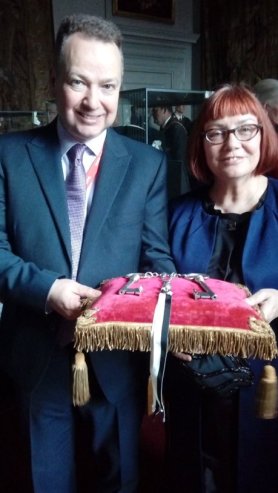
A: [Laughs] The traditional part has a place. It’s all on display, all of the silverware, the keys to the city–
Q: Wait, the keys to the city are just sitting out in the open in the chamber where anyone can take them?
A: We take them to Holyrood Palace and present them to the queen. Then she gives us them back and says, “you’re really good at looking after my city. Keep the keys!” So we did that recently.
Edinburgh, Scotland Councilor Susan Rae (and the keys to the city)
Q: Each of the parties has a section of the room where you all sit together. And generally if the Conservatives are all standing to vote, Labour will not be standing. Are you allowed to disagree with your party and be the only person to vote for something?
A: It depends on the party. Some parties have a whip system and you have to follow the whip’s instruction. We tend to agree on things or we vote with our conscience. Labour and SNP operate a whip system and the Conservatives always vote together.
Q: I don’t know what the penalty is…death, maybe, if you don’t vote with them?
A: I don’t think it’s death quite yet. But I think you can be suspended from the group or they don’t let you have biscuits in your desk.
Q: That’s a steep penalty indeed.
A: The role of a councilor is to look after the people in their ward. I would rather people voted for what the people in their constituency want, not for what their party want.
This is our first trip to New Zealand and I could not be more excited! Lianne Dalziel was a longtime member of Parliament before she became mayor of Christchurch, and here she gives wonderful summary of the differences in those meeting styles. We cycled through all of the cool costumes and inventions she has seen in council meetings–including some mythical creatures!
—
Q: I noticed that you call all of the councilors by their first names in the meetings. Why are you so friendly with your fellow Kiwis? And as a foreigner, am I allowed to call you a Kiwi?
A: Yes, you are allowed to call me a Kiwi. I guess it’s an informality that is pretty Kiwi. I was a member of Parliament for 23 years, so you would never call someone by their first name. Actually, it’s something that I haven’t discussed with my fellow councilors. You’re the first one to raise it. Maybe I better have a conversation with them!
Q: Oh, wow. You’ve gotten to see some pretty cool stuff in your council meetings. You had a demonstration of an electric bicycle. You had someone bring in a model of a cathedral and cranked a pulley to raise the bell. What is the most memorable thing you’ve seen?
A: Well, we did have the faeries come in one day [laughs].
Q: The faeries?
A: They’re just delightful. Faeries that have little wings and wear pretty costumes–
Q: Wait, they live in New Zealand?! Like, Tinkerbells? That’s where they are?
A: Tinkerbells, exactly. They came along and talked about what they did and they go to events and bring joy to children’s lives. That bike that you mentioned was a YikeBike, which was invented here in Christchurch. I don’t know if I’m going to sit on one. They don’t seem to be facing the right way.
Christchurch, NZ Mayor Lianne Dalziel
Q: Your first council meeting as mayor was also the first-ever council meeting that was streamed online. Were you at all nervous that YOU would be the first Christchurch mayor who, four years later, would have ME scrutinize how you ran a meeting?
A: [Laughs] Michael, I didn’t realize that you would be doing this!
Q: That’s how the dice roll, baby! Were you intimidated by the presence of cameras and microphones?
A: I come from Parliament, and Parliament is live streamed. Sometimes I forget to turn off my mic at the front and I lean over to the chief executive and say, “oh, my goodness!” And she quietly leans forward and switches off the microphone.
Q: Did the councilors adapt to the cameras in a good way? Or was there grandstanding?
A: Grandstanding is inevitable in an environment where you’ve got such an open record of what people did say. But that, in my view, encourages high quality debate. If you’ve got one councilor who gets to his feet and he’s really passionate about a particular subject, I’m thinking that’s good for democracy. It’s good for people to see their own representatives being accountable in that way.
Q: What is the history behind the “tea break” that you take in your council meetings?
A: I don’t know! It’s quite normal to have a tea break during the course of a working day. Now we invite the public to join us.
Cork is a very old city and by my cursory count, Tony Fitzgerald may well be the six-hundredth-or-so mayor to lead the council! He has been a councilor since 2004 and I was curious to know where he stood on putting cameras in the council chamber. He has an open mind and wants to do his research, but also says that the rules are a firm “no” on the issue.
—
Q: I noticed that the Cork City Council does not live stream its meetings. In fact, in 2014 the council voted against live streaming by a margin of 22-6. Which side were you on?
A: My understanding was that we didn’t have the proper procedures. I mean, it’s important to make the meetings interesting to the public and it’s important to keep the focus on the issues of the city rather than, you know, making political speeches. So I would have an open mind to that. If I do recall it now, it wasn’t really very well thought out.
Q: I’ve said this before on the program: if people can’t see the entire meeting, all they know is the sensational stuff that gets tweeted out or the protest videos on YouTube. That also skews people’s perceptions of your council meetings.
A: Yes, yes. I think as well that in 2014, budgets were quite limited. I think spending money to video record council meetings…that money would have been much wiser spent in housing or roads. You have to be prudent in terms of what is the best way to spend public money.
Q: I do have a suggestion for you. Cork has, I think, 125,000 people. In an American city of that size, you might have five to seven city council members. Cork has 31. And I would argue that a small council where you can see what they’re doing is MORE democratic than a large council where you cannot. So what do you think of finding the money in that way?
Cork, IE Lord Mayor Tony Fitzgerald
A: Well, at the moment there is a report due on the representation of the number of elected members to the city council. All of that is up for review at the moment. But I would think that it’s good to have a strong interface with the public. I think it’s good to have as many voices as possible. It gives you wide political perspective.
Q: Do you have a smart phone, sir?
A: I do.
Q: Would you commit to doing a Facebook Live video of council meetings on your phone–for free–before you leave office?
A: That’s something I haven’t considered. It’s not as easy for me to say that today. I’m more of a practical representative in doing my research. That would have to be considered by the party leaders, the party whips, in conjunction with the administration. I mean, we have to stick to the rules of the council. But I have a very open mind on a lot of issues.
Q: Well, you have 31 councilors. You can have 31 potential Facebook Live videos, each streaming out to their hundreds or thousands of followers and you could cover a pretty good size of Cork that way.
A: Yeah, yeah. But we have to look at the practicalities of that too. But that’s something that could be considered.
Rebecca Casper thought that her city council meetings were “conventional” and that we wouldn’t have a lot to talk about. I’m happy to report: we had a LOT to talk about. At the end, she shared a candid reflection about how her first two years as mayor affected her friendship with another councilwoman. I cannot recommend it highly enough–go listen.
—
Q: When it comes to running the council meetings, which of the following best describes your style?
A. Iron-fisted tyrant
B. Lead-fisted tyrant
C. Bronze-fisted tyrant
A: [Laughs] I think it depends on who you’re talking to. I’m sure I’ll have an opponent in the election who will tell you that I am lead or iron!
Q: I consider you a very active mayor–and I don’t mean you’re running marathons. I mean that you explain very thoroughly for city council novices what is happening in the meeting. Why do you do that?
A: I attended my share of meetings as a candidate, watching and observing. It did sometimes seem as though they were performing steps to a dance I didn’t quite understand. So I wanted to make sure that when I had that opportunity to lead, I would make it clear to the public what was happening in their meeting. Because it really is their meeting, not ours.
Q: What procedures did you change when you became mayor?
A: Uh, not that I want to open up a can of worms…but the thing that has been the most procedurally difficult for everybody is the agenda-setting process. It can be quite the “power move” in some people’s minds. I don’t see it that way. I’ve had a couple council members who would like to just be able to order up a discussion. I’ve had a rule of thumb: either a [department] director has to request the agenda item or the council president does.
Q: Mmm.
Idaho Falls, ID Mayor Rebecca Casper
A: If a council member wants to talk about something, the president can be the one who can tell that council member, “you know what? That’s a crazy idea.” Or “that’s a great idea.” Or “that’s kind of an interesting idea. Have you done the research?” And that council president can mentor the council member. I’ve had that little screening process and it hasn’t sat well with a couple council members.
Q: In your absence, does Council President Tom Hally do anything differently when presiding that you wish you did?
A: I think there’s plenty of cringe-worthiness no matter who’s running the meeting. I’m a little more rigid. Councilman Hally is a little more laid-back. I’m sure people appreciate that from time to time. Having a bossy mom figure all the time can’t be fun, and so–
Q: Is that how you see yourself?
A: That’s how I hear myself when I go back and listen. Especially as you’re playing all these clips now. I’m kind of uncomfortable!
Q: Oh, I don’t mean to make you uncomfortable! I have to listen to my voice all the time for this and there are things I can’t stand and that I do work to fix. What is a similar tic of yours?
A: I would love to be able to be a little more lean with my language. Normally, I fill the awkward pause with blather. Gotta work on that.
It’s time for the newest installment of the “Best Thing, Worst Thing” project! You probably have not heard of Lake Forest, Illinois, but it is one of numerous Chicago suburbs along the North Shore of Lake Michigan. If you are a lover of trees, animals, or college towns, this is right up your alley. Oh, and the alleys in Lake Forest are beautiful also, by the way.
For an explanation of the project, check out the page here. If you are ready to pet some horses and reptiles with me, come on down to the City Council Chronicles podcast to download the latest episode. Or you can play it below.
Episode 9: Lake Forest, Illinois
Photo source: Google Street View
Lake Forest is about 30 miles north of Chicago on the shores of Lake Michigan. With a population of 20,000, Lake Forest is very affluent, very tree-lined, and the home of Lake Forest College, a private liberal arts school. We hear from a city councilwoman about the most important location in the city, go pet some reptiles at an animal house, plant trees with college students, and visit a horse-riding academy for kids with disabilities.
Marian Orr is the new mayor of Cheyenne and from what I can tell, she learned how to run an efficient council meeting in practically no time. She shares her secret study tool with us and also reveals the one physiological liability that she has to keep in check. If you enjoy procedures, you’ll love this!
—
Q: You don’t preside over a city council–you preside over a “governing body.” Why is Cheyenne TOO GOOD for a city council?!
A: We have a strong mayor form of government. When council meets during their Committee of the Whole, THAT is a city council meeting. But when they add me, it becomes a meeting of the governing body.
Q: I’ve heard you are an honest poker player, which is generally not a good thing in poker! Would you say that being a bad poker player is a disadvantage to running a governing body meeting?
A: I don’t have much of a poker face and I don’t know if that serves me well. People really know what it is I’m thinking and–I’ve always had this since being a kid–when things get heated, so does my neck. Even staff can tell when I’m a little on edge because my neck gets really red.
Q: That’s your tell!
A: I have a tell.
Q: Do the other councilors know about this or is it something you’ve kept with your close friends?
A: I believe it is so obvious that if they haven’t paid attention, they must be sleeping.
Q: How did you prepare for running a meeting before you were sworn in?
A: I spent about half a day with our city clerk who is the queen of Robert’s Rues of Order. She was kind enough–people probably don’t know this, so I’m giving the secret away–she wrote a script for me that I was able to pretty closely read from. I’d say it took the first two months to feel like I can run a meeting without a cheat sheet.
Cheyenne, WY Mayor Marian Orr
Q: I will be filing a Freedom of Information Act request to get that script, so prepare yourself. Did she give you stage directions, like, “say this (inquisitively) or say this (angrily)?”
A: Boy, I think that now she regrets not putting in stage directions! It was, “if this happens, say this.” She would leave a blank as far as “Mr. _______” and I could write in “Johnson” made the motion. But, oh! There were colors. If a motion passes, it was green. If a motion fails, she would have it in red. It was very helpful.
Q: You have begun to crack down on people who don’t ask or answer questions by first saying “through the mayor.” Why do they need to do that?
A: We have had some meetings where city council has had multiple questions of staff. I believe it’s a better way to keep hold of the meetings. [Staff] feel they are being “put upon the stand” for questioning and it is a way to slow down and temper some of the discussion.
Q: Some councilors have seemed resentful when you reminded them of this rule. Did you perceive that?
A: I did feel that. There is heated debate and we end up leaving the dais shaking hands. Individually, I’ve got a great rapport with every member of council.
Charishma Kaliyanda is in her first year on the Liverpool city council–a council which was rocked by threats, discord, and the potential for dissolution. However, things have calmed down considerably. We talk about how state governments can investigate what happens in city council meetings in Australia, plus she gave me a macabre piece of kangaroo trivia.
—
Q: Liverpool councilors also have full-time jobs, I’m assuming because the crocodiles aren’t going to hunt themselves down there. But you go to your job, then you show up for a council meeting for a few hours–do people get irritable the longer the meeting goes on?
A: Absolutely. Tiredness can result in people getting a bit crabby, but we’re also lucky that we’re fed before council meetings.
Q: They give you food!
A: Yeah! They figured out very early that if you feed the councilors, the likelihood of them getting grouchy can be staved off for a while.
Q: What grade of kangaroo meat do they feed you?
A: Well, we have a couple of vegetarians, so I think they’re avoiding the kangaroos. But it’s the good stuff. We don’t just pick it up off the road and throw it on the barbecue and serve it!
Q: [Laughs] That is everyone’s impression of Australians up here, by the way!
A: If you’ve ever been to the Australian Outback, you’ll find a lot of dead kangaroos on the road. They seem to get into lots of accidents with large vehicles.
Liverpool, NSW Councilor Charishma Kaliyanda
Q: The year before you were elected, the Liverpool City Council was in chaos. But one thing that threw me for a loop was learning that New South Wales Local Government Minister Paul Toole–which we don’t have an equivalent for in the U.S.–sent someone to sit in the council meetings to monitor misconduct. And even WILDER, he was deciding whether to disband the city council entirely! He can do that in Australia?!
A: Yes. It’s happened very recently to a different council. That’s what happened in this situation: the councilor would have put in a complaint claiming what happened was not in keeping with the code of conduct. That’s when a representative from the Minister of Local Government would have investigated. That seems like it was a pretty horrible situation to be a part of. The toxicity must have been building up and people went, “I’ve had enough.”
Q: Did Paul Toole send anyone to watch your early council meetings just to see if everything was okay?
A: Not that I can recall. It’s usually at the request of a councilor or the mayor or someone in staff because they have a concern about something.
Q: At the November 2016 meeting, there was a motion to drug test all the councilors and the mayor. Do you know what that was about?
A: Right before the election there was discussion around having an ice [methamphetamine] injecting room. [The motion was] a gesture about how anti-drug councilors are…we should submit ourselves to testing.
Q: During this interview, you have been very articulate and knowledgeable, so I’m curious: did you take any performance-enhancing drugs before we started talking?
A: Does coffee count?
Q: Well, it’s legal here but I don’t know what goes down in Australia. Is it legal there?
A: Yes, but I would classify it as a performance-enhancing drug! [Laughs]
Follow Councilor Charishma Kaliyanda on Twitter: @Ckaliyanda
Corey Branch is in his first term on the Raleigh city council and there is one simple thing that he’d like to receive at a council meeting. (Much to my chagrin, it’s not a flamethrower.) Plus, we talk about how you have to acknowledge criticism from citizens and move past it.
—
Q: Other than grievances, what have people given you at council meetings?
A: Handouts, shirts, mugs are the main things we’ve seen. Little pinwheels we’ve received for child abuse prevention. Those–
Q: I don’t see the connection there.
A: Yeah, they’re pink pinwheels. It’s a symbol for that. I couldn’t tell you how it started.
Q: Well, obviously you remember what the pinwheel was for, so it did its job. But if you could receive anything for free at a council meeting, what would you want it to be?
A: A thank-you. That for me, honestly, means so much because I know the time that me and my peers put in to serve. Sometimes it’s just good to hear that it’s appreciated because we hear a lot of what we’re doing wrong. It’s just good to hear someone say thank you.
Q: Mmm. I would have chosen those novelty glasses that you put on and it looks like your eyes are open but secretly you can sleep behind them, you know?
A: I know exactly the ones you’re talking about!
Q: Yeah, well that’s what I would have chosen anyway. That or a flamethrower.
Raleigh, NC Councilor Corey Branch
When public commenters bring up the issue of race or refer to the other council members as “white folks,” do you feel they are excluding you? Or are they not speaking so much about “black v. white,” but really “citizens v. people in power?”
A: I think it’s a mix of both. People’s experiences play a major role in how they interact and how they may see things or express things. As for me, do I feel they’re talking to me or excluding me? I can’t speak for them. I just know every day for the last 39.5 years when I wake up, I’ve been a man of color.
Q: I don’t want to be the white guy who does this, but I watched an episode of Blackish recently, and–
A: [Chuckles]
Q: I know how this is coming across right now! But the father explains to the son about “the nod,” where if two black men walk past each other, they nod in acknowledgment. Do you get the sense that when people speak to the council, they telegraph to you, “hey, YOU should at least be on my side?”
A: Um, yes. I have to look at the situation, what’s going on. I’m fortunate that I can bring in some experiences that other council members have not [had]. If I feel there is a lack of equity, I need to be a voice. Speaking out may not be directly from that table. It may be a sidebar conversation.
Q: If someone was criticizing me because I was “white folks” or…or anything, “young people,” “left-handed people,” I would get defensive and tune them out.
A: I hear it and acknowledge it. We have to act like adults. That’s why earlier when you asked me what I wanted, I said a thank-you for these very reasons we’re talking about here.






 City Council Chronicles