Interview #97: London, ON Councilor Virginia Ridley (with podcast)

This podcast interview is available on iTunesStitcherPlayer FM, and right here:

How much time should city councils put between heated debates? First-term Councilor Virginia Ridley has some suggestions. Plus, on the podcast we discuss bullying, meeting schedules, and affairs.

Q: I want to go to October 27, 2015. Not to get too specific with the listeners, but there was a report from the city administration about arts funding that the council asked for earlier that year. And Councilors Jesse Helmer and Mohamed Salih did not feel city staff had given you what you requested. So they made a motion to refer the report back to the administration. How often does council vote on something in a meeting and then people don’t follow it?

A: At the beginning of our term, I think it happened more frequently than it should. We had a relatively new council. We had a number of bumps in the road and maybe council’s direction was misunderstood.

Q: So after a bit of debate here, you stood up and offered a motion to reconsider. The council voted on the Helmer-Salih motion, which was defeated, so they moved on to your reconsideration motion. However, the mayor suddenly told you that you were ineligible to make that motion because you were absent from the original meeting. How were you feeling at that moment?

A: Oh, I was angry. We had already established that if we vote no to the motion on the floor, we could do reconsideration right next. You see there was no pause. Within three seconds, it’s, “oh, no, you actually can’t make that motion.” It certainly angered me quite a bit.

Q: Right, one vote can certainly affect a subsequent vote in council. And it did seem a bit suspect that the mayor did not have this information on the screen before he, I guess, clicked “end” on the voting and announced the result. But I’m sure he did the best he could…except for the fact that you learned MINUTES AFTER that vote that you ACTUALLY WERE in attendance and could make the motion! Did you have a realization of, “oh, god. If that was incorrect, what else in our records is inaccurate?”

A: I knew all along I was correct. It was one of those, in the moment, not having the proof at my fingertips. I would agree with you. What other errors could potentially happen here?

1297672163982_ORIGINAL.jpg
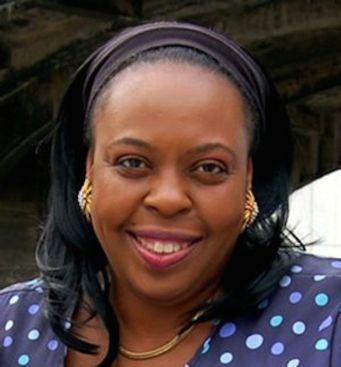
London, ON Councilor Virginia Ridley

Q: At this point, the city manager stands up. He responds to the initial complaint that this report is not what the council ordered by stridently defending the staff. How justified was his pushback?

A: I don’t know if I could say that absolutely he was in the right. That statement probably escalated things more than they needed to. The way our council works is the night before, we would’ve had a committee meeting. That would’ve been Monday night. On Tuesday night, council would confirm and re-debate all of the committees that had happened. We were having the same debates the second time.

Q: I mean, doesn’t that open itself up to the situation we just witnessed? That if you didn’t win the argument on your first night, you get to re-litigate the argument on the second night?

A: The fact that we do it one day apart, people haven’t had the opportunity to reflect. If we’re there until midnight on Monday and we’re back 16 hours later, people haven’t had time to walk away from the situation, think about it, talk to their constituents.


Follow Councilor Virginia Ridley on Twitter: @virginia_ridley
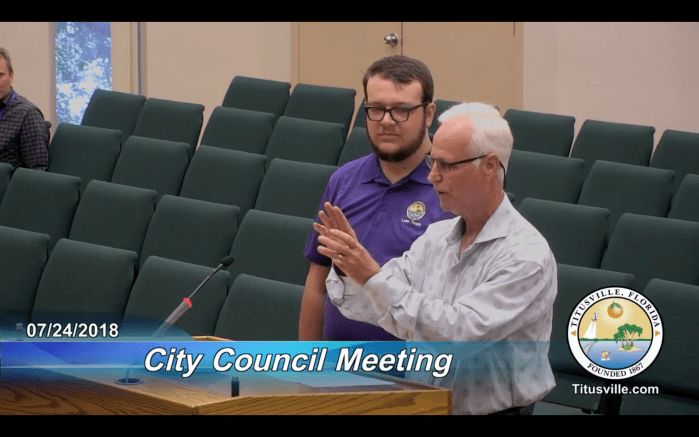
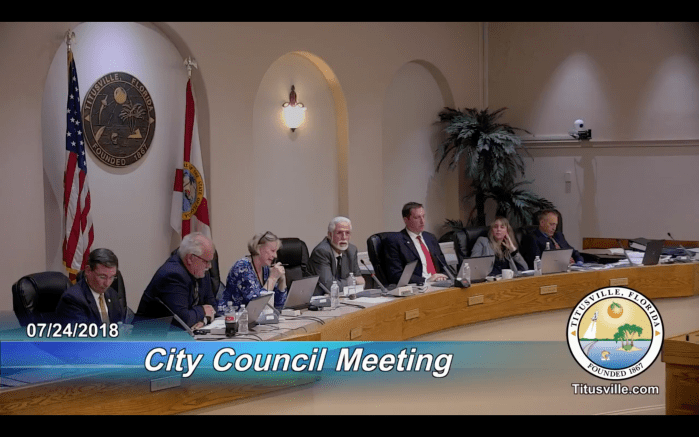
#164: Titusville, FL 7/24/18

It was awards season in Titusville! I don’t mean the Emmys, the Tonys, or the Fakies, but rather the Titusville Employee of the Month trophies, which went to an impressive roster of innovators, life-savers, and jokesters.

First up, the Water Production Department:

“Back in March, this is where we change our disinfectant byproducts. In previous years, this process has taken about two weeks. John was able to turn it into a two-day process.

Next, the police chief:

“Vinny got involved–all the merchandise back and bad guy goes to jail.”

And closing out the honors, the clerk’s office:

“I probably shouldn’t say this, but the last thing Shane did when he left as an intern–he was doing some of our advertisements. There’s something called alt-text where you can hover over a picture. It was a chili festival or something. A few days after he left, somebody hovered over it and it says, ‘ooh! Hot and saucy!'”

Screen Shot 2018-07-25 at 10.58.07 PM.png
Quick, someone check Titusville.com for alt-text

But the next item had potential to get more heated than a four-alam chili: whether to rename South Street after Dr. Martin Luther King, Jr.

“This is important because Dr. King expressed his dream that all minorities would be treated fairly,” an older man in a vest testified. “Renaming the street will emphasize not just the black minority but all minorities–the Asian minority, the Indian minority, Japanese, Chinese, and even the women minority.”

It was a compelling argument. Although to be frank, the reasoning of Vice Mayor Matt Barringer was less about including minorities (even “the women minority”), and more about raw bureaucratic expediency:

“The benefit is that there’s no street addresses, so it becomes much easier.”

The vote to go forward passed unanimously.

Barreling right along like a hurricane up the Florida coast, the council turned to one final teensy, tiny rezoning request for small homes near Park Avenue. Seems like a no-brainer and we can just–

“I’m not an engineer and I’m not fancy with a degree or nothing, but it just doesn’t seem like a practical area to build homes,” a man in a red Polo shirt protested with a swaggering “I’m no big-city lawyer” tone.

Screen Shot 2018-07-25 at 11.19.25 PM.png
Ooh, hot and saucyDAMN IT, SHANE!

That kicked off a cavalcade of concerned residents protesting this wetland building spree.

  • “You’re talking about homes that are 50 foot long and 20 foot wide. That’s a fishing boat!”
  • “I believe your intelligence is wrong.”
  • “If god had made square wetlands, it would’ve been a lot easier. But he didn’t.”

At one point, Mayor Walt Johnson perceived that a commenter was itching to say more after the timer had expired.

“You need some more time, sir?” the mayor gently quizzed.

“Uh,” the man mused, “two minutes. You need uplands for the–”

“One second, please,” the mayor halted him, seeking a motion from council to extend the time. It was a kind and merciful gesture. A one-time exception. Except…

“You need additional time?” Mayor Johnson asked the next woman who ran over. “How much?”

“Two minutes?” she offered hesitantly.

“That’s what I’m looking for,” he grinned. Fine, twice in one meeting is extremely benevolent and certainly not–

“Need more time?” the mayor prompted yet another commenter who ran over.

Screen Shot 2018-07-25 at 11.29.40 PM.png
Would someone get a whip for the mayor to crack??

Finally, the applicant for the housing stepped forward indignantly. “The lady that spoke before had a parade of horribles of things that happen maybe once in a while and acted like they happen all the time! We’re not gonna wipe out the wetlands,” he insisted.

Mayor Johnson frowned. “I’d like to see everybody at least have a shot at talking together and making something better,” he murmured.

And in classic fasion, the council that gave everyone two more minutes gave themselves two more months to figure it out.

Podcast Recap: Heated Meetings

This podcast episode is available on iTunesStitcherPlayer FM, and right here:

CCC_Logo

During these hot summer months, why not make it even hotter by listening to some of the most contentious city council meetings featured on the City Council Chronicles podcast?

This week, we revisit:

  1. The takedown of a racist street sign–with Norman, Oklahoma Council Member Breea Clark
  2. A woman who had a traumatic encounter with the Lancaster, Pennsylvania police–with Councilwoman Janet Diaz
  3. Whether to fly the confederate flag on city property–with Danville, Virginia Councilman Lee Vogler
  4. Why the Greensboro, North Carolina city council decided to screen footage of police brutality in a crowded council meeting–with Council Member Justin Outling

Oh, and we did cover one feel-good moment in this episode: the award we recently won! Hooray!

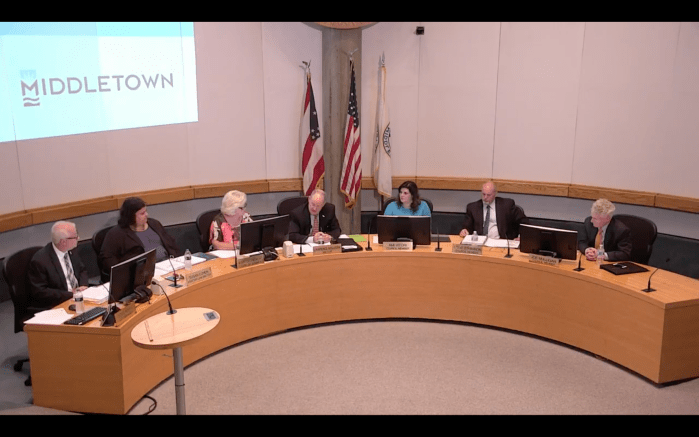
#163: Middletown, OH 7/17/18

The atmosphere was pleasantly calm in the Middletown council chamber. Perhaps that had something to do with Mayor Larry Mulligan, Jr.’s preferred icebreaker: “If you’d please stand and join me in a moment of meditation,” he directed, precipitating a hush across the room.

If the vibe wasn’t mellowed enough, they certainly brought in the right person to finish the job: the director of the library.

“Book Mobile hit the road again. First time since 1988,” he announced with the excitement of, well, someone who works at a library. “Regularly stopping around 22 different schools, they’ve seen about 14,000 people on the Book Mobile.”

The first Book Mobile in 30 years? The first since the invention of the World Wide Web? Since Taylor Swift was born? The first since the U.S. and Russia were enemies and–well, okay, the Book Mobile didn’t miss that part. But like any 30-year-old, it can’t live with its parents and needs a place of its own.

“We have a garage project. That will be the permanent home for the Book Mobile,” the director said. “We’ll also have some staff there that can pull in, run in, restock the Book Mobile, and head back out. That’s exciting.”

Screen Shot 2018-07-19 at 11.44.59 AM.png
If the Book Mobile’s a-rockin’, the staff is restockin’.

A resurrected Book Mobile was only part of the reason to celebrate in Middletown. “We actually got compliments on the fireworks!” exclaimed Council Member Ami Vitori. “I think maybe they were a little longer this year. Just long enough to make everyone happy. AND THEN THEY KEPT GOING!” she breathlessly recapped the experience.

“Really enjoyed the activities downtown–First Friday, the ice cream social event,” Mayor Mulligan reminisced. “I heard they gave out over 350 pieces of ice cream. Some of us just stopped at the adult beverages and not the ice cream.”

Mewonders how many adult beverages it takes for someone to call scoops of ice cream “pieces of ice cream.”

Screen Shot 2018-07-19 at 11.58.24 AM.png
“I’ll take a cone with two pieces.”

But there was a bigger problem confronting Middletown–and it wasn’t the historical lack of book mobiles or compliments for the fireworks.

“Since my involvement with the city back on the financial oversight committee in 2004, you know that’s–man, 14 years ago. Time flies when you’re having fun, I guess,” the mayor deadpanned. “The roads have been a real area of concern.”

He continued on a long monologue with a message of: hey, we need to wake up and smell the asphalt.

“While I’m certainly not a proponent of higher taxes, the financial landscape has changed quite a bit. We need to come up with some creative solutions,” he warned. “While other cities are at a two percent tax or more, we’re still below that. We could really get a lot of paving done, truly extend those deteriorating roads another 25-30 years.”

Screen Shot 2018-07-19 at 12.10.20 PM.png
Without roads, how will the Book Mobile survive?!

The clerk read the giant text displayed onscreen. “An ordinance to impose an additional one-quarter percent income tax effective January 1, 2019 for period of ten years to be used solely for the construction, repair, improvement, and maintenance of streets and roads in the city.”

She paused, then added: “We’re not requesting any action until August 7.”

“Be aware,” the mayor mused, glancing around the dais to the three other council members present, “to make our August 8 deadline to get it on the ballot, it will require four votes from council.”

For the sake of the Book Mobile, I hope they have them.

Interview #96: Charlotte, MI Councilman Branden Dyer (with podcast)

This podcast interview is available on iTunesStitcherPlayer FM, and right here:

Branden Dyer spent 2011-2015 on the Charlotte (rhymes with “car lot”) city council, was defeated for reelection, but was appointed back on the council this March. The difference in tone between 2015 and 2018 is night and day.

Q: In your final meeting during 2015, you said you felt that the “negative campaign” against you was a distraction. Your city is only 9,000 people; don’t take this the wrong way, but what was there to be negative about in Charlotte?

A: A group of individuals who were not happy with the situation made an effort to remove me and other individuals from council. You kind of expect it in national elections, but there was a lot of rumors, a lot of negative Facebook comments and attacks.

Q: Some meetings, commenters seemed to imply the council was a rubber stamp for the city manager. Was that part of the tonal shift in Charlotte politics?

A: Yes. Their intention was to get rid of the city manger. When they made a move to not renew the city manager’s contract, there was a significant community uproar and they eventually backed down.

Q: Did you ever feel any pressure on council to go out of your way to question or oppose the city manager’s recommendations because you had this accusation of a rubber stamp being hurled at you?

A: No, I had no qualms with disagreeing with the city manager. But also, the city manager has a PhD literally in city management and I do not! In this age of complex government regulations and techniques, I think it’s best to defer to the expertise.

21751573_1416223605165826_181747683923107386_n
Charlotte, MI Councilman Branden Dyer

Q: Well, I have a PhD in making quality municipal affairs audio content (obviously from the University of Phoenix), but it is 100 percent impossible to look at any of your council meetings from 2015 without noticing a young man named Zachary who was a candidate for mayor and an unrelenting critic of your government. What was his deal?

A: [He] was a disgruntled citizen that definitely exercised his five minute public comment limit down to the second at every chance he got. I tried to get him involved on a city committee but he never responded to my offer. After losing the mayor race, apparently his concerns were satisfied or he just kind of disappeared.

Q: He was pretty much in there nonstop to troll you guys and, I’m assuming, get free video of his speeches for his campaign. How did you respond to being baited?

A: Zach never really came after me personally. [The mayor] did not choose to run for reelection. Her term as mayor was difficult on her. Zach routinely attacked her and the city manager personally. The environment and vibe on council was a lot different than when I first went on council and my current term on council. “Toxic” is not really the word I want to use, but I think that’s kind of the best way to describe it.

Q: Was part of the reason you wanted these meetings videotaped and put online so that people who were not the attackers could look at what you were encountering and kind of sympathize with the situation?

A: I don’t think I was necessarily looking for sympathy, but you want everybody to be informed. The group that came against me and other council members were very savvy at using social media. They could get their view out there, and I wanted to be sure there was an official record so that if individuals chose to, they had the ability to see what actually happened instead of taking one viewpoint from one group in town. I wanted to make sure things weren’t skewed.

#162: Inglewood, CA 7/10/18

Dueling realities were on full display in the council chamber, where on the one hand city leaders boasted that they were Making Inglewood Great Again, despite evidence that things were actually a bit of a bonfire.

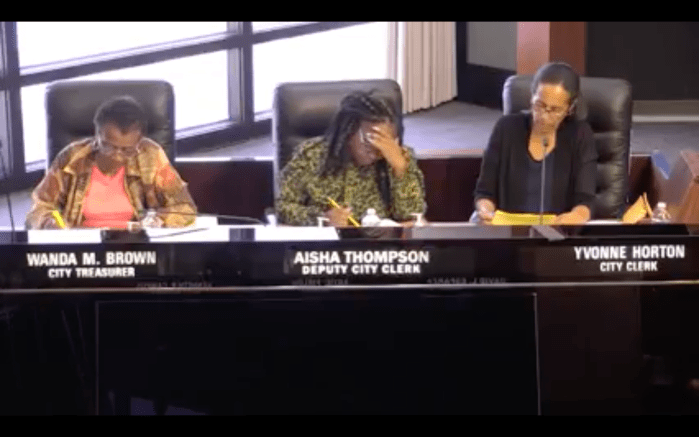
Even the city treasurer was conflicted about the state of things as she started off the meeting with a positive report that the city’s “gross investment interest earnings is $6,902.”

However, “just a little report regarding global debt,” she pivoted. “Global debt has risen to more than $247 trillion, which is 318 percent of the world’s gross domestic product.”

I’m not an economist, but it seems like all the world needs is a slight 318 percent increase in GDP and problem solved, no?

Screen Shot 2018-07-12 at 9.07.40 AM.png
We are all the deputy city clerk.

But fear not: the meeting was not simply a platform to realize that faraway debt is a problem. It was a platform to realize that nearby city hall is a problem.

“This is a lawsuit filed by an assistant pastor,” a commenter waved around a sheet of paper at the lectern. “He says, quote, ‘this is about abuses of power and civil rights perpetrated by the city of Inglewood through its current mayor, James T. Butts.'”

With his voice raised, the man summed up the lawsuit in a single sentence: “He says both the mayor and his assistant used intimidation and defamation to try to ruin his career and have him shunned.”

To conclude, “at least one other community paper reported on this, but in order to hide problems with this mayor, Inglewood Today is hiding problems from the public.”

Screen Shot 2018-07-12 at 9.14.18 AM.png
Consider it unhidden

“I don’t appreciate anyone, not even the mayor, suggesting that I choke myself at a public meeting,” the next woman began, sadly providing no further context. “I wonder how many situations are going to be created where someone sues us for a hostile work environment that YOU created. I hope that everyone goes on the Internet and checks out the Daily Breeze story.”

So to recap: one media outlet is covering the hostile work environment. Another one is hiding problems. And a third one is, apparently, giving the mayor glowing coverage.

“I’d like to congratulate the mayor for his interview on ‘Eye on Newsmaker,'” Councilman George Dotson heaped on the praise. “I’ve heard nothing but great comments. I’ve had people call me wanting to see it over again.”

“I also wanna congratulate you,” fawned Councilman Alex Padilla. “You talk about putting Inglewood on the map for all the right reasons.”

Screen Shot 2018-07-12 at 9.46.46 AM.png
The reviews are in!

Mayor Butts grinned at this 180-degree tonal shift, knowing that amid all this talk about choking and intimidation, he had the final word.

“I’m glad that we have one person the Breeze can always go to to tell us how bad we’re doing. But they can only find one!” he joked. “There are media broadcast outlets that wanna know the real story of what’s going on in this city.” (I am assuming The Chronicles falls in that category, Your Honor.)

Then as he prepared to adjourn the meeting, the mayor reached full-on elder statesman mode.

“Remember, this is an election season. And there’s gonna be all kinds of crazy lawsuits filed and all kinds of stories,” he said quietly but forcefully. “Look at the results. Look at the reality of what’s going on here. Not all the smoke and the distraction. This is the new Inglewood.”

Well, it will be once the “crazy” lawsuit is cleared up.

Interview #95: Hillsboro, OR City Manager Michael Brown (with podcast)

This podcast interview is available on iTunesStitcherPlayer FM, and right here:

The thing you need to know about Hillsboro is: they have fun. Whether it’s art in the council meetings or elaborate comedy routines at the state of the city, creativity abounds in the Hillsboro council chamber. City manager Michael Brown elaborates on why that is.

Q: I am impressed by the range of creative expression that gets showcased in Hillsboro. Just in the past six months, you had artists, you had high school performers, and–my favorite–you had second and third graders dressed up as historical figures from Hillsboro. Is there any segment of society or culture that you would like to be featured in your council meetings?

A: Anything. We view our council meetings as basically a community gathering where half of it is creating performances and different ways to connect with the community. And the second half’s a business meeting. The ones that stand out to me are musicals. Those are really, really fun.

Q: Do those ever make you wish you were on the opposite side of the dais entertaining the audience?

A: No, not anymore. I tried to do acting when I was in high school and the acting director pulled me aside and said, “you know, I think you’d be better as a stagehand.” I worked in the back of the stage, not the front.

Q: Is that a good philosophy for a city manager? Be the stagehand, not the leading lady?

A: [laughs] There’s different expectations council has for you, whether you’re out in front or behind. I like being in the background with charismatic, smart, intelligent leaders out in front of me.

Q: Something completely unexpected to me was watching your state of the city address. Normally across cities, these things are pretty uneventful. The mayor gets up there; rattles off statistics about how well the city is doing; people applaud; and an hour later it’s done. But in Hillsboro, the state of the city is not just a speech. It’s a production. In the 2017 state of the city, for instance, Mayor Steve Callaway had the audience do a text message poll. How does the state of the city come together?

michaelbrown2jpg-fbc185b8da57067d.jpg
Hillsboro, Oregon city manager Michael Brown

A: Over the course of maybe six months in advance of the performance, we have a group of people that are laying it out and planning it. We sit around, talk about what things might be interesting. In the case of the last mayor and Mayor Steve Callaway, they’re really funny. They really enjoy the opportunity to engage the audience and not get up and give a big speech and have everybody clap. They recognize the value of humor and wit. It is a performance. We view it as a performance.

Q: Your mayor is probably one of the best deliverers of this highly specific kind of entertainment. And speaking of deliver, this year’s state of the city featured former Mayor Jerry Willey walking in as a pizza delivery guy. Did any of the other cities you worked for come close to this kind of choreography?

A: This is a unique place! They enjoy poking fun at each other in a positive way and if you knew Jerry Willey, having him in a pizza uniform is the last thing you think he would do.

Q: One thing that’s not exactly entertaining, but it’s certainly unorthodox for any state of the city address, is that Mayor Callaway actually gives up the microphone midway through and lets councilors have their own time to speak. Why would the mayor give up precious camera time to the hoi polloi on the council?

A: Because it’s a council and the mayor is part of the council. While he’s the political head of government–the person people look to–he wanted to create the space for them to be up there and have the group be together and say, “we view it as a team.” He cares a lot about that.

Month in Review: May-June 2018

We came back from our hiatus (because of Tear It Down) last month and not a moment too soon! If we hadn’t, we might have missed, for instance, the poor cockroaches that got dumped onto the dais.

Or the mayor who had secret side gossip with council members during a meeting.

And on the podcast, we encountered one councilor who wanted his own coverage erased–a request to which we flatly said “no.” But on the brighter side, another council member offered to have a sleepover in his council chamber–to which we flatly said “YASS!”

To relive the moments that are only memorialized in time on these very cyberpages, surf the May-June Month in Review.

And if you doubt that last month’s council meetings were heated after all, feast your eyes upon the body language right here:

scr3

Interview #94: McDonough, GA Councilwoman Sandra Vincent (with podcast)

This podcast interview is available on iTunesStitcherPlayer FM, and right here:

Sandra Vincent has been on the McDonough city council for over a decade and only recently experienced her first meeting about tattoos and piercings. We also covered her frustration over a park and what that meant for a business owner who wanted to comment upon it.

Q: Last year, there was one part of the city employee handbook that bothered you–the council was trying to limit tattoos and piercings. Was this the first time in your more than a decade on the city council that this subject came up?

A: There have been other times we discussed dress code. I don’t recall there being another time when we specifically were creating policy that descriptive around tattoos. Tattoos, even though I don’t have a tattoo and don’t particularly like them, culturally there are more young people who are into tattoo wearing. To say that we’re not going to hire individuals with tattoos above the neck is to limit ourselves.

Q: How surprised were you that the others did not see it your way?

A: I was extremely. I think I had a weeklong debate with my four daughters. What was even more odd is that there were people presenting in the audience that evening who represented the local chamber [of commerce], one of which had tattoos and a mouth piercing!

Q: No way!

A: I was sitting there thinking, this is a professional woman that has just presented this amazing piece to us. She has tattoos and piercings and we’re saying that if you exemplify those characteristics, that’s not considered professional. I almost felt like I had been propelled back about 20 years.

56992c9f518ef.image
McDonough, GA Councilwoman Sandra Vincent

Q: At the meeting on April 18, 2016, you moved to add a discussion of the Overlook subdivision park to the agenda. But other council members said they had already told people that there would be no discussion and therefore it should stay off the agenda. How sympathetic were you to that reasoning?

A: I wasn’t. Initially, the Overlook discussion was on the agenda. In that chamber were somewhere between 50 and 75 individuals from the Overlook community who had come out. Somebody took it off [the agenda].

Q: After you gave a presentation despite the mayor trying to gavel you down, the audience applauded and you left the chamber. Do you remember where you went?

A: I walked outside of chambers through the back door to try and capture myself. I went out and did have a conversation because those are people that I represent. I think the most heartbreaking thing was an elderly gentlemen–he just kind of looked at me and said, “Ms. Vincent, what do we do now?”

Q: When you came back in the room, you and a public commenter had an exchange in which you wanted her to state that she did not live in the city, despite owning a business there. Did you have a history with that person?

A: The commenter had concerns regarding the park. My response concerning whether or not the individual lived in McDonough was germane to the fact that there were almost 75 individuals who live in the city that were refused an opportunity to speak. We’re talking about specific issues for a particular geographic area and this business is across town. I don’t see how it’s fair to not disclose the fact that the person is not a resident.


Follow Councilwoman Sandra Vincent on Twitter: @sandravincent