#167: Iola, KS 8/27/18

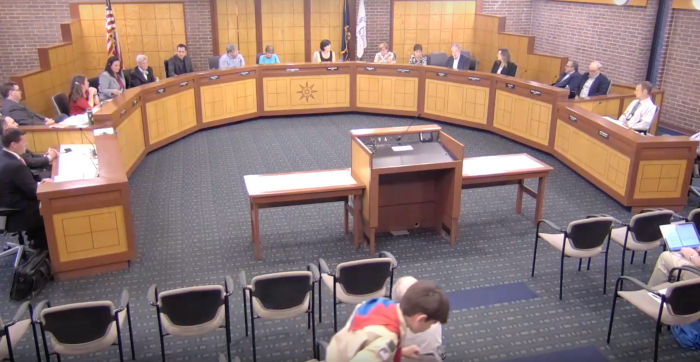
A tall, thin young man strolled up to the lectern as council members patiently folded their hands and arms in front of them.

“I am the coordinator for the Libertarian Party of Allen County,” he announced. The introduction was entirely plausible, as his baseball cap and tan shorts were consistent with a minimal government/minimal dress code philosophy.

“Since this is only my second meeting so far, I’m a little lost. What is the purpose of a public hearing?”

Mayor Jonathan Wells leaned forward to help. “Generally, public hearings are to allow the public input on a specific issue–usually on things like budget or whenever we are doing a demolition or condemning a house.”

“I see,” nodded the lanky libertarian, despite this intrusion of Big Government into his comment time. “I would like to start off with reading a bit from the city code.”

He turned to his notes and quoted city policy to the silent council members. “In chapter one, article five: ‘the objective of the investment program shall be to aggressively manage and invest all public monies to relieve demands on the property tax and reduce the cost of public services.'”

He looked up. “I would really like to emphasize the relief on property tax and to reduce the cost of public services. I would appreciate if the council keeps in mind my desire for lower taxes.”

Screen Shot 2018-08-30 at 12.11.30 PM.png
Look at all the tax money wasted on those extravagant folding chairs.

“I’ve seen in the officially-approved minutes of the special meeting on July 16, Council Member…Murick–”

“MYrick,” corrected Eugene Myrick.

“–mentioned a private trash service, to which administrator [Sid] Fleming noted that having heavy trucks on our streets that the government does not control may be more damaging.”

He delivered his bottom line. “As a libertarian, government control of anything is fundamentally and philosophically threatening to me.”

Before the council could thank him for traveling on the fundamentally-threatening government streets to the fundamentally-threatening government building to broadcast his views over fundamentally-threatening government cameras, they leapt ahead to discuss another possible menace: people.

“Do we really need two recreation directors? AND an administrator assistant?” Council Member Myrick quizzed. “I’m not saying, ‘cut ’em. Get rid of ’em.’ But once that position becomes open, can we just not fill that again?”

Screen Shot 2018-08-30 at 12.17.05 PM.png
I seem to remember the city code mentioning reducing the cost of public services….

But Council Member Aaron Franklin pumped the brakes on the HR Express. “I think we’re approaching this from the wrong direction,” he frowned. “We need to focus on staffing the city with the right people in the right places for the right reasons. And not look at this as, ‘we need to cut things across the board.'”

He urged everyone to check their libertarian impulses. “I know that everybody wants to cut. But if we go into a study trying to find the result we’re looking for, we’re gonna have failed before we even start.”

“The intention of this is not to get rid of anybody that is currently employed,” Council President Nancy Ford maintained. “It is just if there is a vacancy, determine whether that needs filled. That shouldn’t upset anyone. If they’ve already all picked up that workload and split it among them, you know, that’s part of having a job!”

That’s true. And if the city ends up being short-staffed, there is at least one person willing to come in and read the city code for free.

Interview #101: Lakewood, CO Mayor Adam Paul (with podcast)

This podcast interview is available on iTunesStitcherPlayer FM, and right here:

Adam Paul is a city councilor-turned mayor who has had to deal with a series of crises–major and minor–at recent Lakewood council meetings. From the “rat house” to the brawl over a mayor pro tem, he explains how the council confronted the problem and moved on.

Q: I was pleasantly surprised to see at your June 25 meeting this year that you had some guests from Lakewood’s sister city in Australia. Was there anything that you had to explain to them about how your meetings worked?

A: Public comment was an eye-opener for them. It was a little bit foreign to them and [they] were surprised at some of the boldness of the community members in their comments.

Q: Did you get a sense of what their public comment is like?

A: Yeah, limited public comment and certainly in their system, from the queen down, kind of that proper Australian, proper English attitude toward it.

Q: When they’re not wrestling crocodiles and drinking Foster’s, I assume. What did you hope those Aussies took away from your meeting?

A: It was good for my council to understand that while we are literally a world apart, our issues are the same. That was a cool takeaway for me to see this is normal. These are the normal functions of local government. We’re not an outlier.

Q: This same meeting with the Australians, there was actually a bigger, more disgusting concern. When I say the words “rat house,” what does that mean to you?

A: Well, it’s taken on a whole new meaning. You know, in local government, we try to plan against storms and shootings and traffic accidents. You try to be prepared for everything. We were experiencing a quite sad situation. A family was dealing with some mental illness and a hoarding house. They had some pet rats that they were feeding and taking care of and it started to snowball into a terrible situation. We had to have all the rats killed, which is over 500, 600 rats, I think.

12509539_741148109351483_8106868115234131589_n
Lakewood, CO Mayor Adam Paul

Q: At that meeting, neighbors stood up and described in graphic detail the feces, urine, and rat carcasses that they were dealing with because of this house. When you were listening to that, how did you feel?

A: I felt terrible. I mean, goodness. What a terrible ordeal. At the end of the day, I’m the mayor. The buck stops with me. Our first thing that we needed to do was contain it, get it stopped. This has been a learning process. There will always be something else that you don’t catch.

Q: Yes, and it’s unrealistic for you to know everything that’s going on in the neighborhoods before someone brings it up at a council meeting. But rats with tumors on their faces? And carcasses lying in yards? I mean, how was this happening for a year and a half and all of a sudden, it’s June 2018 and it’s a crisis?

A: If we didn’t act in a manner that we should have, we need to fix that and we will. But for some it was still too slow and we need to do a better job.

Q: Obviously, you don’t want people coming into the council meeting for public comment with every little situation for you eleven to address. But on the other hand, you don’t want someone’s house literally on fire and then coming in and telling you about it. Where have you given direction to city staff to say, “when a problem gets this bad, we should be talking about it in a council meeting?”

A: That’s why we’re there on Monday night. To hear that. When there comes a point where people don’t feel like they’re being heard or they don’t see things being affected, we’re the last remedy.


Follow Mayor Adam Paul on Twitter: @adampaullkwd

#166: Prairie Village, KS 8/20/18

“Last week, as you all know, I went to Washington, D.C.,” Mayor Laura Wassmer casually mentioned her Kansas and Nebraska mayors’ powwow at 1600 Pennsylvania Avenue.

“We had quite a dog and pony show,” she continued, gingerly stepping around all of the names she was dropping. “Kellyanne Conway talked a bit about working to help the opioid crisis. Ben Carson talked about affordable housing.”

She paused. “They made the point over and over, there are a lot of great things happening at the White House that is not being reported by the media–and asked that we pass that along.”

Consider it passed! Just think of all the people who haven’t pleaded guilty! Everything’s great!

And you know where else great things were happening? Right there in the Prairie Village council meeting, where it was a very big week for city administrator Wes Jordan.

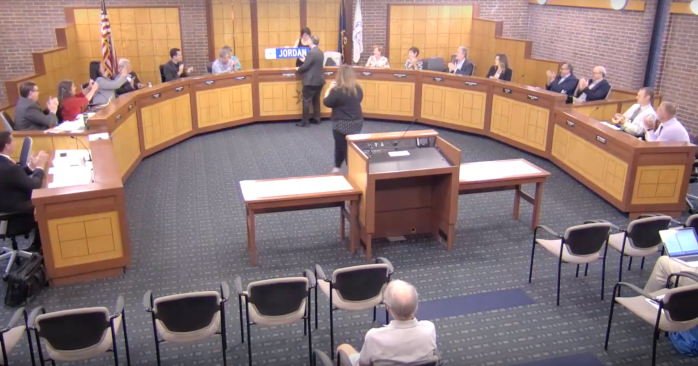
“Wes, this is a very big week for you!” Mayor Wassmer glanced slyly over to him. “Not only is it your birthday on Thursday, but SOMEBODY has been with Prairie Village for 30 years as of Wednesday.”

“Woo-woo!” came an anonymous catcall as applause broke out.

The mayor went down the line of compliments, from the professional–“I think of how conscientious he is”–to the…intimate.

“There’s the perfect hair. The forever perfect hair,” she observed, although the video quality was not good enough to independently confirm. “We have your favorite ice cream cake in the back. And more importantly–”

Mayor Wassmer disappeared under the desk for a moment, then emerged brandishing a giant, shiny blue object.

“–your own Prairie Village street sign!”

“Speech! Speech! Speech!” yelled Council Member Brooke Morehead.

Screen Shot 2018-08-22 at 10.52.16 PM.png
The hair! Show us the hair!

The only thing standing between the council and ice cream cake was a tiny bit of official business. Namely, a resolution “in support of the principles of the Convention on the Elimination of All Forms of Discrimination Against Women.” It seemed like the kind of routine measure that would pass without a fight.

But then the fight began.

“I will vote no because I’m not comfortable placing our city under international law when the U.S. Senate refuses to ratify the treaty after nearly 40 years,” announced Council Member Morehead defiantly.

“By passing this resolution, it could be mistaken that we are endorsing its tenets on civil rights, reproductive rights, and gender relations.”

“There are probably places where men are discriminated against, arguably,” Council Member Dan Runion echoed in the vein of “All Lives Matter.” “It’s a feel-good measure. Why pull one group out and treat them differently?”

Council Member Ron Nelson was incredulous at what he was hearing. “There are 189 state-nations that have adopted the Convention. There are seven that have not,” he retorted. “Those are Palau, the Holy See, Iran, Somalia, Sudan, and Tonga. And last and, sadly, least: the United States.”

“It frankly amazes me that we can say highlighting that there should not be discrimination against one class of people minimizes others’.”

Council Member Jori Nelson stared down at her notes. “We’re proclaiming this to be Diaper Week and Electric Car Week. And we’ve done Peanut Butter Week.” She clenched her fist. “It is MY opinion that women’s equal rights is more important and should take precedence over peanut butter, diapers.”

“I’m not sure what–what–if we’re…I’M certainly not trying to equate this resolution with Peanut Butter Week!” shouted Council Member Andrew Wang. “We are creating an enormous act of discrimination by passing this resolution while there has NOT been any shred of evidence that we have a problem.”

Screen Shot 2018-08-22 at 11.36.24 PM.png
What is happening here?

“I don’t know why this anxiety exists because a United Nations entity thought that this was important,” pleaded Council Member Chad Herring.

Council Member Morehead reiterated her firm opposition. “I’m a successful business owner. Longtime mom, grandma. I think I’m a pretty good role model.”

She caught the eye of an employee in the back. “Jamie! You, lady, you’re doing a terrific job. And you, little girl back there? Yeah, you’re doing wonderful!” She leaned back. “You are tying yourself to the United Nations. We don’t need it!”

Council Member Jori Nelson’s hand shot up. “When you speak about women as ‘little girls,’ or not addressing the staff as educated and intelligent, I think it’s demeaning.”

She glowered across the dais and pointed angrily at Morehead. “They’re not little girls. They’re women.”

“Make no mistake,” Council Member Ron Nelson interjected softly, “a vote that no, this resolution should not be adopted, is a vote that there should be discrimination against women.” It appeared the council was evenly divided in this standoff. All of a sudden–

“Motion to refer to staff,” Council Member Runion moved to ditch the resolution entirely for the night after a half hour of anguish.

The mayor called for a vote. Seven hands went up in favor. Five against.

It was a disheartening ending to the meeting. And an even more bizarre beginning to Diaper Week.

Interview #100: San Jose, CA Councilmember Dev Davis (with podcast)

This podcast interview is available on iTunesStitcherPlayer FM, and right here:

Dev Davis may be known as the District 6 council member, but she is also the mastermind behind the San Jose council curfew, the originator of the Star Trek meeting costume, and–as you will hear–a skilled actor in medical dramas!

Q: I would like to start with the April 18 council meeting of last year, when you all invited Apple co-founder Steve Wozniak into city hall. What stood out to me was what you were wearing. Would you describe your attire that day?

A: I was wearing a traditional Star Trek female crew member dress.

Q: How did you conceive of that?

A: Well, all Comic Cons are celebrated–at least in the United States–by having many of its attendees wear costumes. I thought it would be in the spirit of celebrating Comic Con for the city council to have costumes.

Q: I see your logic but don’t you think it sets a dangerous precedent to have council members putting on costumes for meetings? I mean, what’s to stop your mayor now from wearing assless chaps during Pride?

A: That would not only be a great homage to Pride but also to Prince, who is one of my favorite artists. But our mayor is quite conservative and would never don assless chaps.

Q: Well, Mayor Liccardo, if you were to make that fashion choice, just know you have two supporters of that right here. We will validate your choice. Dev, let me ask you about a procedural oddity in San Jose: does your council not have ordinances or bills? You have “memos?”

A: We do have ordinances, but we have the Brown Act in California, which means that we can only communicate with a minority of our colleagues prior to voting. So the way that we communicate with everyone is through these formal memoranda that get attached to each agenda item. We can say what our thoughts are and basically what motion we’re going to be making on the floor.

_3y0OziX_400x400
San Jose, CA Councilmember Dev Davis

Q: There seems to be this dance every few months when your council considers affordable housing at a meeting. Renters say, “we cannot afford to live here and it’s too easy to evict us.” Landlords say, “we need to be able to evict people and raise the rents.” And other people say, “this is all beside the point. We need to build more housing!” Then your council around midnight votes to side with the renters. Do you feel good after those meetings that you’ve accomplished something? Or are you frustrated that, okay, we put a Band-Aid on it. In a couple months, we’ll have another midnight meeting on housing again?

A: I do feel frustrated after those meetings. I feel emotionally drained. The reason that we continue to have these discussions is because it took us decades to get into this mess. It’s not something we can solve in one city council meeting and one year.

Q: Logistically, is there any way to structure these meetings better so that you all are not forced to make a decision very late at night after you’ve been yelled at for four hours, and maybe you’re not in the freshest mindset?

A: The only reason we have a midnight curfew is because Councilmember [Chappie] Jones and I asked to have a midnight curfew. Prior to the curfew last year, there were multiple meetings that went until 2:30 in the morning. As we get more and more tired–whether we want to or not consciously–subconsciously our brain starts shutting down and we don’t make the best decisions.

Q: Have you ever felt that you voted the wrong way because of all those stress factors on your brain when you were going to those extremely late meetings?

A: I’ve never regretted any of my votes, but I’ve often wished we had more time to think about the sausage we were making to get to six votes after a long meeting like that.


Follow Councilmember Dev Davis on Twitter: @DevDavisCA

International #CityHallSelfie Day Top 10 List

Yesterday was International #CityHallSelfie Day and the results were captivating. Take a peek at our top 10 city council selfies here!

Interview #99: St. Petersburg, FL Council Member Darden Rice (with podcast)

This podcast interview is available on iTunesStitcherPlayer FM, and right here:

Darden Rice is the District Four council member in St. Pete and we spent time dissecting her city’s restrictive public comment period. Then we practiced convincing teenagers to come and speak to the council! (BONUS: Info about International #CityHallSelfie Day.)

Q: Council Member, I was angry when I heard that only city residents, owners of property, business owners in the city, or their employees could speak in your meetings–and only on city government issues. Does this mean I am not allowed to come and tell you folks why “Shrek 2” was better than the original “Shrek?”

A: Yeah, there might be some issues if you wanted to speak if you’re not a St. Pete resident. Although you could call your friends, like Council Member Darden Rice, and I could invite you to come talk about “Shrek.”

Q: I do know it’s highly unusual for a council to limit the kinds of people who can speak during a public comment. What would you say to the argument that, as a representative, you are obligated to hear what your people are concerned about? Even if that concern is not, strictly speaking, about city business?

A: I think you’ve got a really good point. I tend to be a little more liberal in the application of what rules we use. But at the end of the day, it is on advice from our legal team that the people that speak–because there’s limited time–that we honor those who are residents.

Q: Practically though, how do you screen out people who don’t meet those criteria?

A: There’s really a trust system involved. It’s so rarely that someone doesn’t meet the criteria.

Q: For the record then: if the Queen of England herself walked into the St. Pete council meeting for open forum and you had your suspicions that she was not a resident, you would still not say, “sorry, Mum, I’ll need to see the address on your driver’s license first?”

A: I would imagine that our chairperson of council would give the courtesy of the Queen to speak at council.

Darden_Rice-D4
St. Petersburg, FL Council Member Darden Rice

Q: Recently, Council Member Steve Kornell had an idea to ask the ministers you invite to do your invocations to also bring children from their youth groups to speak at council meetings. Can you explain what this procedure is supposed to look like? And please do use words like “dope” or “extra” in your answer.

A: [laughs] I think it has a good intention. I think it would take a lot of work bringing kids and getting them out of school to come and speak to council. I haven’t really thought about whether this is an idea I think is really great or if it’s just gonna make meetings run a lot longer.

Q: Let’s do a role-playing exercise. Let’s pretend you are a minister about to give the invocation–Presbyterian, if you need to get into character. And you are trying to convince me, a moody teenager, to come and speak during the open forum.

A: Hey, Michael. This is Pastor Darden Rice and we are gonna go up and talk to city council today. I’d like you to share some issues you have going on at school and talk about how safe you feel in the neighborhoods or not and just let your elected officials know about what it’s like living in St. Pete. How does that sound?

Q: Ugh, city council? That sounds like old people stuff. You are embarrassing me so hard right now in front of my phone. I will not be on camera without a filter. No way. #noway.

A: Hey, Michael, I think you ought to give this a second thought. When young people show up, we really listen. I think it would be a great learning experience.

Q: It’s not gonna be boring is it? My boyfriend went to an Ed Sheeran concert and said it was super boring and I’m worried this will be like the Ed Sheeran concert.

A: It won’t be boring because you’re just staying for the beginning of it. I promise.

A: Okay, fine. Only if I can text my friends about how I’m at the city council meeting and they’re not so they’re lame.


Follow Council Member Darden Rice on Twitter: @DardenRice

Month in Review: July 2018

July was a solid month for a couple of our key demographics. Readers, for instance, were buoyed by the news that the Book Mobile was roaring back after a 30-year absence!

People who enjoy theater and comedy were also pleased when we interviewed the city manager whose council loves to put on an elaborate production once a year.

We also heard on the podcast from two council members who were part of a once-hostile atmosphere at their city halls that has since cooled down considerably.

To find out who is a city council trendsetter and who is still working out the kinks of the job, check out the July Month in Review.

And if the thought of catching up on all of the council meetings you missed seems daunting, the deputy city clerk here feels your pain:

Screen Shot 2018-07-12 at 9.07.40 AM

Interview #98: Newport, OR Public Works Director Tim Gross (with podcast)

This podcast interview is available on iTunesStitcherPlayer FM, and right here:

Tim Gross is the first public works director to appear on the program! We spoke about how he prepares the councilors to decide on technical issues and what he learned as an actor that applies to the meetings.

Q: How do you feel about the fact that you have to sit at the dais with your councilors during every meeting?

A: Well, there’s a lot of business that takes place at a council meeting that is not public works-related. I wish that I was at the beginning of the meeting instead of at the end [laughs].

Q: What do you do when you’re sitting through that copious downtime?

A: The council meetings honestly are the longest period of uninterrupted time I have for doing work that I have otherwise not had the time to do. It’s a great opportunity for me to get some correspondence done. I’ll keep an ear out for what’s happening in the meeting.

Q: So a public council meeting for you is a better work environment than your actual work environment?

A: Yes, absolutely!

Q: You obviously have a specialized field of knowledge. How frustrated do you get when there is a technical concept that they are voting on and they don’t seem to be getting it?

A: I’m gonna actually turn that on ear a little bit. More often what I get is people coming in from the public who have a solution to whatever problem they’ve identified. It’s not necessarily a good solution. It’s my opportunity and responsibility to–I hate to say the word “educate”–educate the council on how public works operates. I usually make sure that I don’t necessarily get in a battle of wits with somebody who comes into the council chambers.

Timothy Gross PE
Newport, OR Public Works Director Tim Gross

Q: Tim, I’m surprised you don’t like to engage in battles of the wits because is it true that you once acted in “Schoolhouse Rock Live!?”

A: [laughs] Yes, that’s one of the shows I’ve been in. I was the teacher in that musical.

Q: Did you learn anything from working with children that was beneficial to you in the city council meetings?

A: I mean, a city is made up of people. What I like about acting in musicals is you’re working with a bunch of people from a huge variety of backgrounds. I enjoy that.

Q: Most of the meeting is not, unfortunately, public works-related. Because you are a department head–because you are sitting at the dais with everyone else–if there is an issue before council, do you automatically feel that it’s partly your responsibility? Or do you think, “good luck with that, but it’s not really my area?”

A: I have a motto: “if I have the ability, I have the responsibility.” If the council doesn’t get back on point and discuss the issue at hand, it’s my responsibility to be able to make sure they are factual in what they’re deciding. Sometimes they just figure it out on their own.

Q: One time a county commissioner candidate came into a meeting and complained about how the commissioners specialize on issues and aren’t able to speak to everything. Does that happen with the Newport council?

A: It depends. To have everybody do everything is not possible. The candidate was pretty spot-on in that the county commission, because there’s only three of them, have become very specialized. Oftentimes the other commissioners won’t comment at all on some of the special interests. But I have not seen that with the city council.

#165: American Fork, UT 7/31/18

“The city is considering a three-month, temporary land use restriction,” Mayor Brad Frost announced sternly as the first order of business. His microphone was off, but his voice carried through the intimate and ornate meeting space.

“The city will not be accepting new development plans or requests for zoning modifications.”

If you want to rile up a town, nothing does it better than talking about people’s land. Surely enough, a strange but emotional scene slowly unfolded before the council in which one family, member by member, stood up with a single message: get off my lawn.

“What gives anybody the right to decide what’s on my property?” pleaded a gray-haired woman. “I own it. We have no interest in selling this. Ever. It’s a family farm. Please, I would ask that you take us out of the T.O.D. [transit-oriented development area].”

Screen Shot 2018-08-01 at 10.32.50 PM.png
Lock the doors! Don’t let her leave.

She was replaced by her husband, who stood uneasily as a dozen onlookers stared at his back.

“I’m not very comfortable doing this. But I’m going to because I feel so strongly about it,” he admitted.

“We do not want to sell or develop–at least not in my lifetime and certainly not in my kids’ lifetime. And it’s looking like not in the grandkids’ lifetime.”

Councilmember Clark Taylor fidgeted with his ring. The mayor folded his hands in front of him on the desk. The commenter sighed loudly into the microphone.

“If we could, we’d like to leave the city. We get nothing from the city. No sewer. No water. We don’t even get police protection. We never wanted to be part of the city. We were talked into it by the late mayor.”

He gazed into council members’ eyes and nodded to his wife.

“She grew up there watching her grandparents crawl up and down row crops on their hands and knees. Our kids have grown up there. This is home. It’s not just a piece of property.”

Screen Shot 2018-08-01 at 10.36.24 PM.png
This story is more American than a baseball bat eating apple pie.

As the man turned on his heels and returned to a chair, Mayor Frost tugged on his microphone.

“I appreciate the decorum. I really do. You haven’t yelled or screamed, but we get your message and I appreciate it,” he said thankfully as the rest of the family–the daughter and the grandson–stepped forward.

“I’m fifth generation that’s lived on the farm. He’s sixth generation,” she said, clapping a hand on her son’s shoulder. “I have no desire to sell ever.”

With this family seemingly committed to guarding their compound to the death–and no one in the government itching to call for a raid by the National Guard–the council segued into other business. Although for a moment, it didn’t seem as if the theme had changed all that much.

“It was really one of those moments where you can say I’m proud to live in American Fork and I’m proud to live in America,” Mayor Frost recalled. “This last Saturday night, we welcomed home a soldier deployed to the Middle East. It was put out on Facebook and boy, did our citizens catch ahold of that!”

His voice was low and measured as he told of the heartwarming scene. “We ushered him in with emergency vehicles, and along Main Street people were holding flags. When he got home, there was 200 flags in his neighborhood. It was really special.”

Screen Shot 2018-08-01 at 10.34.20 PM
This story is even more American than the last one!

The lesson here? A city is not just a collection of property. It’s a home. And I think the farm family would approve of that message.