Somewhere out there, a city council meeting is happening. And you're not watching it. But I am. Each week, I bring you the highlights, lowlights, and weirdlights from places you don't live.
That’s all pretty heavy. But on the lighter side, we also looked back to International #CityHallSelfie Day and received a final judgment about who took the best city council selfie.
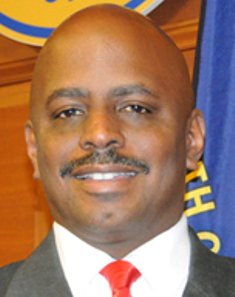
David James is a longtime Louisville Metro councilman who became president this year. We talked about an odd twist to the oath of office, how council members spend money in meetings, and about the sexual harassment proceedings against a former councilman.
—
Q: On January 11 you became the new council president. And I hope you’ll forgive me when I say that the more interesting part of that meeting was when your clerk was sworn in a few minutes later. This was part of the oath:
Do you further solemnly affirm that since the adoption of the present constitution, you have not fought a duel with deadly weapons, nor have you sent or accepted a challenge to fight a duel with deadly weapons, nor have you acted as a second in carrying a challenge?
How big of a problem is dueling in Kentucky that it has to be part of the oath?
A: Apparently back in the day it was a huge problem in the state of Kentucky and they have left that as part of the oath that everybody takes throughout the state, I guess for historical and cultural purposes.
Q: You used to be a police officer. How many times would you break up a duel by saying, “hey. Hey! If you don’t cut it out, you’ll never be sworn in as a municipal officer!”
A: It never happened! I don’t think anybody would listen to me anyway.
Q: We could talk about dueling all day, but this program is about city council meetings. The Louisville Metro council is a smorgasbord of intrigue that makes the Minneapolis city council look like the Branson board of aldermen! Can you explain what “neighborhood development funds” are?
A: Each council member receives $75,000 a year in neighborhood development funds that they get to assign for different purposes. Whether that is to help a nonprofit, or if that’s to put in lighting in a railroad underpass, or if that’s to fund some other organization doing good work in the community.
Louisville, KY Council President David James
Q: So if you had an organization that, say, produced quality audio content about city council meetings and they wanted to apply, and there was a council member or even council president who supported that cause, how would I–I mean, that organization, get some of that easy cash–I mean, neighborhood development money?
A: You apply for the grant. You have to list your board members and what you’re going to do with the funding. And it’d be up to the council member to introduce it and council would vote on it yes or no.
Q: In the meetings, when council members distribute money through NDFs, it’s like a slowed-down version of an auction. Is it that spontaneous when it happens in a meeting?
A: People have already signed on for X number of dollars by the time it gets to that point. They come to the council meeting as a last opportunity to join in on that. Once we have voted on it, you can’t add any more money to it. It’s the last opportunity.
Q: It’s like going door to door as a Girl Scout selling cookies, and your mom just gets the rest of the orders at her office that day to backfill it.
A: That’s it. There you go.
Q: There is this overtone of salesmanship in these NDFs and it can take the form of guilting people into spending money.
A: Oh, absolutely.
Q: I get that this is politics and you have to be a bit of a cheerleader, but does any of this seem more theatrical than it needs to be?
A: No, not really. You’re just advocating for the particular cause that you believe in.
Follow Council President David James on Twitter: @CouncilmanJames
It’s a holiday, so enjoy your day off and remember to thank your city council members. We will be back on Wednesday with a new podcast interview. But in the meantime–hey, did you read EVERY council meeting review in December? Including the one with the border wall around the city council?
If not, you can do your part to Make America Great Again by browsing the month in review. And as always, you can listen to the regular and bonus podcast episodes (22 in all) on iTunes, Stitcher, and Player FM.
UPDATE: You can now listen to a dramatic reading of this review on iTunes, Stitcher, Player FM and right here:
What do you do when a council meeting is so emotional–so raw–that it makes the winter a little colder, the night a little darker, and the world a little more vulnerable?
The Louisville Metro Council was a sight to behold: 26 people. Young and old. Black and white. Thick Kentucky accents and thicker Kentucky accents. David Yates, the youthful council president with hair slicker than a mint julep at sunrise, stared icily at the overflowing chamber.
“For those that are addressing the landmark designation of Tremont Drive, the council will not accept any further testimony. ANY attempts by ANYONE will be ruled out of order,” he warned with the gravity of a doctor breaking the news about your husband’s coma.
“Mr. Clerk, would you please bring up our first speaker?”
An older man with a white goatee lumbered to the podium. If you took all of my college professors and mashed them into one person, this would be the dude.
“I am new to the city, having moved here a year ago,” he began casually. “Tonight, I urge the council to delay the granting of a demolition permit for the Powell/Smith House for a couple of reasons. Delaying–”
President Yates sharply cut him off.
“Excuse me. Did you–” he sounded incredulous. “I JUST had to read that we are not to address the landmarks decision. We cannot hear ANY information relating to the landmark.”
The man looked hurt. “Can I continue if I do not?”
The president softened. “If you do not.”
The man adjusted his glasses and stared down at his papers. He paused. “Another reason for delaying the decision on the Powell/Smith House is to allow time to fully document–” home boy picked up exactly where he left off!
Two men behind him covered their mouths stifling laughter. Even his own lips creeped upward into a grin as he shamelessly trolled the council.
Well played
President Yates was enraged. He slammed the gavel on his desk. The man looked up.
“I’m done?” the man asked innocently.
Yes, yes he was. His heart was in the right place. But his mouth was not.
As the chamber settled down, Council Member Robin Engel took to the microphone with bittersweet news.
“After 27 years of service, Monica Hodge will be retiring from Metro government,” he beamed at the woman standing to his right. He leaned into the podium and suddenly took on the role of emcee in a “This Is Your Life” trip down memory lane. He waved over Kentucky political titan Rebecca Jackson, who strode to the microphone with an air of confidence.
She grasped Hodge’s hand. “If I reached out my hand and said, ‘come pray with me,’ Monica would come pray with me. We saw a lot of those prayers answered, including those prayers for her health and those prayers for our crazy husbands who never knew where we were. Monica, we love you.” The two women embraced and the chamber erupted in applause and laughter.
But the eulogy wasn’t over yet. Council Member Engel gestured to the ample man with the broad shoulders and a bright tie. “Pastor Hodge?”
“Oh, good evening!” the pastor bellowed with a wide grin. “Let’s take up an offering, that’s what I say! Ha ha ha!” The audience went wild.
Can I get an Amen?
“I love my wife. And what you see here is what you see at home. I’ve gone through a lot. Open heart surgery. I do dialysis. But–” his voice quaked and he blinked back tears. His voice became high and tiny. “But I stand here today because I have someone who stands with me. An amazing lady. Your loss is my gain.”
All around him, heads nodded like a Sunday sermon. “Thank you.”
Finally, Hodge stepped forward to a 15-second standing ovation. “I want to give thanks first of all to the lord because ten years ago I didn’t know if I would be standing here tonight, struggling to to get through a day of chemo.” Her husband, the pastor, wiped his eyes.
“Enjoy every tomorrow that you’ve got because you don’t know what life is gonna bring you. You’ve all blessed my life in some way. I thank you for that.”
As Hodge and her entourage cleared the chamber, there was one piece of lingering business that, unpleasant as it was, had to be done.
“We are reviewing the landmarks designation,” President Yates announced heavily. “The commission voted to landmark. The committee voted to overturn. The resolution is now before the full council.”
The lone man wishing to speak was Council Member Tom Owens and he had one heartfelt plea: save this house.
“There is a certain innocence, I think, that we all share. And this innocence is that the landmarking process ought to be without rancor. But the truth of the matter is,” he spoke carefully and quietly, like a tired old lawyer begging the jury not to sentence his client to death, “the truth of the matter is when it comes to the old farmhouse in your subdivision, or in your neighborhood, there is going to be some desire to see that old house” saved.
“Don’t make me chain myself to this house.”
With dark circles under his eyes, he hunched down in his chair. “Our decision to overturn the Landmarks Commission will, in all likelihood, bring the wrecking ball to that” 145-year old house. “Thank you, colleagues.”
No one else came to his defense. Owens and two others voted to save the house. Twenty-two council members voted to destroy it.
In one night, the city lost a valued employee and a valued home. Such is life in the hollers of Kentucky.




 City Council Chronicles