Somewhere out there, a city council meeting is happening. And you're not watching it. But I am. Each week, I bring you the highlights, lowlights, and weirdlights from places you don't live.
This past year, I had an AMAZING experience. I visited 12 cities and towns across North America for the “Best Thing, Worst Thing” project. The idea was simple: see as much of the city as I could, talk to as many people as I could, and ask them all the same two questions.
What is the best thing about this place?
What is the worst thing about this place?
Answering those questions can be surprisingly difficult, but it was important for me to hear about individuals’ values and experiences with their communities. I learned that a small city in conservative western Kansas thinks of itself as “progressive.” I learned that diversity in Toronto is much heralded, but also has a dark side. And I was present for a medical emergency in the desert outside Las Cruces, New Mexico.
Butter tart bake-off in Toronto, ON
The goal was to find out what cities are doing well to make their communities livable for residents. Then, to find out what people want that their cities aren’t providing now.
You can listen to all 12 episodes on the project page. And this week, I bring you the highlights in a special audio episode about the best of the “Best Thing, Worst Thing.” This “best of” is available on iTunes, Stitcher, Player FM and right here:
Robotics camp in Pittsburgh, PA
If you liked what you heard, please give the podcast a five-star rating on iTunes and like our Facebook page. There are other big projects in the works, so keep checking back!
“In the interest of brevity, I’ll try to keep it as short and concise as possible,” city attorney Jason Meyers promised. I was skeptical. No lawyer can resist the allure of long, drawn-out soliloquies–and that was exactly what council members would get here.
However, I immediately became less concerned about the length of the monologue and more concerned about the dire situation erupting in Fort Morgan.
“Every year the state legislature passes another set of bills that restricts the ability of the municipal court to operate,” Meyers began solemnly. “More recent changes have stated that if anybody is in custody on a jailable offense, regardless of whether they’re indigent, they have to have a court-appointed attorney available at the time they’re talking to a judge.”
Seems reasonable enough, yes? Right to counsel. Habeas corpus. Gluteus maximus. The bedrock of our country!
“How do we have a court-appointed attorney available every Wednesday, whether we have cases?” Meyers asked rhetorically. “We’re paying an attorney to sit there just in case.”
Ah yes, the other bedrock of our country: money. But listen, buddy, if you knew this was gonna cause problems, you should have said something about it earlier.
“I did go to the legislature two years ago and testify,” explained Meyers. “I got grilled for about 30 minutes. It felt like hours. In essence, they don’t care about the rural communities. This is the result.”
I care about you.
The council listened stoically to the scenario. I am sure this can be resolved without drastic measures.
“We removed jail as an option for most municipal court violations. You can still be written into municipal court for assault and disorderly [conduct] and resisting arrest. We just can’t put you in jail for it anymore if this passes,” he concluded.
“This” being the following proposal from Mayor Pro Tem Lisa Northrup: “I would offer a resolution eliminating jail as a possible penalty in Fort Morgan municipal court cases and request to schedule a public hearing.”
Mayor Ron Shaver waited a beat. “Roll call.”
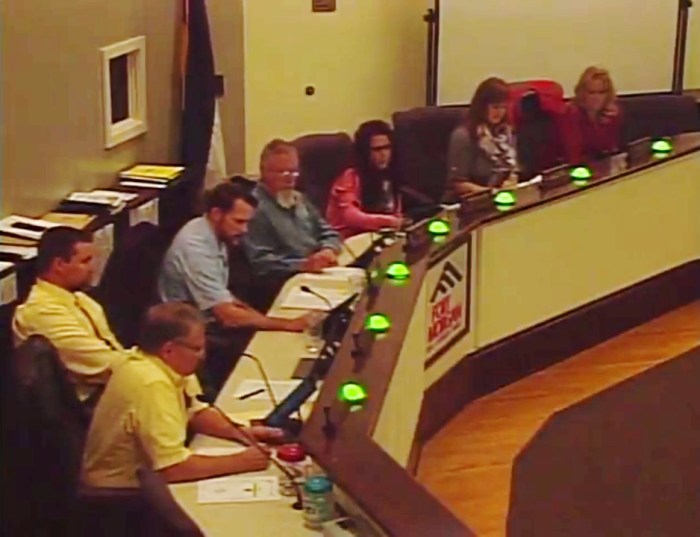
A string of lighted domes blazed green in front of council members as everyone voted yes. Let that be a lesson: if you’re looking for a place to resist arrest for being disorderly, Eastern Colorado is the promise land.
Ooh…the orbs!
There was little time to dwell on the fate of the jail or ponder the imminence of anarchy. Winter was fast approaching and Fort Morgan had a reputation to uphold:
“When people ask, ‘why are we the Christmas Capital of the Plains,’ it’s because we do more in the four weeks before Christmas than any other community in Colorado,” city manager Jeffrey Wells bragged to the council–and, technically, to any other council in earshot.
“I would tell anybody to try and take us on,” he challenged brazenly.
“You may have seen in the paper,” Wells continued, “that our very own [Director of Public Works] Steve Glammeyer was awarded the–”
He halted in search of the name.
“William E. Korbitz!” yelled someone from the side.
“–the William E. Korbitz Award with the Colorado Chapter of the American Public Works Association,” recovered Wells. “So thanks a lot, Steve.”
Hell yes, Steve.
The room broke into applause and Wells grinned fiendishly. “He HATES it when we do this.”
“Do it again!” someone hollered. A second round of applause and whoops thundered down for Steve. Luckily, they could get as disorderly as they wanted–it’s not like they’ll go to jail.
Michael Qaqish is in his first term on the Ottawa city council and we had a lot to talk about: his appearances on the “Man Panel” and “Fun Friday,” but also his thoughts on bilingualism, distractions, and protesters in the council chamber.
—
Q: Do you know when you are on camera in the meetings and think about how to come across best on TV?
A: Yeah, it’s funny because I sit on the left side of the table. The camera is usually in my left corner so I never get picked up. I don’t get much on the camera, but we’re all sort of aware. I’ve also had photos snapped of me at committee or council where I didn’t realize they were, so sometimes we’re not necessarily staring at the media.
Q: In the U.S. there are certainly politicians who are obsessed with their image, watching hours of cable news while sitting in the White House (not naming names). Do you ever go back and look at council meeting videos or media coverage of yourself?
A: I want to learn from what I see: am I doing it right? Do I look okay? Do I speak fast, slow? So whenever I do an interview I try to catch it and improve. Do I watch council videos? No, I don’t! [Laughs]
Q: What behavior do you sometimes see in council meetings that grinds your gears?
A: One of the things I don’t like is when people around the table or in the audience start talking and–especially when somebody says something and they don’t agree with it–they start, “ugh!” or making noises and starting to have side conversations. Whenever I have an opportunity to raise it with a chair of a committee or someone else, I do take the opportunity to raise that.
Ottawa, ON Councilor Michael Qaqish
Q: I noticed something that disturbed me: your councilors sometimes speak in English one minute and then in French the next. Please explain to me–IN FRENCH–why you guys can’t pick a language!
A: [Laughs] Well, my French is not as advanced as some of my other colleagues. We have a couple of Franco-Ontario colleagues. I was taking French classes and I took a break in the summer. Bilingualism is part of our culture.
Q: Do you think the councilors who switch to French know they’re doing that? Does it serve a purpose?
A: Some of the councilors are French. Councilor [Mathieu] Fleury has a lot of [constituents] whose first language would be French. For some of them it’s a personal thing because they want to maintain the langauge. But for some of them it’s to let their residents know–who are predominantly French–that they are asking questions in French as well.
Q: In the meeting of April 13, 2016, there was a lengthy discussion about how to regulate Uber. But one angry taxi driver stood up and yelled at you all for nearly two minutes. Do you guys have security there?
A: We do have security. Those situations are always tricky because on the one hand, you don’t want to create a scene. But give them a couple of minutes to vent and it’s done. He wanted to get something off his chest and he did. I think it’s okay for people to vent. We didn’t need security–the people around him were telling him to calm down.
“It’s encouraging,” Mayor Vern Rasmussen, Jr. quipped after the Pledge of Allegiance, “to not see anybody kneel down tonight.”
That topical humor prompted guffaws from the audience. But faster than you could say “land of the free,” he reached for his proclamation on the splash pad community celebration.
“I think we have a little presentation,” he glanced toward the proud line of ladies responsible for this aquatic masterpiece.
Suddenly, city manager Chad Adams jumped in with a message: stall.
“My computer’s still configuring. If you want to do the check presentation?” he said with a frown.
One woman in a flowing sweater approached the mayor. “This is a check to the splash pad for $28,000,” she announced.
Do spend it in one place.
Much to my chagrin, the check was not the gigantic, Publisher’s Clearing House-sized prop. Rather, a normal, deposit-ready slip that was quick to hand over.
Too quick.
“The slides aren’t coming up yet,” said Adams in exasperation. “Do you want to just talk about the fundraising?”
Another woman stepped to the podium and revealed the eye-popping total: “the fundraising cash value is approximately $152,000.”
But before you call that a lot of money, the economic development director stepped forward to provide the play-by-play on a major deal that had Albert Leans abuzz.
“In January, we signed a nondisclosure agreement so we could start working with the client,” he recalled mysteriously, only disclosing that Client X was seeking a “distribution center.”
Blink once if it’s Amazon.
“In February, a contingency of us went to Saint Paul and pitched to the company,” he continued. Their response? Thanks, but no thanks.
However, “we submitted a revised proposal. The company was impressed and got us back into the running. We were in the final three.”
He braced himself on the podium to conclude with what councilors unfortunately knew already.
“It came down to Austin [Minnesota] as the preferred site and Albert Lea being runner-up. All of us are disappointed. The number one thing we’ve been hearing is we need to provide tax breaks and incentives.”
He looked slightly annoyed as he dismissed the naysayers. “We provided a VERY robust incentive package. We were gonna do water and sewer extensions. Cash. Waive permit and review fees. Tens of millions of dollars.”
Wow. Mister, if you’ve still got those tens of millions ready to go, I’m happy to locate the first-ever City Council Chronicles distribution center in Albert Lea. My only other requirement is a nearby splash pad, which–hey! You’ve got it!
I could store SO MANY city council meeting reviews here.
But the director had one more point to make–apparently on the heels of some tumult in the community. “The negativity behind the scenes online…people see that. Be careful what you put out there.”
Councilor Jason Howland was still devastated and turned to the hotshot state executive in the audience. “Any idea why Austin ended up being chosen?”
The man shuffled to the microphone with his hand in his pocket. “Anything I state at this point is speculation,” he prefaced. “The site in Austin has great visibility from the interstate. Folks put value on getting that free advertising.”
(Again, City Council Chronicles has no such demand. Only tens of millions of dollars in cash.)
“I just want to show you a couple of photos,” broke in the city manager, who at last got the splash pad slideshow functioning. It was a nice reminder to be thankful for what the city does have.
Jennette Arnold is a Labour Party Assembly Member who has been chair for several terms. We discussed how London Assembly meetings are radically different from U.S. city council meetings–plus some juicy stories about former Mayor Boris Johnson.
—
Q: Madam Chair, I see you are an Officer of the Most Excellent Order of the British Empire.
A: I am.
Q: So, “Most Excellent Order”…are you a knight?
A: [Laughs] Only an American would ask that question! Knights are men and the equivalent of a knight would be a baroness and I’m not that. I’m just straightforward Jennette Arnold, OBE.
Q: Gotcha. In the U.S., most city council meetings cover things like zoning, passing laws, and honoring groups in the community. What is the primary function of your assembly meetings?
A: Our governmental structures are very different. The main power that we have is whatever the mayor does, we have the power to call him in front of us so that he can give an account to Londoners through our questioning….Scrutiny is relevant, it’s informed, and you can bring it alive by using case study and evidence from Londoners.
Q: What do assembly members get out of the questioning and what does the mayor get out of it?
A: I think there is something about the political exchange that is adversarial. I’m sitting in the chair aways thinking, “is this member going too far?” That’s in terms of inappropriate language, going outside the mayoral remit, getting personal. My job is to always be monitoring and when I see a member has just about reached the line, to come in and remind that member he has now stepped over the line.
London, UK Assembly Chair Jennette Arnold, OBE
Q: You had some tough questioning of previous Conservative Mayor Boris Johnson. But if a Conservative assembly member grilled your Labour Mayor, Sadiq Khan, and the crowd was cheering that member on, would you shut down that applause?
A: No, I wouldn’t. My job isn’t to stifle the feeling of the meeting. If you’re chairing a charged meeting, you have to be very careful in terms of the interventions. I don’t see it as my job to stop what I call that “energy,” which is a reflection of people’s feelings.
Q: Has a constituent ever come up to you after a meeting and said, “I saw what you did there and I like that you gave the mayor the business?”
A: I can refer you back to the applause in the chamber with the questioning I carried out of Boris Johnson. I remember a school closure. What this school was looking for was for their mayor to hear their case. A cross-section of the school came and I was speaking on their behalf. And I didn’t know that they brought a cake. [Johnson] was not listening. He was not making the proper responses for the young people.
Q: Hmm.
A: I said, “oh, come along. They brought a cake for you! Don’t be so mean!” Everybody laughed and he laughed and it took the heat out of the room. At the end of the meeting, I met the young people downstairs and he just happened to be passing. It was lovely to see the young people surrounded him and there was no getting away from them!
Follow Assembly Chair Jennette Arnold on Twitter: @JennetteArnold
Warning: if you are easily triggered by unrelenting happiness and optimism, proceed with caution.
“Wendy, thank you for 15 years of service,” city manager Erin Reynolds smiled warmly at the planning director while brandishing an award.
“Her husband is here tonight,” Reynolds stared out to the audience as a man lumbered forth. There were light giggles as he proceeded to pull the master-of-all husband moves: he stood beside her holding a bouquet of roses.
“He does the recording of our city council meetings, but he’s also her husband,” the city manager explained as councilors clumped together for a photo. Ah, yes: it’s fitting that the man thoughtful enough to bring flowers is also the unsung caretaker of the council feed.
SMOOOOOOOTH
As the husband took his place behind the camera (“nice flowers” someone grunted), he swung it to the projector screen on the wall.
“We’re about 500 people away from 5,000” likes on Facebook announced Reynolds, proudly scrolling through the city’s carefully-curated page.
“I’ve got a couple fun swag items for the 5,000th person,” she teased.
Folks, THIS IS NOT A DRILL. Get over here and claim. the. swag. Also, Florence? If this review gets you to 5,000, I expect commission. Just a water bottle, t-shirt, or a street named after me. Something easy.
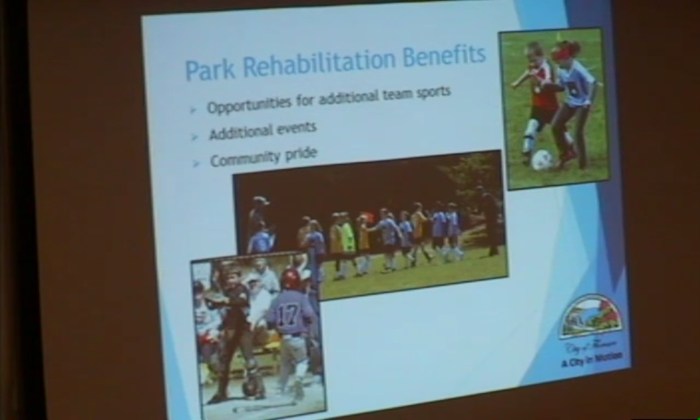
But the fun didn’t stop there: Miller Park is getting a facelift and the public works director was positively stoked.
“Miller Park’s a great facility. It just needs to be amped up.” He went all-in on the sell. “It’s a HUGE community destination. Regional draw!”
With glittering scenes of an urban utopia on the screen, he revealed the pièce de résistance. “With this new concession stand, if a group wants to come in and have a movie night, there’s a popcorn machine, soda machine.”
I now want my commission to be a popcorn machine. Love you, Florence.
After the whirlwind tour of Miller Park 2.0, the meeting turned to what could have been a sticky topic: the performance review of the municipal judge.
“How does it feel down there?” Reynolds joked as the judge slid behind a low table. He chuckled nervously in response. But it quickly became apparent that His Honor had zilch to worry about.
“It’s the recommendation,” disclosed Mayor Joe Henry, “to implement an increase to the monthly retainer of 2.8 percent.”
The pay raise sailed through. But just as quickly, another employee landed in the hot seat.
“We’ve heard a lot from Mike tonight,” Reynolds glanced at the public works director. “He has the challenge of being in the public eye. He does end up taking some heat that he doesn’t enjoy.”
There was nervous fidgeting. Where was she heading with this?
“I think you can all trust in the work that he does,” she pivoted. “So with that, happy birthday, Mike!”
There were several “ahhs” and boisterous applause as the tension dissipated.
“He didn’t know I was going to do that!” boasted Reynolds.
Quick, bring the roses!
From beneath her desk, she produced not a cake, but a hunk of wood in the shape of Oregon gifted to the city. She thrust it into the hands of Mayor Henry for a picture.
“If you crop it like this, you can get the detail,” Councilor Joshua Greene leaned over and gestured. Inspired, he jumped in front of the dais and held up his phone.
“There you go,” he clicked blissfully away. “One more.”
Flowers, a pay raise, birthday wishes, and the perfect picture. What more could you want from a city council meeting?*
Levon Manzie is a reverend by day who served on the school board and recently won his second term as the District 2 representative. He shares how he benefits from having prayer in the council meetings, plus his thoughts on rules and compassion. And be sure to listen to the audio–I give him some suggested catchphrases for District 2.
—
Q: Every Mobile city council meeting opens with a prayer. Whenever you give that prayer, how is it different from the prayer you write for Sunday morning?
A: To be honest, it isn’t that much different because I really don’t write it. When I’m called upon, I seek inspiration. At that moment before a council meeting, I wanted god to bless what we were voting on. What we were deliberating over touches the lives of [thousands of] individuals.
Q: Have you ever watched someone else give the prayer and thought, “oof, that’s a little heavy handed?”
A: That has not happened to my knowledge. The scheduler tries to have a variety of ministers offer the blessing. Now, there have been some I thought were too long!
Q: [Laughs] Would you ever begrudge someone who says, “this is a business meeting. I don’t think it’s appropriate to be praying.”
A: I wouldn’t begrudge someone. But for me, I think prayer is most appropriate. Just last week to the right of us, Hurricane Irma. To the left of us, Hurricane Harvey. So I’m not ashamed about being mindful that we’ve been blessed and it’s most appropriate to acknowledge that. Again, those are my personal views. I believe most persons would pray specific to the city of Mobile or a general prayer asking for guidance in a general sense.
Mobile, AL Council Member Levon Manzie
Q: You were on the school board before this. Is the difference between school board meetings and council meetings like the difference between the minor leagues and the major leagues? Or between decaf coffee and a shot of espresso? How would you compare them?
A: I think decaf and espresso would probably be the best analogy. On the school board we dealt with one overarching theme, which was providing quality education. Everything was judged off of that standard. Every contract. Every appointment. Every vacancy. Here in the city, it’s not as single-focused.
Q: How would you describe council President Gina Gregory’s style at running meetings?
A: You know, she’s a veteran. She’s compassionate, sometimes allowing individuals to go over the alloted time so they can completely finish their thought. But she’s also orderly. And when people go off topic or when they abuse their time, she knows how to be strict.
Q: So you’re saying that compassion and rule-bending are just as important in some situations as being strict and treating everyone the same in every circumstance.
A: Well, one hundred percent. You have to be as compassionate or as strict as the person will allow you to be. If you’ve got somebody who is causing a ruckus in the meeting, there isn’t any room for compassion. But if you’ve got an individual who is impassioned about changes that are proposed for his or her community and they’re about 90 percent from finishing a complete thought and they’ve followed the rules, it’s incumbent upon you to judiciously allow some rule-bending. And I think she’s mastered that.
Follow Council Member Levon Manzie on Twitter: @lcmanzie06
Benny Zhang graduated from the College of William & Mary last year–then started as a city council member one month later! We talk about his unique first meeting and his pre-council meeting ritual.
—
Q: Your swearing-in meeting happened a little differently than those of most city council members. You’re packed into the old courthouse and the town crier yells, “god save the king!” What did you think of that?
A: Being a history buff, I think that was entirely cool. Being the first Asian-American elected to that office, I felt a little bit out of place given where my heritage came from.
Q: Being in Williamsburg for college for four years and walking through Colonial Williamsburg, did that make you feel out of place? Or was it just this moment where you thought, “this is too much pageantry for me?”
A: I think it was just that incident. You also have to see the picture: there is a golden mace [and] the reenactor talks about how, in certain southern states, that mace signifies that there’s a session for the government. But also they’d use it as a drinking cup! I was very tempted to drink from that mace with some beer.
Q: You got onto the city council one month after graduating from William & Mary. Were you concerned that becoming a city council member so soon would impact your chances of moving back to your parents’ basement?
A: [Laughs] Not necessarily. My family invested in a home in Williamsburg, which gave me the ability to campaign as, “I am a Williamsburg resident who pays local taxes, receives city services, who also HAPPENS to be a William & Mary student.” I guess technically in this house, I am living in my parents’ basement–
Q: Is that where you’re talking to me from?
A: Yeah, we’re talking from my home base!
Q: I love how millennial-centric this podcast will be!
Williamsburg, VA Council Member Benny Zhang
Do you wish more students would show up at council meetings to rebut the complaints of residents?
A: Sure. Students comprise 43 percent of the city’s population. In public comment, it might seem totally one-sided. But not everyone that you wish was in the room are in the room.
Q: Was there any expectation that you would be the “students’ representative” on the council?
A: For me, definitely. I am that resident in Williamsburg and since I can empathize with other residents, I think they see me as more of a young professional.
Q: Have any of your friends who see you now in council meetings said, “Councilman Benny Zhang is different from the Benny Zhang we knew?”
A: Yeah, I think there is a degree of awe there. I will say, I have not changed my wallpaper on my iPhone–“never forget where you came from.” I’m just the same guy on that dais. I’m a little more serious because I have to. I got involved in city council [by] sitting in on meetings. I would go up the dais and say hi and bye to them. What I do now is I always arrive 30 minutes before a city council meeting and I go up to the audience before the meeting starts and try to shake everyone’s hand. That’s an interaction I wish I had when I was sitting in on council meetings.
Follow Council Member Benny Zhang on Twitter: @benming_zhang
There are a handful of things in this world that regularly get people’s blood pressure up. Fidget spinners. Avocado toast. Anything surnamed “Kardashian.”
But in Whitefish, the trigger word was “water.”
A citizen in a plaid shirt planted herself at the podium and gazed steely eyed at Public Works Director Craig Workman. “Are you thinking about implementing any of the new technology in wastewater treatment?” she inquired.
“Yes, we are,” he replied. “We’ve begun the design of the wastewater treatment plant upgrades.”
“Including metals and microbes?” she pressed the witness.
“Yeah, metals are one of the parameters–”
“Is that being inspected now?”
“Yes–”
“Are you adding more sensitivity?” she interrupted.
“Well, the detection is done at the laboratory–”
“Which is here?”
“It’s in Kalispell.”
She collected her notes and concluded the interrogation. “Thank you…for now.”
The prosecution rests
The mayor and council sat quietly during this aggressive questioning. A cheerful and somewhat nervous new resident smiled from behind the microphone.
“I’m a single mom of a three-year-old boy,” she greeted the council. “My first month, the water bill was fairly low. In June, my water bill was $100. In July, my water bill was $437.”
She turned to Workman and wondered, “do we really need all of these enhancements going into a water treatment plant?”
“I’ll allow this question,” Mayor John Muhlfeld firmly interjected. “Just for the audience, this isn’t an opportunity for Q&A between the public and our staff.”
Well, well, what a fine time to start enforcing the rules!
If you’re going to ask questions, go for the jugular right away.
A man in a t-shirt and shorts took his turn at the mic. In a slight British accent, he winced while calling attention to his casual attire. “I just want to apologize for my lack of professionalism.”
“I’m $200,” he referred to his own water bill. “I just can’t keep up. I don’t want to sound like a whiner, but my family is hurting. I have a family of five who shower once a day and I put pressure on the boys to take short showers.”
He grimaced deeply while staring down the bridge of his nose through glasses. “My lawn is brown. When I water the fruit trees, I feel guilty because I see money running into the ground. I’m hurting.”
Councilor Richard Hildner, himself touting a large family, smiled faintly. “I don’t know how you get around that other than you turn off the hot water and they get a cold shower!”
He added, as a glimpse into his own parenting style, “having had three teenagers at home all at once, I know what you’re up against.”
The hot water czar
At this point, Councilor Andy Feury glanced up from his computer. “I’ll save you a trip to visit Craig,” he hollered to the single mom who had spoken earlier.
“Your usage in June was 6,000 gallons. You used 32,000 gallons in July. And you don’t have a sprinkling meter, so you paid sewage charge on an additional 26,000 gallons of water. That’s why you went from $100 to $400.”
Wow, that was some speedy research! Now do me! How many gallons did I use?!
“I would like to see,” plaid-shirt-lady announced during a reappearance at the podium, “some pencil-and-erasure math on the operating costs. It’s the one area where maybe there could be some tightening of the margins.”
If by “tightening the margins” you mean “policing teenagers’ shower length”–tighten away.






 City Council Chronicles