Somewhere out there, a city council meeting is happening. And you're not watching it. But I am. Each week, I bring you the highlights, lowlights, and weirdlights from places you don't live.
Nothing seemed amiss at the start of the Beavercreek council meeting.
“This is the second reading of an ordinance making certain additions, deletions, and changes to various sections of the zoning code,” read the clerk.
“Is there anyone present tonight that would like to address council on this?” Mayor Bob Stone called to the audience as a balding man stepped forward.
“I didn’t catch this until today, but this thing is effective last week,” the man waved his paper in disbelief. “Did you all catch that?”
Super sleuth
People on the dais stared down at their copies while he added, “it says this ordinance shall take effect November 1. That’s last week.”
“It’s been a standard practice,” reassured city manager Pete Landrum. “We begin at the beginning of the month.”
“But let’s go by the city charter,” shot back the commenter. “City charter says 30 days after passage. NOT postdated. Change it.”
He again thrust the paper in the air. “This one is showing up as an ’emergency’ ordinance. That’s wrong. It’s not an ’emergency.’ Now let’s get into the meat of it–”
Mayor Stone halted him before the meat. “We’re not showing this as an emergency anywhere.”
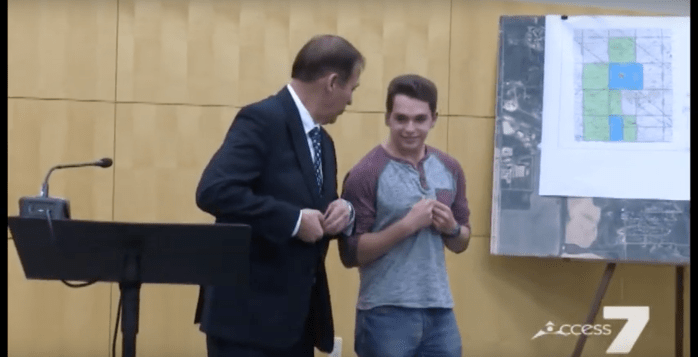
The man reached out holding his papers. “Can I approach?”
The prosecution came prepared
There was a small conference at the dais. “This is an emergency…effective immediately…” mumbled the mayor as he read off the page.
“That’s from the previous time,” explained the city manager, “but in the current packet–”
“No, that’s what I got off the website,” insisted the man.
More muttering about whose packet said what. Chaos was beginning to unfold. Luckily, the commenter cut off the crosstalk by getting back to his original point: this ordinance is awful.
“We have enough problem with our zoning code. This is a beautiful one,” he said sarcastically, donning his glasses and reading from the passage prohibiting trucks from parking in front of commercial buildings.
“Every business around has a truck! What have we done here?”
“Not at a business. [Parking] at a residence,” interrupted Mayor Stone.
“No, sir. Disagree,” retorted the man.
“Oh…” the mayor whispered as council members gently indicated that he was wrong and the commenter (again) knew the ordinance better than some.
The man closed in the plainest way possible. “This is a disaster waiting to happen. This is too much. Stop this tonight.”
With such an intense airing of grievances, eyes were on the mayor to clear the air and lighten the mood with his report.
“I know everybody else is gonna mention it too and I hope we all repeat it,” he grinned. “The girl’s soccer state champs–”
“And cross country,” interjected Council Member Julie Vann. “State champs! Yaaaay, women!”
Let’s-go la-dies. Clap. Clap. Clap-clap-clap.
“Are we gonna have enough sign space coming into the city” to list the new championships, mused the city manager.
Council Member Vann nodded. “The signs at the entryway of the city that have all the sports winnings on them–when we started that program, we didn’t expect it to be–”
“That good?” chuckled the manager.
“We were gonna post the teams within the last five years,” she explained. “We wanted to celebrate the recent ones but not every single one for eternity!”
“We will have to revisit that,” the city manager agreed, “because when we squeezed the boys’ [championship] the last time, it was like, okay, the next one we’re gonna have to have some decisions!”
I suppose this answers the question: is there such a thing as too much winning? When it comes to sign space, the answer is “yes.”
This past Tuesday was Election Day in the United States, which means there were plenty of city council races to keep track of. We provide you with some updates on a handful of city councils profiled on previous podcast episodes.
As always, the podcast’s sponsor is Dig Deep Research. They assist local governments in obtaining grant money and are eager to hear from potential new clients. Find out how they can help you today:
Things were looking optimistic for the developers of the quaintly-named Veronica Springs subdivision.
“I’m that odd-shaped square in the middle of this project,” the pastor of the Community Church of the Nazarene announced at the lectern while looking very pastoral in glasses and a sweater vest. “At first I wasn’t sure that I wanted 200 homes built around us like that.”
However, he continued, “we’re in support of it. We decided that it was a good thing for this community. Affordable housing is something we need, and we’ll try to be a good neighbor.”
It was a compelling endorsement to have the lord’s representative on the project’s side. But I wonder, could god possibly send a mixed message through another messenger?
“I ran across an interesting article on Cain and Abel,” began a white-haired man now standing at the microphone. “The practice in ancient time was the father left everything to the oldest son. The reason for that? So it didn’t constantly get subdivided. It would get to the point where people couldn’t sustain themselves on that little land. I think that’s a real important point to consider.”
Amen
It would be an important point if the future homeowners were grazing cattle and not driving down the road to the Walmart Supercenter for groceries. But there was a more insidious, moral implication to the subdivision.
“We have moved from a predominantly rural to a predominantly urban society,” he continued. “Like with the Tower of Babel, people were supposed to disperse and multiply and they tried to exalt themselves with the tower.”
“Well, there is the war, and the good and evil is done by self-centeredness. That’s what takes us away from god. Urban settings tend to push people toward the self-centeredness–”
“Thank you. We’re gonna stay on track with the public hearing,” Mayor Bobby Kilgore gently nudged the speaker away from the microphone at the end of his three rambling minutes. With no further communications from god, the council moved on.
“Here comes ducky,” council members heckled an employee as he approached the lectern. “Quack, quack!”
Is this hazing?
The man grinned at the apparent inside joke and proceeded. “We request that the industrial parks owned and developed by the city of Monroe be exempt from the ‘naming of public facilities and lands in recognition of individuals’ policy.”
He added, “the industrial park’s name is significant and needs to be really a brand, not attached to a person.”
“I don’t think it’s good to exclude us from naming,” countered Council Member Surluta Anthony.
“It’s not excluding you. You’re the naming entity.”
“We just don’t have a part in giving the suggestion of names?” she asked.
“You can,” was the reply. “The name can be whatever city council decides.”
Council Member Lynn Keziah was satisfied with this names-but-not-names suggestion. “Motion to approve the amendment to exempt city-owned industrial parks from the naming policy.”
“City Council Chronicles Industrial Park” is still on the table.
“This is only going to be for industrial parks?” Anthony clarified.
“What I just read,” Keziah replied resolutely.
In case anyone was not 100 percent clear on the new policy, they would have to figure it out on their own time because the council promptly approved it and breezed on to more important matters.
“Thanksgiving is coming up. We give our employees Thursday and Friday,” pointed out Keziah. “I think we should give them Wednesday. Traveling time to get to where they’re going.”
“They’re already smiling in the audience!” Mayor Kilgore exclaimed. The employees had good reason to, for the council voted to make the five-day weekend a reality.
Anne Watson is a high school teacher and first-term mayor who made a few tweaks to the council meetings when she took the gavel this year. She explains why high school students come into the council chamber regularly and we discuss a contentious meeting about a vacancy this spring.
—
Q: I noticed that your council does not say the Pledge of Allegiance in your meetings. Mayor Watson, simple question: how dare you?
A: You know, I think it’s sort of assumed that we’re all on board with loving America. So we just use our time well and want to just keep moving forward!
Q: Please tell me that you at least have Judeo-Christian prayer before the meetings.
A: No, we don’t pray before the meetings either!
Q: Oh, my god. If the French Canadians want to invade you people, I could care less at this point. I notice that you have been cursed with a finicky sound system. What is the problem with the microphones in your council chamber?
A: The microphones were a little bit far away from the edge of the desks and so for a long time, we had to lean over the desks to get close enough to actually be heard. We could look into getting some better mics that might actually pick us up, but they were just recently moved to be closer. And actually, since that meeting happened, we’ve had some better sound.
Q: I want to talk about some of the aspects of the meetings that changed since you became mayor earlier this year. Do I understand that you instituted a two-minute limit on public comment?
A: That’s correct. We actually have a card that one of our councilors holds up. The one side says you’ve got one minute left and the other side says you’ve got to stop.
Q: I love low-tech solutions. Perhaps for the sound system you could just roll up a piece of paper and talk through it like a megaphone instead!
A: There we go!
Montpelier, VT Mayor Anne Watson
Q: Is there now in your council chamber a white board with future agenda items?
A: There is an agenda board and that was something that I asked for. I think it’s really helpful for planning our time. When we’re in the council meetings and we’re thinking about if we are going to table this topic or somebody raises an issue that’s worth talking about further, then we can right there have a visual representation of when it might fit in our future agendas.
Q: Tell me about the kids who come into your meetings to drop policy on you.
A: So every year, there’s a class at the high school that does a project around civics and whatever topics are going on in the city. They come to the council and make a pitch. There was one we had about possibly banning plastic bags in the city of Montpelier. We have an item on the ballot on November 6 coming up as to whether we should be asking the legislature for permission to enact some kind of ban on plastic bags. The kids were definitely a part of that.
Q: You are actually a teacher at the high school there. If a student said to you, “Ms. Watson, I didn’t do my homework for your class because I was working on my policy project for the city council,” would you be mad?
A: Oh, of course I would! Well, I probably wouldn’t be mad, but I would probably say something like, “listen, you need to manage your time.”
Jyoti Gondek is a first-term councillor in Calgary, where the discussion has recently turned to council transparency. She explains how it is sometimes necessary to go into closed-door meetings, and responds to the accusation that bullying is occurring therein.
—
Q: What is your position on city councillors’ attendance?
A: We had one of our fellow councillors raise the point that we should be better documenting when council members are present for a vote or for a meeting. I don’t disagree that it is important that your elected official is weighing in on your behalf. But the way that it was being proposed–through a roll call–to me was a bit ridiculous. There was an article written in a local newspaper about it and it called me out for being terribly nasty and not in favor of transparency. So I took a lighthearted approach and wrote a little something myself about what an “awful person” I was for not wanting transparency! It was a bit of a parody, but it was asking people to think about: do you just want a roll call? Or do you really want to know what kind of job your elected official is doing?
Q: I’m between your position and the more transparent position on attendance. Say you are able to keep track of councillors who wander out of a meeting, who are not there for votes, and who are strategic about when they are in their chairs. What am I supposed to do with that information? I’m not saying, “who cares about attendance?” But if I did care, is this a problem that’s actually affecting things?
A: Attendance has been exceptionally high. We have not seen council members who are trying to use the system and leave for a contentious vote. I don’t think the system is being gamed.
Q: Your council has had some drama about what happens behind closed doors generally. On April 3, Councillor Jeromy Farkas tweeted out:
While sometimes they are warranted, these secret meetings have also been abused and misused to instill fear, intimidate, and shut down new ideas. I am very pleased that Councillor @peterdemong is helping to tackle this issue. #yyccc 2/
Of the charges in that tweet, what percentage are true? What percentage are false? And what percentage are maybe just misinterpretations of people’s intentions?
A: I think it was an interesting thing to post on Twitter rather than bringing it up in a council meeting or to the integrity commissioner or to the mayor. Intimidation is a very big reach. I’ve never felt that way. This idea of secret meetings–or the “chamber of secrets” as it’s been dubbed by Councillor Farkas–perhaps he is learning the ropes. Sometimes a council has to take things offline because there’s confidential information.
Calgary, AB Councillor Jyoti Gondek
Q: On April 5, there was a motion to study the amount of time Calgary spends on closed session meetings. But all of a sudden, Councillor Jeff Davison stood up and expressed his displeasure at those tweets, then apologized for any offense he may have caused. When that happened, did you think, “oh, good! This will clear everything up!”
A: [laughs] No, I did not. Before we go in [to the closed meetings], it’s clearly identified what we are going to talk about. This idea of saying we’re going in camera [closed session] to insult a colleague or intimidate them, it’s not a fact. Now you’ve got a council that’s second guessing, “did we ever say anything that may have been construed in a manner other than what we intended?” If this is a big gang of bullies ganging up on one person, I think you would’ve seen more people actively doing something a lot less public, but we’re not. I think we were caught by surprise. I never expected him to say something about intimidating and bullying because I haven’t observed it.
Follow Councillor Jyoti Gondek on Twitter: @JyotiGondek
Even though Thornton gets rid of its council meeting videos (boo), there was still a lot of ground to cover with two-term Mayor Heidi Williams. She discussed difficult public hearings, titular protocol, and her frequent public commenters.
—
Q: Your Honor, the city of Thornton video streams its council meetings–which is good! And they are even in high definition with remarkable sound quality. So that is even better. The problem is: you only have videos posted for the last year. And I was told that Thornton takes down and destroys videos older than one year! Now look, we all made questionable fashion choices in the mid 2010s. Short shorts. Mom jeans. White people dreadlocks. So if that’s what this is about, I’m empathetic. But Mayor, when it comes to those videos, how do you defend what I am calling the Great Thornton Purge?
A: Well, I have to be honest: this is the first time I’ve heard of that. I did not realize that we took those videos down and destroyed them. So I will be getting to the bottom of that. I really thought that you could go back and watch videos a long time back.
Q: I am glad you are on the case. I take it from your answer that you don’t often watch videos of the council meetings after they happen. Is that accurate?
A: Oftentimes, I don’t want to actually relive it. The times that I’ve gone back and watched a portion of a meeting is because I thought maybe I said something really stupid. And generally I find that I either did or it wasn’t as bad as I thought. I think it’s a little narcissistic–again, I’m already there. But having said that, I understand how a lot of people aren’t there. And constituents are like, “oh, we watch you on channel 8 or we watch you online!” And I’m like, “you do?!” It’s always surprising to me that people do.
Q: Well, it’s all the more frustrating to me that I can only watch 52 weeks’ worth of meetings! I noticed that you don’t often miss meetings, which is admirable. But whenever you are gone and the mayor pro tem is in charge, everyone calls the mayor pro tem “Your Honor.” That title is reserved for you! Have you ever told your mayors pro tem to get back in their place–or do you want me to do that for you right now?
Thornton, CO Mayor Heidi Williams
A: In Thornton, all the elected officials are considered “The Honorable.” So actually, everybody that serves on council with me is “Your Honor.” I only missed two meetings the first six years. But the city manager called the mayor pro tem at the time “mayor” and somebody texted me right away. Apparently, that’s what they used to do. They don’t do that anymore, but they will say “Your Honor.”
Q: On March 20, there was an extended stay hotel proposed in Thornton. This council meeting was to approve it or reject it. Hearing people in the public hearing talk about “this type” of hotel and how “no college educated” people would stay there, and talking about how transient families would send their kids to school and “use our resources,” I felt uncomfortable with how people were resorting to elitist arguments when they really didn’t have to. Did that cross your mind at the time?
A: Sure, it’s always tough when a developer wants to put something in that people don’t want–the NIMBY effect. I’ve heard probably worse than that. That was a difficult hearing.
Q: You also had crowded meetings about marijuana stores, and I’m sure people were making arguments about destroying the city or letting in the “wrong type” of people or threatening children. Does it concern you when people make it seem that with one vote, your council will do all of those things to the city?
A: Yeah, and the longer I’m the mayor, I’ve just seen so much of that. That would probably be one of my most frustrating things. Everybody’s like, “not in my backyard.” As a society, we have to start being more thoughtful and less hateful. And try to talk to our council members about what we want and don’t want, but in a way that’s not demeaning or hateful. I’ve just seen in the last couple of years a lot more hateful stuff being said. Not tons, but a lot more than I did.
Follow Mayor Heidi Williams on Twitter: @mayorheidi
That’s all pretty heavy. But on the lighter side, we also looked back to International #CityHallSelfie Day and received a final judgment about who took the best city council selfie.
Jerod MacDonald-Evoy is a reporter with The Arizona Republic who had a front-row seat to many hot-button debates of the Tempe council. From the border wall to a car wash, he explains how things got heated in the desert. Plus, we talk city council fashion!
—
Q: Can you please explain what the “Tempe Tie” is?
A: So when I was covering Tempe, I found that Tempe has an online store where you can buy all sorts of interesting little merchandise like a city of Tempe pen or a mug. I noticed they also had this tie. One of those fatter-style ties. It had a bunch of Tempe themes on it. I jokingly tweeted [that] if it got 100 retweets, I would wear it to the next council meeting.
Q: And…?
A: And as I should’ve known, you don’t challenge the Internet to those sorts of things. It quickly got over 100 retweets. I bought the tie and ended up wearing it to a few council meetings. I made some other people realize that they wanted that tie and they ended up selling out of them on the store!
— Jerod MacDonald-Evoy (@JerodMacEvoy) April 2, 2018
Q: Let’s get into the council meetings. In January of this year, the Tempe council was considering a resolution to oppose a wall on the border with Mexico. There were some reasoned arguments about it, and those reasoned arguments lasted until one lady began yelling her comments from the back, which flustered your mayor into opening public comment. Were you expecting him to do that–and do you think that was a good idea?
A: I was expecting him to tell them, “you can have public comment at the end.” I’ve never seen the council open an item that was closed to public hearing. I was very nervous when he decided to do that because some of the women that were there had also been outside and were pretty vocally protesting this border wall resolution. I had a feeling it would only go downhill from there.
Q: Your nervous instincts were correct. Do you get the sense that council members were expecting the comments that ensued–the Trump defenders, the race war advocates, and the references to immigrants as rapists and murders?
Tempe, AZ reporter Jerod MacDonald-Evoy
A: I don’t think they were expecting it to the extent that it came. A lot of the people weren’t actually from Tempe. A lot of them drove up from the border to talk about this. The resolution they were trying to pass actually was a more gutted version of a resolution that was being pushed nationwide by a lot of cities that would say they wouldn’t do business with companies that work on the border wall. Well, one of the main companies that’s doing the prototypes is a Tempe company. When it didn’t pass, I was very surprised. It seemed very odd that they would give in to–I don’t know if they were giving in to these people exactly, but giving in to that idea that they shouldn’t be doing it.
Q: Do you think the public comment ended up making a difference for any of those council members?
A: I think it could’ve. I think there were a few that were already a little wary because of that idea of the city intruding into federal matters. Having those people show up was enough of a push to get them to not vote that way. It was during an election cycle. They decided they didn’t want to push the controversy and have the attack ad against them say they opposed the border wall and the president.
Follow Jerod MacDonald-Evoy on Twitter: @JerodMacEvoy










 City Council Chronicles