#179: Clawson, MI 12/18/18

It was the type of announcement that separates the city councils who take the winter holidays seriously from those who are, well, Scrooges.

“Every year we have beautification awards,” explained a representative from the Parks and Recreation Department. “People can call in houses they see around town that they really like the way they’re decorated.”

She added, “our Parks and Rec Advisory Board also goes out and are each assigned a section of town. They kind of score all the houses. The top five point-getters were the ones we give awards to tonight.”

With that, the five chosen families strolled to the front of the chamber for a photo. Many of them sported some type of seasonal attire–from the more discreet Santa pin and St. Nick hat to the more flashy necklace of Christmas lights and festive sweaters.

Screen Shot 2018-12-19 at 5.34.38 PM.png
The decorators

If you were expecting this Yuletide cheer to be followed by three French hens, two turtle doves, or even six geese a-laying, city attorney Jon Kingsepp disappointed you–but only slightly–by talking instead about backyard chickens.

“Fifty years ago, they were barnyard animals. Dinner table items. That’s no longer the case,” he explained.

“Chickens are great in most cases, unless you’re a neighbor that doesn’t want chickens next door to you,” Mayor Debbie Wooley observed dryly.

Kingsepp sighed. “There are two ways to look at that. There’s one that can say, ‘I don’t like chickens next to me because they’re loud and they’re gonna attract vermin.’ The other approach is, ‘if you like cats and dogs next door, then what is the difference with chickens?’ The noise level of a chicken is extremely low.”

“I want zero” chickens, shot back Council Member Paula Millan. “Not because I don’t like people’s chickens but because I don’t want them in my backyard. I just don’t.”

Screen Shot 2018-12-19 at 9.20.06 PM.png
Beware the Butcher of Clawson

She paused. Although her reaction was intense, it was not, in fact, poultryphobic. “I don’t think it’s the animal that’s really the problem,” she admitted. “I would assume it’s most likely the owner. If you have a neighbor that cares only about themselves and not the people around them, there’s an issue.”

A woman in the front row seized on a lull in the discussion and launched into a tutorial on chicken care. Rather than cut her off, surprisingly, the mayor allowed a microphone to be passed down.

“Great pets,” she boasted of her own chickens. “No one ever knew we had ’em. My aviary was spotless. The rats cannot get into it.

“There are rats in our neighborhood. A lot of ’em. But they never came for my chickens.”

A posse of women from the earlier home decorating contest were sitting two rows back in their Christmas sweaters nodding vigorously.

“My grandchildren–24 grandchildren–played with those chickens like a puppy. They were very sweet,” she argued, while one of those 24 grandchildren slumped in his chair next to her asleep.

Screen Shot 2018-12-19 at 9.31.27 PM.png
Dreaming of poultry playtime at grandma’s

Chickens may have been quiet and kind. Heck, they could have been the cure to cancer. But Council Member Millan was immovable.

“Some of my neighbors have been on our block since they built their homes in 1967. They don’t want chickens in their backyard,” she insisted. “Their perception is not that they are pets.

“It’s not against the animal. It’s about, ‘I moved to a city. Didn’t move to a farm. Where’s it gonna end?'”

She shrugged. “We have to address the ‘where’s it gonna end’ thing.”

Perhaps next year, Clawsonians can decorate an aviary and win the beautification contest. Then people might realize that chickens can be family, not food.

#178: Marion, IL 12/10/18

While the Marion city council undoubtedly gets points for its assortment of dais decorations–including flower pots, a wall portrait, and a giant construction-style sign–the real focus was off-camera.

“We have a great big group here tonight,” observed Mayor Anthony Rinella as his eyes darted across the audience, “and we have a spokesman for that group. Would you come forward and tell us what you guys are here for?”

A teenager wearing a baseball cap and camouflage sweatshirt popped up at the microphone. “We’re here for our civics class. We have a service learning project and coming to a meeting like this is one of the requirements.”

“Okay,” responded the mayor. “Who’s your teacher?”

“Mr. Martin.”

“Coach Martin. How come he’s not here?”

“Good question,” the teenager answered uncomfortably. “I’ll have to ask.”

“Ask him tomorrow. I mean, does he not have to be part of the program?”

Pause. “I guess not.”

“Make him run laps,” insisted the mayor.

Two of the commissioners smiled and glanced at each other. Commissioner Angelo Hightower surveyed the room cautiously. Commissioner John Goss stared blankly at the desk.

Screen Shot 2018-12-13 at 10.03.29 AM.png
Was it an excused absence?

“Okay. Our favorite council meeting of the year,” Mayor Rinella announced in monotone. “Guys, this is exciting. We’re gonna go over the city audit.”

A car alarm sounded outside the chamber. “Uh-oh, we gotta leave!” joked the mayor as the car’s owner quickly silenced the horn.

Although it was likely a joke that the audit meeting was the “favorite” of the year, it wasn’t at all a bad thing to hear that money was coming hand over fist into Marion.

“If you look back at 2005, the first year I got here, your total revenue was $15 million,” explained a city employee. “Look at this year. Thirty-three million dollars. That says a lot.”

“So since 2006, our total revenue has more than doubled?” the mayor quizzed incredulously.

“It has.”

Mayor Rinella nodded. “That sends you to bed feeling good about yourselves, guys,” he offered to the commissioners.

He then stared into the crowd at one of the city’s recreation employees. “Favorite part of the night,” he deadpanned by way of summoning the man to the lectern.

“If I may brag a bit on our Marion HUB Manta Rays. I’m sporting a shirt today–” the recreation employee opened his jacket to show off a bright yellow t-shirt emblazoned with a large ray. “They finished fourth out of 15 of the non-home teams.”

Screen Shot 2018-12-13 at 10.03.07 AM.png
Smells like team spirit

After the swim team had received sufficient on-camera promotion, the mayor wrapped up. “Last week we talked about some apps that the city introduced. One was a Facebook page and the other was the Nextdoor app. Well this past week, we had some incidences of vandalism on people’s Christmas ornaments.

“One of the people that was videoing this occurring had the Nextdoor app. So our Nextdoor app, in just one week’s time of people getting on this, is nothing more than the neighborhood watch going high tech.”

He added, “hats off to our IT department.”

He shuffled his papers and remembered that the group of students was still watching him. “You guys got any questions? Did you learn anything?”

Screen Shot 2018-12-13 at 10.18.09 AM.png
I learned that there is a “Governor’s Hometown Award.”

A few in the audience mumbled replies.

“You’ve just come to one of our mild, boring meetings how we conduct city business,” Mayor Rinella said matter-of-factly. “I apologize for that.”

Well, at least he is making their teacher run laps. Perhaps that made it all worth it.

Interview #114: Toronto, ON Former Councillor Joe Mihevc (with podcast)

This podcast interview is available on iTunesStitcherPlayer FM, and right here:

Joe Mihevc was a councillor for over 20 years when Ontario’s premier suddenly announced in the middle of this year’s election that he was cutting the size of Toronto’s city council from 47 wards to 25. This prompted several chaotic council meetings and even more chaotic provincial legislative sessions.

Q: Where were you on the night of July 26, 2018?

A: All councillors were in council session. That’s when we heard rumor on the second floor during the council meeting that something big was happening. We very quickly understood that the premier was going to be making an announcement the very next day that he was going to reduce our council.

Q: You said the word “premier.” For our American listeners, you’ll have to explain what that is. I’m assuming the premier is some sort of demigod? An authoritative mystic with the magic of Dumbledore and the charisma of Barack Obama?

A: Well, the equivalent to premier is “governor.” Here if you win the premiership, you also run the political party that has charge of the legislature. So it’s a pretty neat gig if you can get it.

Q: Councillor Paula Fletcher used the term “Trump tactics” to describe Premier Doug Ford’s council cuts. Do you agree with her description?

A: Absolutely. When we use those words in Canada, in this context it meant that the premier was acting in an authoritarian way. He was not consulting the folks that were impacted. It basically came from his head and he felt he needed to act, which is our perception of how things flow these days at the presidential level.

Q: During the July 27 meeting, you took a dinner break. And after councillors came back, the tone was completely different and more confrontational. What changed during that break?

A: As the day went on it became clear that the threat was real. I would suggest that what Doug–a part of him wanted us to fight it out. He actually provoked a “Hunger Games” at the city. Forty-four councillors recognized that if we did go to 25, there would be a fight for many a seat. Every councillor positioned himself to be active on the issue partly to show the community how strong they were going to be opposing Doug Ford.

b2yZpibO_400x400
Toronto, ON former Councillor Joe Mihevc

Q: Help me understand the types of councillors who were in favor of the province’s action. You mentioned there were Doug Ford’s allies, but were there also people who really could not stand the way your council operates?

A: I think the people who were supportive of Doug Ford’s actions–all of them were on the right-wing side of council.

Q: What do you make of the notion that as a councillor, you don’t have to have 12-hour days and do everything for everyone. With fewer councillors, your focus should be on taking votes in meetings, legislating, and not micromanaging everything that goes on in your neighborhoods?

A: That’s a very good point. It depends on your philosophy. If you want to put it on a spectrum, you can say on one side you are the board members of this $12 billion corporation called the city of Toronto and you are there to make decisions. That’s your job and that’s it. Others feel–and I would be one of them–that you have face time with residents. To double the size [of wards] means to get half the amount of face time.

Q: You knew Doug Ford when he was a city councillor. I take it he was a stickler for efficiency, effective governance, and moral rectitude?

A: [chuckles] Doug Ford was a stickler for trying to grab the limelight and score political points on how he hated all government. The word “dysfunction” that Doug Ford labeled city council–it was dysfunctional for many years when he and his brother [Rob Ford] were here. He was willing to go up into the audience. There was once when he was taunting them to come down and take him on. I remember those times as really tumultuous. Once they left, guess what? A new calm. I would suggest right now that provincial parliament is highly dysfunctional, and he’s at the center of that dysfunction.


Follow former Councillor Joe Mihevc on Twitter: @joemihevc

#175: Beavercreek, OH 11/12/18

Nothing seemed amiss at the start of the Beavercreek council meeting.

“This is the second reading of an ordinance making certain additions, deletions, and changes to various sections of the zoning code,” read the clerk.

“Is there anyone present tonight that would like to address council on this?” Mayor Bob Stone called to the audience as a balding man stepped forward.

“I didn’t catch this until today, but this thing is effective last week,” the man waved his paper in disbelief. “Did you all catch that?”

Screen Shot 2018-11-15 at 9.10.37 AM.png
Super sleuth

People on the dais stared down at their copies while he added, “it says this ordinance shall take effect November 1. That’s last week.”

“It’s been a standard practice,” reassured city manager Pete Landrum. “We begin at the beginning of the month.”

“But let’s go by the city charter,” shot back the commenter. “City charter says 30 days after passage. NOT postdated. Change it.”

He again thrust the paper in the air. “This one is showing up as an ’emergency’ ordinance. That’s wrong. It’s not an ’emergency.’ Now let’s get into the meat of it–”

Mayor Stone halted him before the meat. “We’re not showing this as an emergency anywhere.”

The man reached out holding his papers. “Can I approach?”

Screen Shot 2018-11-15 at 9.12.16 AM.png
The prosecution came prepared

There was a small conference at the dais. “This is an emergency…effective immediately…” mumbled the mayor as he read off the page.

“That’s from the previous time,” explained the city manager, “but in the current packet–”

“No, that’s what I got off the website,” insisted the man.

More muttering about whose packet said what. Chaos was beginning to unfold. Luckily, the commenter cut off the crosstalk by getting back to his original point: this ordinance is awful.

“We have enough problem with our zoning code. This is a beautiful one,” he said sarcastically, donning his glasses and reading from the passage prohibiting trucks from parking in front of commercial buildings.

“Every business around has a truck! What have we done here?”

“Not at a business. [Parking] at a residence,” interrupted Mayor Stone.

“No, sir. Disagree,” retorted the man.

“Oh…” the mayor whispered as council members gently indicated that he was wrong and the commenter (again) knew the ordinance better than some.

The man closed in the plainest way possible. “This is a disaster waiting to happen. This is too much. Stop this tonight.”

With such an intense airing of grievances, eyes were on the mayor to clear the air and lighten the mood with his report.

“I know everybody else is gonna mention it too and I hope we all repeat it,” he grinned. “The girl’s soccer state champs–”

“And cross country,” interjected Council Member Julie Vann. “State champs! Yaaaay, women!”

Screen Shot 2018-11-15 at 9.13.27 AM.png
Let’s-go la-dies. Clap. Clap. Clap-clap-clap.

“Are we gonna have enough sign space coming into the city” to list the new championships, mused the city manager.

Council Member Vann nodded. “The signs at the entryway of the city that have all the sports winnings on them–when we started that program, we didn’t expect it to be–”

“That good?” chuckled the manager.

“We were gonna post the teams within the last five years,” she explained. “We wanted to celebrate the recent ones but not every single one for eternity!”

“We will have to revisit that,” the city manager agreed, “because when we squeezed the boys’ [championship] the last time, it was like, okay, the next one we’re gonna have to have some decisions!”

I suppose this answers the question: is there such a thing as too much winning? When it comes to sign space, the answer is “yes.”

#173: Philadelphia, PA 11/1/18

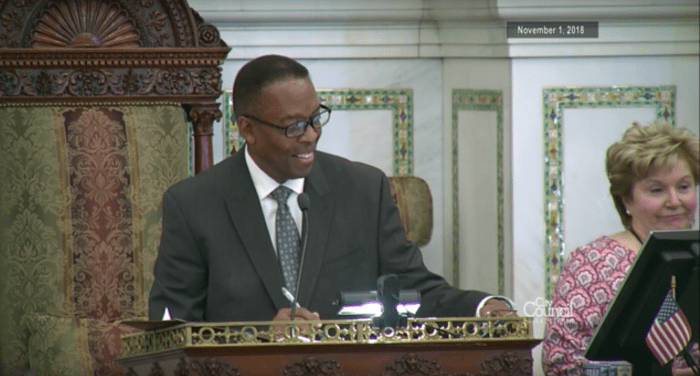
“I’d like to recognize some students from my district visiting today in the chambers,” announced Council President Darrell Clarke in the normal course of the council meeting getting underway. “They are embarking on a voting project, to get people out and talk about the importance of voting. So I would like to recognize them….”

He scanned the audience expectantly. “And now I’m being told that they’re not here yet!” He looked into the camera and grinned as council members guffawed. “We’ll recognize them when they get here.”

That minor blip was instantly forgotten when Councilwoman Jannie Blackwell issued her own stunner of an announcement.

“We were privileged to be at a wedding last week,” she said. “One of the members is a retired administrator with the Philadelphia School System. She got married and they decided that they would spend their first week visiting us. Could they stand?”

In the audience, the newlyweds rose to be cheered. The bride ceremoniously waved to the council while the groom thrust his palms in the air in a “raise the roof” gesture.

Screen Shot 2018-11-02 at 9.20.46 AM.png
He’s got the right idea!

With President Clarke’s band of students still en route, a dozen council members crowded the front dais, with Councilwoman Blackwell taking center stage.

“You know, it’s a special calling when you care enough about people–some very disabled, very ill–to make them feel better and do better because you make them look better,” she praised the man standing next to her, the salon operator at Children’s Hospital of Philadelphia.

“He gives of his time styling the hair of patients and caregivers–” she read from the proclamation.

“–This offers a much-needed moment of relaxation to those who are continually putting their needs aside for the benefit of their loved ones,” picked up Councilman Allan Domb.

“–He also consults with transgender youth and assists them in creating their new looks,” continued Councilman Al Taubenberger.

“–Which raises morale and instills joy and dignity in those receiving his services,” finished Councilman Derek Green.

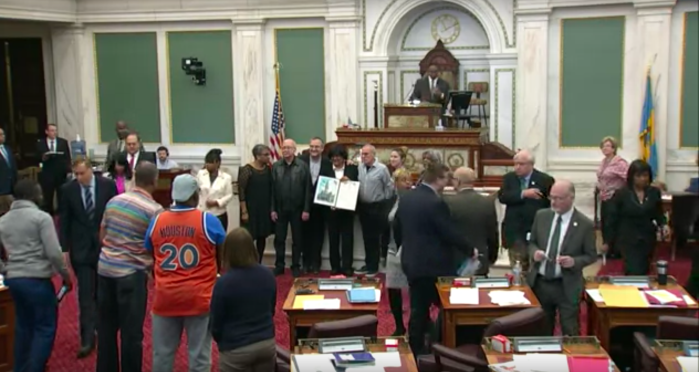
The man stepped to the microphone and paused emotionally. “Thank you, everyone,” he smiled as President Clarke declared “council will be at ease” for the official photograph.

Screen Shot 2018-11-02 at 9.35.28 AM.png
This is what “at ease” looks like.

“QUIET, PLEASE” came a yell from the rear of the chamber as council un-eased itself.

“Our next order of business is introduction of bills and resolutions,” the president ordered, kicking off an unusual dance of council members handing packets of blue paper to a courier, who then ferried them across the council floor to the clerk for a formal introduction to the body. Other city councils have found more subtle ways to do this, but in Philly, it was perhaps as well-choreographed as that couple’s wedding from earlier.

President Clarke slowly segued into the final portion of the meeting. “Are there any speeches on behalf of the….I’m stalling, waiting for the schoolchildren,” he admitted with a chuckle.

Screen Shot 2018-11-02 at 9.57.59 AM.png
FILIBUSTER

Several council members took the bait, with Councilman Bobby Henan describing his new hate crimes legislation and Councilwoman Blondell Reynolds Brown complimenting diversity in the Pennsylvania attorney general’s office.

There were two minutes left in the meeting and only one item of unfinished business. Fortunately, all systems were go.

“Before we conclude, I would like to recognize our students. I understand they got here just in the nick of time!” President Clarke called out as the three young ladies–no doubt fresh from getting Philadelphians to vote–stood up to end the suspense.

Interview #107: Tempe, AZ Reporter Jerod MacDonald Evoy (with podcast)

This podcast interview is available on iTunesStitcherPlayer FM, and right here:

Jerod MacDonald-Evoy is a reporter with The Arizona Republic who had a front-row seat to many hot-button debates of the Tempe council. From the border wall to a car wash, he explains how things got heated in the desert. Plus, we talk city council fashion!

Q: Can you please explain what the “Tempe Tie” is?

A: So when I was covering Tempe, I found that Tempe has an online store where you can buy all sorts of interesting little merchandise like a city of Tempe pen or a mug. I noticed they also had this tie. One of those fatter-style ties. It had a bunch of Tempe themes on it. I jokingly tweeted [that] if it got 100 retweets, I would wear it to the next council meeting.

Q: And…?

A: And as I should’ve known, you don’t challenge the Internet to those sorts of things. It quickly got over 100 retweets. I bought the tie and ended up wearing it to a few council meetings. I made some other people realize that they wanted that tie and they ended up selling out of them on the store!

Q: Let’s get into the council meetings. In January of this year, the Tempe council was considering a resolution to oppose a wall on the border with Mexico. There were some reasoned arguments about it, and those reasoned arguments lasted until one lady began yelling her comments from the back, which flustered your mayor into opening public comment. Were you expecting him to do that–and do you think that was a good idea?

A: I was expecting him to tell them, “you can have public comment at the end.” I’ve never seen the council open an item that was closed to public hearing. I was very nervous when he decided to do that because some of the women that were there had also been outside and were pretty vocally protesting this border wall resolution. I had a feeling it would only go downhill from there.

Q: Your nervous instincts were correct. Do you get the sense that council members were expecting the comments that ensued–the Trump defenders, the race war advocates, and the references to immigrants as rapists and murders?

ZLMPm5JT_400x400
Tempe, AZ reporter Jerod MacDonald-Evoy

A: I don’t think they were expecting it to the extent that it came. A lot of the people weren’t actually from Tempe. A lot of them drove up from the border to talk about this. The resolution they were trying to pass actually was a more gutted version of a resolution that was being pushed nationwide by a lot of cities that would say they wouldn’t do business with companies that work on the border wall. Well, one of the main companies that’s doing the prototypes is a Tempe company. When it didn’t pass, I was very surprised. It seemed very odd that they would give in to–I don’t know if they were giving in to these people exactly, but giving in to that idea that they shouldn’t be doing it.

Q: Do you think the public comment ended up making a difference for any of those council members?

A: I think it could’ve. I think there were a few that were already a little wary because of that idea of the city intruding into federal matters. Having those people show up was enough of a push to get them to not vote that way. It was during an election cycle. They decided they didn’t want to push the controversy and have the attack ad against them say they opposed the border wall and the president.


Follow Jerod MacDonald-Evoy on Twitter: @JerodMacEvoy

#171: Bellflower, CA 10/8/18

Like a well-choreographed symposium, Bellflower council members took turns sounding off on the events of the week, with everyone sharing an equal–and equally pleasant–slice of Bellflower life.

“The mayor’s prayer breakfast will be held Tuesday, October 9, at 7 a.m. to 8:30 a.m.” said Mayor Ray Dunton (naturally).

“Nominations for the 2019 BRAVO Awards open today,” chimed in Council Member Dan Koops. “Jim Abbott, a Major League pitcher, will serve as our special keynote speaker. Jim Abbott was that pitcher born with one hand.”

“The chamber of commerce will host the tenth annual Trick-or-Treat on the Boulevard on Friday, October 26,” finished off Council Member Ron Schnablegger, who even received a slight assist when Koops reached over and subtly switched on the microphone.

At this point, city manager Jeffrey Stewart piled on. “I wanted to ask the council if they would indulge us in a small presentation by the folks from Liberty Utilities.”

Screen Shot 2018-10-11 at 5.06.11 PM.png
Small but mighty

A man and woman strolled to the microphone with a message which–while not quite as important as the trick-or-treat–did catch the attention of one council member.

“I wanted to announce a free workshop on Saturday, October 27. It’s a drought tolerant plant landscape class,” the woman said. “We did set up for our customer service representatives to be available the second and fourth Friday of each month.”

“So how would a customer who’s not watching us here tonight know your available times?” Council Member Juan Garza pressed.

“We have a mailer that we sent,” was the answer.

Screen Shot 2018-10-11 at 5.06.27 PM.png
Psst. They just found out about it here!

It didn’t matter that the announcements ran long, since there was a lack of residents interested in commenting on any of the business the council raced through. At one point, Mayor Dunton joked about the light turnout.

“We got some quiet people tonight. That’s not a good state of the city, huh?” he chuckled.

But when the subject changed to RV permit fees, the heat turned up from “room temperature water” to “warm oatmeal.”

“What we’re seeking direction on are two questions,” said a staff member after outlining the brand new online permit store. “Whether the city will be absorbing any of the processing costs or passing them along to the customer. Secondly, whether the city will be absorbing the credit card transaction fee or passing it along to the customer.”

“I don’t think we’re talking a lot of money here,” the mayor muttered, glancing through the sub-$5 charges proposed on the screen.

Screen Shot 2018-10-11 at 5.14.56 PM.png
Speak for yourself

Council Member Koops scratched his chin. “I’m just concerned once we start things like this, it’s hard for us to revoke it. Do we look at everybody’s ability to pay? Or do we say, ‘we’re all in this together. We need to keep it equal for everyone?’ That’s what I’m struggling with.”

“I was on the fence myself,” agreed the mayor.

“This is about convenience,” the city manager argued. “The person doesn’t want to come into city hall.”

“So then should they pay for that convenience?” countered Koops.

“It’s not a lot of money either way,” reiterated the mayor.

“But once you start it–”

“You can’t turn it around,” finished the mayor.

There was a pause. Council Member Koops suddenly had an idea. “Why don’t we give it a year’s try and see how it goes?”

That was the magic compromise everyone had been looking for. With the stalemate resolved, the council adjourned eager for the next day’s prayer breakfast.

Month in Review: August 2018

If ever there was a time to start following City Council Chronicles, it was August. And I’ll give you one hint why:

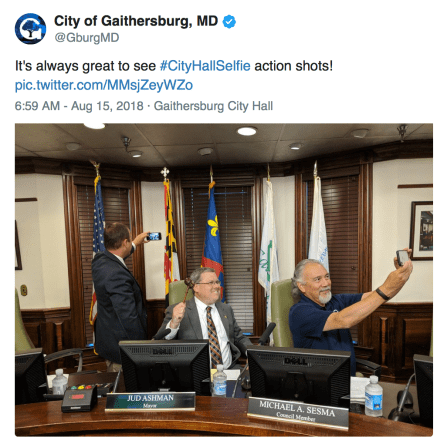
International #CityHallSelfie Day.

That’s right, we picked the top 10 city council selfies and showcased them to the world! But we had plenty of other serious news to cover, too. Have you heard of the mayor with a rat infestation?

Or the seven city council members who blocked an anti-discrimination measure?

That is some pretty serious fare. But you can also find more lighthearted segments with the council member who reenacted a medical drama and a role-playing exercise for teen engagement.

To engage yourself in a whirlwind of activity, check out the August Month in Review.

And if you aren’t a big reader, you’re in luck, because we’ve got images galore like this one:

Screen Shot 2018-09-02 at 9.50.58 AM.png

#167: Oskaloosa, IA 9/4/18

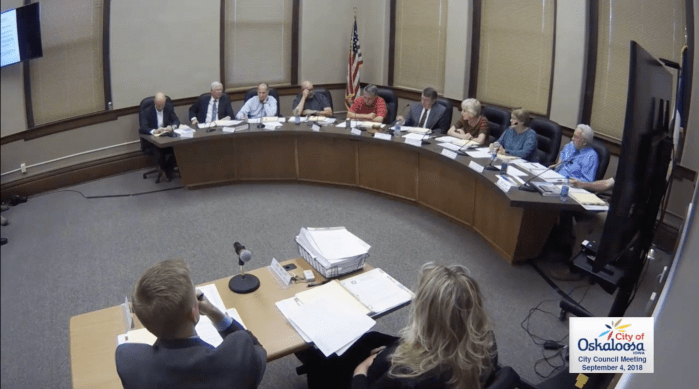
A flurry of confusion threatened to derail public comment after a man with a ponytail and shorts leaned into the microphone and quietly began his remarks.

“I came in tonight to speak about the resolution to sell–”

“We can’t hear you!” interrupted one council member.

“Speak up a little more,” coached another.

“Hey, Kyle! That microphone doesn’t work. That’s just for the tape,” shouted a third over the crosstalk.

The man at the lectern swung the microphone away from his face and restarted his statement, prompting another fusillade of instructions from every possible direction.

“Let’s get you on TV!”

“We’re still gonna want you to speak into it.”

“We still want you to speak into it so that people at home–”

“Gotcha,” the man responded calmly to cut off the furor. “It’s on TV, too? I didn’t know they still recorded this.”

“You’re live right now!” exclaimed a council member, causing the audience to burst out in laughter, with some smiling knowingly at the camera staring them in the face.

“Cool,” the man nodded. “I was behind the camera like a decade ago.”

Screen Shot 2018-09-06 at 11.08.34 AM.png
Oh, how the lenses have turned!

Moving into the substance of the meeting, Mayor David Krutzfeldt outlined a tricky scenario that stemmed from a meeting several weeks prior.

“The city council discussed the potential sale of several city owned properties,” he prefaced, one of which was 207 North G Street. “An appraisal of the property had been completed with a value of $33,000.”

“In August,” he continued, “staff received a letter requesting to purchase the lot for $10,000. His justification for offering less than the appraised value is that there are significant costs to make the lot developable.”

“At this time, the motion is to set the public hearing.”

City manager Michael Schrock cautioned the council, “it’s not always about the dollar amount. It’s about the plan and the concept. He’s presented a letter saying, ‘hey, I know you have this. Will you sell it to me?’ We’ve done that before.”

Screen Shot 2018-09-06 at 11.10.05 AM.png
The Art of the Deal

“We don’t have to make a decision in two weeks, do we?” quizzed Council Member Steve Burnett.

“No,” replied Schrock. “We’re required to hold a public hearing for any disposal of property. Say, ‘okay. Anybody that’s interested, come on in.’ You could have a third party show up, which we’ve had before. We had people basically outbidding each other in the audience.” Some council members chuckled at the imagined chaos.

Schrock clarified: “that wasn’t ideal.”

“So the public hearing–Wendell would be there with his bid and somebody else could show up and bid on it as well?” an incredulous Council Member Bob Drost reiterated.

“But we’re asking for more than dollars,” interjected Council Member Tom Walling, attempting to tamp down the expectations of a free-for-all in two weeks. “The more complete the proposal is, the higher the likelihood something gets approved that night.”

Screen Shot 2018-09-06 at 11.11.13 AM
Bring blueprints, people

There was a minor commotion from the back of the room. The mayor raised his eyebrows. “Wendell, if there’s something you think the council needs to know–?”

The man with the plan was all at once at the lectern. “I’ve been here for six and a half, almost seven years. I don’t plan on going anywhere else. It makes sense to me to try and control my investment,” he announced firmly–perhaps firmly enough to scare off the competition.

With that, the hearing date was set. May the bidding begin!