Interview #88: Greensboro, NC Council Member Justin Outling (with podcast)

This podcast interview is available on iTunesStitcherPlayer FM, and right here:

Few people have had as eventful a three years on their city council as Justin Outling has had in Greensboro. From the infamous transgender bathroom bill to screening police body camera footage in a meeting, we relived some of the most contentious moments in his council chamber.

Q: I noticed that every council meeting, you bring in a courier. Is this a position of honor or does it go to the city employee who’s about to be fired or what?

A: I think definitely more of the former than the latter! Greensboro city council has had a courier for quite some time now and that person’s task is to provide council with notes either from staff or from persons in the gallery. It’s traditionally a city employee from one of the many departments who has the pleasure of spending four or five hours with us on a Tuesday. Human conveyor belt is probably an apt description.

Q: But if they drop a bunch of files on the floor, they’re not gonna walk in and be fired the next morning in the Parks and Rec department, right?

A: If the call were mine, they would not be fired. But that’s really the city manager’s call. So all couriers in Greensboro, beware: don’t drop the papers!

Q: At one meeting, your Republican state representative came to defend the controversial North Carolina transgender bathroom bill. Do you as council members have to watch what you say about higher level politicians in meetings to avoid them retaliating against you?

A: I think there is a lot of strategy that one has to undertake in moving the ball forward and working with state legislators who do have the power to make your life difficult and act against the interests of the city. There are definitely occasions where you have to exercise restraint and do what you think is best for the city, not necessarily what’s best for your sanity.

justin
Greensboro, NC Council Member Justin Outling

Q: In the summer of 2016, there was an incident involving a white police officer who used excessive force against a black man and it was captured on body camera footage. Your council decided not only to release that video, but to do it at a council meeting, on camera, with a full room of onlookers. I can imagine council members in other cities going, “what? Why would you ever do such an emotionally-charged, embarrassing, or uncomfortable thing in a council meeting?” 

A: Allowing the citizens to actually see what happened and giving them an opportunity to express their frustration, their disappointment, and their hopes for the future–through that incident, it helped bring some members of the community closer together. It perhaps wasn’t the best for council members’ egos in terms of hearing a lot of unpleasant things from members of our community who were hurting like we were.

Q: As the footage was playing in that council chamber, I’m not sure what you were expecting to happen, but did it happen?

A: Yeah, I was expecting to see a lot of hurt on people’s faces, and that’s exactly what I saw. And it’s the same images I saw on the faces of my colleagues the first time we saw it in a closed session.

Q: Do you see a divide on your council between people who consistently think about what the proper role is for council members, and then others who are better at reacting to the mood of the room?

A: I think there is a divide. I would not characterize it as being better to reacting to the mood of the room. I think some people are much more willing to tell folks what they want to hear, notwithstanding the merit. The reality is that I’m an elected member of Greensboro city council. It is not about me feeling good about what I say and what I do.


Follow Council Member Justin Outling on Twitter: @JustinOutling
#155: Richfield, MN 3/27/18

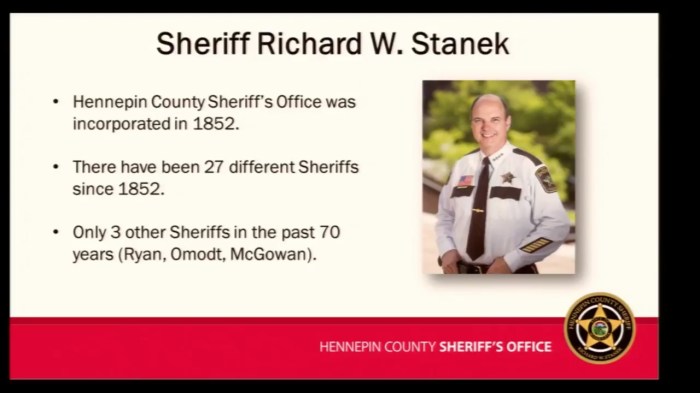
When the sheriff shows up in cowboy movies, it’s a sure sign the bad guy is going down.

“To make sure he got here in time, [he] hustled the vice president out of town so he wouldn’t be late,” joked Richfield Mayor Pat Elliott, welcoming the top cop to apparently the second-most important event of his day.

The sheriff stared down his nemesis: a slide show on the computer. “Which do you think it is? Arrow to the right?” he mused aloud. “Up-down?”

Everyone waited patiently while he solved the mystery of the puzzling PowerPoint. “Help,” the lawman murmured, proving that sometimes even heroes need heroes.

rch1
I believe in you.

Finally he got the hang of it and opened with a bit of trivia.

“I will not ask you, Mr. Mayor, what are the names of the three rivers that flow through Hennepin County. But I know you know the Crow, the Mississippi, and–what’s that last one?” he stumped himself.

“Minnesota,” Mayor Elliott replied, acing the rivers pop quiz.

But between those rivers lay a festering problem, and the sheriff turned on the rhetorical lights and sirens for his nearly 200 opioid overdoses.

“If I had 162 homicides in Hennepin County last year, I’d bet that it’d be in the front page of the Star Tribune or on the 4, 5, 9, 10, 11–all news channels in between. But it’s not.”

As frustrated as he was by the drug deaths, the sheriff was also irritated at himself for the crime of third-degree long-windedness.

“I promised you, Mr. Mayor and council members, eight to ten minutes. I took eight minutes and 35 seconds. I went a little bit over.”

As he surrendered the lectern, Mayor Elliott welcomed a former mayor who had since risen to the ranks of the elite.

“Commissioner [Debbie] Goettel, it is good to see you! You’re back in your stomping grounds,” he gushed. “I hope you have some words of wisdom for us yourself.”

“There are some pretty startling facts that he didn’t share with you,” she countered, dodging any happy wisdom and instead beelining to the opioid wisdom.

“They are disproportionately affecting our younger folks. Anywhere from the age of 15 to about 45.”

After waiting a beat to digest the news, Council Member Edwina Garcia confessed, “we still miss you.”

“I beg your pardon!” exclaimed the current occupant of the mayor’s seat.

rch2
Mayor brawl!

“I mean we,” Garcia quickly clarified, referring to the royal “we.” “Not necessarily sitting right here,” she jabbed at the mayor.

I don’t know who would win in the battle of the mayors. But I will admit: the high point of the meeting was when Mayor Elliott revealed the catchy slogan for “council member announcements.”

“On to ‘Hats Off to Hometown Hits,’” he said.

In his Hometown Hit, the mayor offered the most striking analogy of the day. “Anytime you get a special verdict form that comes back that’s in your favor–this is gonna sound a little strange,” he admitted, holding up an official document. “But when I get one like this, it’s akin to the birth of a child. We got one this past week.”

rch3
Boy or girl?

But Council Member Maria Regan Gonzalez used her Hometown Hit to once again ground her colleagues. “This morning we met with our congressman, Congressman Ellison. The opioid crisis, we did talk about that.”

Well, I think we know what Richfield Public Enemy Number One is. Citizens, let’s run these opioids out of town like they are the vice president.

#154: Monona, WI 3/19/18

What did the city council know and when did they know it?

That was the question one sleuthful citizen had after doing a little amateur detective work on some government documents.

I’m here again to urge the council to reject all of the bids related to the Wyldhaven Park project, a flannel-clad man informed the crowd. The deck is a detriment to the park and serves no practical purpose.

I also have serious concerns regarding procedure. According to meeting minutes–” he continued, hoisting a sheaf of papers in the air as the smoking gun, “there was a committee discussion of a plan for Wyldhaven Park on October 6, 2015. That plan had no deck in it.”

The plot was thick with intrigue. A deck had appeared out of nowhere.  What’s next? A swing? Wind chimes? A grill and some hot dogs? The precedent was dangerous.

mon1
Bag it for evidence

“A number of people I’ve talked to were surprised to hear that there’s gonna be a deck. They said, ‘really? Like, a deck?’” the man recalled, albeit with zero ounce of surprise in his delivery.

“Where did all this detail, including deck, come from? Certainly not in the committee meeting minutes.” He paused before delivering the verdict. “My opinion on this is that the committee must’ve acted on its own!”

Aha! And how did Mayor Mary O’Connor then attempt to shut down the investigation and suppress further testimony?

“If anyone else is here to speak about the Wyldhaven Park project or would like to register, there’s a slip over there to fill out,” she indicated politely.

“We have a deck. We love it,” smiled the next commenter. “The location of the Wyldhaven Park observation deck is one with a spectacular view. You have beautiful sunsets. You have the super moon.”

Having heard from both sides, the mayor wheeled around to a staff member.

“So that was in the minutes?”

mon2
It was there the whole time?

“It’s in the packet,” the employee clarified. “And we approve or recommend approval of all the projects as a whole. Not each individual project.”

Alderperson Doug Wood made it crystal clear that nothing nefarious was afoot. “I think this did go through the normal process, if not maybe a little more so than most capital projects?”

“Correct.”

Well, so much for the secret society theory. Apparently the deck was simply a victim of insufficient bullet-pointing.

But if you thought the council was done with deck-related problems, they weren’t in the clear yet.

“I will move approval but with the requirement that video surveillance be installed,” Alderperson Wood piped up as the council was about to approve an alcohol permit for a Mexican restaurant’s patio.

After several minutes of wrangling, Alderperson Brian Holmquist finally inquired, “Do all our other patios require that you have surveillance?”

The answer was yes–clearing the deck (as it were) for a council thumbs-up.

mon3
No more deck talk

Mayor O’Connor waited until the end of the meeting to air a concern she had been pondering.

“One thing I wondered about: if we want to think about having–” she paused and stared up at the ceiling. “I hate to even bring this up but the way the world is today, some active shooter training for the council might not be a bad idea.”

She indicated to either side of the room. “Frankly, sitting here and seeing these doors, I think it might be a good idea if anybody’s interested.”

Yikes. I guess if Monona keeps having deck problems, it couldn’t hurt.

Interview #86: Indianapolis, IN Councilor Michael McQuillen (with podcast)

This podcast interview is available on iTunesStitcherPlayer FM, and right here:

Michael McQuillen is the Republican District 4 councilor and minority leader on the Indianapolis-Marion County city-county council. Despite his council’s long name, he tries to make quick decisions on votes, including the difficult ones involving unseating the council president. We talk about those occasions, his perfect attendance, and more.

Q: I hope it is not too late in the year to congratulate you for winning a perfect meeting-attendance award in 2017. Why does the Indianapolis council prefer to honor people who attend all of the meetings instead of my preferred method of shaming people who miss any meetings?

A: That’s actually my crowning achievement for 2017, so we can’t take that too lightly. But seriously, I think it’s something that’s been done for 40, 45 years and I’m just caught up in the minutiae of it now.

Q: You’ve been on the council for ten years. How many of those years have you had perfect attendance?

A: I’m probably about a 50-50 hit or miss. But I generally hit all the council meetings, occasionally will miss a committee meeting here and there.

Q: Okay, gotcha. Well it actually was five out of the ten, and I appreciate you pretending like you didn’t have that memorized. Very convincing! In your second year on council, Republican Council President Bob Cockrum decided to alternate the adjournment between his vice president and the minority leader, rather than have the minority leader do it always. How strongly do you feel about being in charge of that part of the meeting?

A: Being the minority leader, there are very few bells and whistles that that person gets to use. The reading of the memoriams at the end of the meeting is one of the very few. As you point out, that has been my responsibility for the last several years now on council. I don’t know where it would rank in the hierarchy of importance in the council meetings, but I do enjoy brushing up on tricky last names sometimes when I’m on camera.

Q: Sure. I mean it’s ceremonial akin to the invocation and the Pledge of Allegiance. So would you be pretty protective if someone tried to take that away from you?

A: I guess I probably would. Again, it’s one of the few things that puts the spotlight on the minority party for just a very few minutes at the end of the meeting.

mcquillen
Indianapolis, IN Councilor Michael McQuillen

Q: Earlier this year when the council was choosing whether to retain the council president or elect a challenger, the vote stayed open for a really long time. Do you recall what was going on that took people that long to decide?

A: I’ve never understood in the ten years that I’ve been on the council why some councilors, especially if they know how they’re going to vote on an issue, sit there and wait to hit the button and be perhaps the last person. That’s great if you want to be on the news as the councilor that “made the decision” on how the vote goes. It’s not really true that that’s the way it works, but sometimes that’s how it’s perceived. My personal philosophy has always been to hit that red or green button immediately and move on.

Q: Is that something you’re obligated to do as the leader of the caucus? Or might that be why you’re the leader of the caucus: because you’re so darn decisive?

A: Good point. I do try to throw the button down fairly early for that reason. But also again, I just don’t want to be the last man standing. A few years ago there was a vote on overriding the former mayor’s veto. I was the only person to hit a red button that night. It was 24-1. But it was kind of lonely sitting there at the end of the 60 seconds the board was open and having one lonely, little red button up there.


Follow Councilor Michael McQuillen on Twitter: @mike_mcquillen 

#153: Pullman, WA 3/13/18

“I’ve sorta got it figured out,” mused Mayor Glenn Johnson after the roll call was complete. “If I start with ‘present,’ then everyone else goes ‘here.’ And if I go with ‘here,’ everyone goes ‘present!’”

It was an intriguing conspiracy theory–made even more intriguing when no one issued any denial. But what was undeniable was that the mayor’s booming radio voice made his mundane announcement about the Irish Feast twice as tantalizing.

“They have corned beef and cabbage, salad, hot bread, pie, and coffee for a mere seven bucks,” Johnson rattled off in a cadence not heard since the days of Cronkite.

“Dave at one time went to Ireland just to get the right corned beef recipe,” he gave an avuncular nod. “And the pie is top of the line, I’ll tell you that.”

pul1
TOP O’ THE LINE

Before I could even reserve my tickets for the Irish Feast, the mayor added with sizzle, “with that, it’s time now for arts in Pullman!”

“This is a picture of our fab new building,” the art museum director bragged, flashing the looming structure onscreen for the room to admire. She then lasered in on her main purpose: to get the council on board with a creative district in downtown Pullman.

“I’m hoping that with the Downtown Coug–I’m calling it the Downtown Coug. It’s not the official name,” she cautioned. (It was probably for the best; “Downtown Coug” is, I suspect, a type of fetish I am not willing to Google.)

“I don’t know personally if I’m 100 percent [for] making Pullman an ‘arts district,’” Councilmember Al Sorensen winced.

pul2
This man is not into Downtown Coug.

“It’s a creative district,” the museum director gestured excitedly. “If it was just about art, I’d be out there throwing statues up. You know me!”

She added, “we’re moving away from coal. We’re moving away from gas. We don’t have the Big Five anymore. We don’t have cars.”

Wow, I had no idea Pullman was once a coal-gas-carmaking hub. By all means, reinvent yourselves! Councilmember Ann Parks heartily agreed.

“We don’t really have an identity in our town and I think it could be something we could be known for.”

But I would argue that Pullman, as of this writing, already has an identity: as the home of politicians moonlighting as art critics.

“In 2016, we wrapped the utility box that you see here in the photo with art,” a staffer explained, displaying a colorful photo of the masterpiece. “And we have gotten just rave reviews about that!”

But two more utility boxes were in line for a makeover and the council would now get to review the cream of the crop submissions.

“The colors appear a little more muted than they actually are in the art,” she hedged as council stared at the vivid landscape titled “Starry Lentils.”

pul3
This screams “utility box.”

“I like the drawings more than I like the photography. I think that we have more possibility to make it pop,” noted Councilmember C. Brandon Chapman. “I like the ‘Starry Lentils.’ I think that could be just cheerful.”

“When the artist says he likes people to come up close, we’ve already had a utility box hit by a car,” quipped the mayor to laughter.

The staffer nodded after noting council member preferences. “Okay, so we have very strong direction on ‘Lentils.’”

“That’d be a great mural!” exclaimed Chapman, pointing to a black and white pictorial of a woman in various costumes. “That’d be really fantastic on one of these spaces where we just have a lot of concrete. I think you could tell a story better that way than if it were wrapped.”

Save it for the new Downtown Coug, folks!

Interview #85: Aurora, CO Council Member Allison Hiltz (with podcast)

This podcast interview is available on iTunesStitcherPlayer FM, and right here:

First-term council member Allison Hiltz has already seen a ton in her first three months: a bicycle shop in distress, sexual harassment training on the rocks, and an uproar involving the Girl Scouts. Listen for all the details!

Q: There’s this image of city council meetings that they are the place you go if your back is up against a wall and you need to plead your case to somebody. On February 5, there were over half a dozen people who came to beg that your city council save the Second Chance Bicycle Shop, which was about to be evicted.  Were they correct to come to you in a meeting to ask for help?

A: Yeah. I think it’s always correct to come and talk about the community at council meetings. That’s what city councils should be. That’s our job to know what’s happening in the community and to help.

Q: Do you get the urge to drop everything and figure out how to help these folks out?

A: I always want to drop everything and fix everything but then I have to stop, take a breath, and just work on getting the right people on it.

Q: Right, you’ve got to pace yourself. You’ve got a four-year term! I heard you are a lifelong Girl Scout. Is that correct?

A: Yes!

Q: Nice, nice. Same here. What was the idea that the Girl Scouts had for the Aurora city council?

A: It was to protect the health and safety of minors who are in cars with people who are smoking.

Q: This proposed ordinance came up at the January 22 meeting. At one point, Council Member Bob LeGare said the ordinance was trying to “legislate the action of stupid people.” You took offense to his use of the word “stupid.” How do you respond to the argument that Bob LeGare may simply have been “telling it like it is” while you were being “politically correct?”

allison
Aurora, CO Council Member Allison Hiltz

A: You know, I still stand by that comment. I understand that we live in a political world where you can just say whatever you want and call people the names that you want. I do think that as an elected official, you’re held to a higher standard. It is up to us to maintain a level of professionalism. I think once you start calling names over one action, why not start calling everyone else a name for whatever action they have?

Q: Was it the word that bothered you or was it the judgment behind that word being leveled upon people for some behavior?

A: It’s the judgment. No one’s saying that smoking in a car with children is a good idea. But it’s also not our job as council members to start judging the individual actions of people. Once you start passing judgment on people, it just goes into a whole different way of legislating that is not my preferred way.

Q: How surprised were you that between the first meeting with the Girl Scouts’ ordinance and the second meeting, the rhetoric had shifted to opposition?

A: I think it was easy for some to forget that these are 12-year-old girls. There was a lot of conversation about some things that I think maybe were not necessary to have said so vehemently and sternly in a public setting to 12-year-old girls. I would have much preferred those concerns to have been made to those Girl Scouts in a one-on-one context. It’s easy to forget sometimes that the people you’re talking about are real human beings and also 12.


Follow Council Member Allison Hiltz on Twitter: @AllisonHiltz 

Month in Review: February 2018

It was a tall order to pack a months worth of city council action into only 28 days, but February pulled it off. We welcomed new blood to a city council and saw one person walk away from the job mid-meeting.

We also had a busy podcast schedule, talking to people who are doing wonders for helping their constituents understand the meetings, as well as those who are frustrated by how opaque their council truly is. Plus, we got one promise to video stream council meetings by December!

To see which city councils are doing well and which ones are way behind the times, take a look at the February Month in Review.

And if you heard that nothing innovative ever comes out of a city council meeting, I implore you to read about this little girls revolutionary new homeless shelter:

mcm2

Interview #84: Vancouver, BC Councilor Andrea Reimer (with podcast)

This podcast interview is available on iTunesStitcherPlayer FM, and right here:

Andrea Reimer has been a councilor since 2008 and has witnessed a significant rise in points of order at her council meetings. We talk about why that is, as well as why some speakers acknowledge indigenous territory.

Q: In the Vancouver council meetings, I noticed a lot of people acknowledge that you are on native territory. Are you obligated to do that?

A: We have a formal protocol that the chair of the meeting needs to acknowledge we are on the unseated homelands. But it’s up to each speaker to decide how they want to engage with that. It would be a rule for the mayor or myself when I’m chairing. For Vancouverites, though, who come to speak to council, it’s totally up to them. Many people do make that acknowledgement.

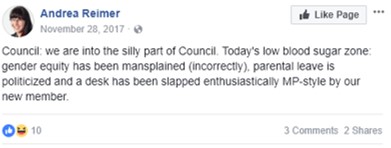
Q: You posted this last year:

sugar

Is blood sugar any different now than it was when you got on council in 2008?

A: The main goal of the chair is to get people out of that room by 3:30 in the afternoon. If they don’t, we hit the low blood sugar zone. We do have a brand new council member who just joined us in October who has introduced some activities such as slapping desks. We see that in our parliament–I don’t know if you guys do that in your national government. But we generally don’t do that at municipal council because we’re sitting maybe ten feet away from each other at most. We don’t really need to slap tables to signal that we’re happy or unhappy with something!

Q: I have not seen a city council raise the volume of points of order that I see in Vancouver. Why do you think that is?

A: On my first term of office, 2008-2011, I think we might have had one point of order in the entire three-year period. Then one of the individuals was elected and suddenly we skyrocketed up in number. And then another one, Councilor [Melissa] De Genova, got elected in 2014 and she can do that many before lunch in some meetings. So I think it’s just, different councilors have different styles. Your president’s really into Twitter. We have a councilor who’s really into points of order.

andrea.jpg
Vancouver, BC Councilor Andrea Reimer

Q: I heard that last year, a lady fainted in your public comment. Is that true?

A: Oh, yeah. We’ve had a few. We’ve had fainting. We had a medical emergency. We had a fire once while I was chairing. I was the only one who didn’t notice it because it was happening behind me!

Q: Has anyone called point of order on that fire?

A: You know, it’s funny. Those were never points of order! We actually completed the council meeting outside. I’m such a stickler for rules because I’d hate for all of the decisions to be overthrown because some procedural breach happens. I made us go outside and formally adjourn the meeting correctly.

Q: During a public hearing about a proposed development in Chinatown, I heard there was some poor behavior. What did you see that concerned you?

A: It sounds like there was some attempts to intimidate [speakers] either verbally or in one case, physically. We definitely heard booing. Probably the most difficult moment for me was we had two members of the Musqueam nation, one of the three indigenous nations, who came up to the microphone to speak and they were booed by a crowd that had used indigenous issues to try and justify their case. It had such a deep-seated disrespect for the issue. I talked to the organizers and they’ve since reached out to the individuals involved on the Musqueam and I understand there has been reparations made. They’ve apologized.


Follow Councilor Andrea Reimer on Twitter: @andreareimer 

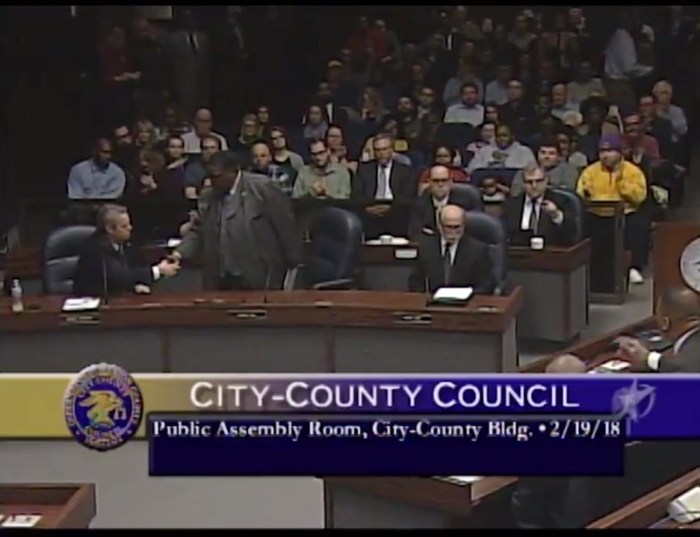
#151: Indianapolis, IN 2/19/18

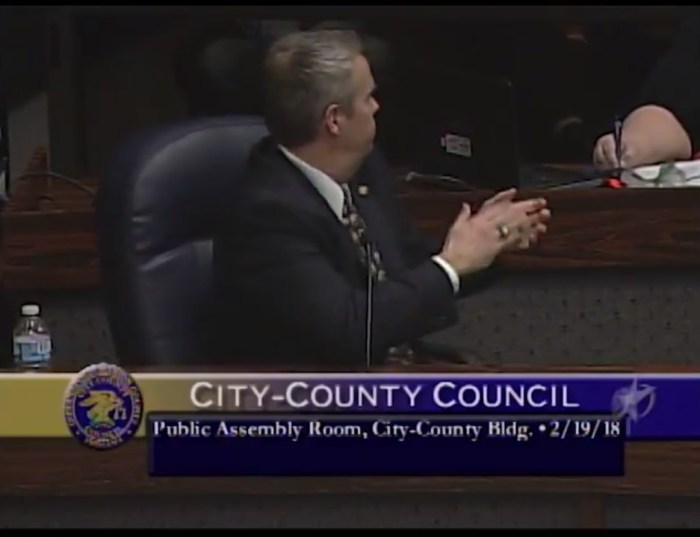
The meeting of the City-County Council of Indianapolis-Marion County (a.k.a. the “Most Hyphenated Council” in the country) began in the most democratic of fashions: with applause for pretty much everybody.

“I’d like to introduce an Orange Township resident, active guy in the community, good friend,” Councilor Michael McQuillen announced, leading the claps for his man in the audience.

Taking a step up from “active guy,” Councilor Scott Kreider introduced two firefighters. Claps.

Not to be outdone, Councilor McQuillen grabbed the mic again. “We have a former city-county council member in the audience.” More claps.

“I want to acknowledge this month being Black History Month,” cut in Councilor LaKeisha Jackson, “and that we give a round of applause for Black History Month.” Raucous claps.

ind1
I like this warm-up!

With no one being able to top Black History Month, the councilors settled in for the business portion of the meeting. But suddenly, Council President Stephen Clay dropped a bomb so large it could have leveled a less-emotionally prepared council chamber.

“In an effort to preserve this institution and advance the people’s agenda, Councilor [Vop] Osili and I have agreed to the orderly transfer of power,” Clay read emotionlessly from his prepared statement.

“My letter of resignation from the office of the president will be presented tonight. I will call upon Democrats and Republicans to support this transition,” he warned sternly, “thus averting any political filibustering.”

Picking up the gavel in preparation to slam it, Clay noted, “I give the gavel to the parliamentarian.” The chamber applauded one last time as Clay stood up, shook hands, and departed for greener pastures–or whatever you’d call the place where the rest of the councilors sit.

ind2
I hardly knew you.

But even this orderly transfer was thrown into momentary disorder when Councilor Leroy Robinson raised his eyebrows and his hand. “Shouldn’t the vice president receive the gavel as opposed to the parliamentarian?” he quizzed.

A constitutional crisis was averted as the parliamentarian calmly agreed. Vice President Zach Adamson hustled over to the chair and opened the floor for presidential nominations.

“I nominate Councilor Vop Osili,” announced Councilor Maggie Lewis.

“Are there any other nominations?” asked the parliamentarian to silence. “The effect of closing nominations with only one candidate will have the effect of electing Councilor Osili as president.”

With no one disputing the outcome, it was official. The new president strode to his seat and with a reassuring smile, delivered a message best characterized as: “there’s a new sheriff in town.”

“Our council has shaken the confidence of our constituents.” He paused. “But that was yesterday. It is time for us to get back to business. And we will start with the next item on the agenda.”

ind3
Crack. The. Whip.

With a calm, steady hand steering the ship, the rest of the meeting proceeded with only minor hiccups.

“Madam Clerk, can you set the, uh…?” Osili backtracked after forgetting to open the voting machine. “All right, let’s go!”

A few minutes later, “proposals numbers 56 and 57 were referred to the Metropolitan Economic Development Committee,” Osili read, glancing up from his notes to the chair of the committee.

She was nowhere in sight.

The council patiently waited while someone rushed to fetch Councilor Jackson. Within minutes, she reappeared, power walking back to her seat.

“I apologize Mr. President,” Jackson blurted.  While the old president might have chewed her out six ways from Sunday, President Osili remained serene. As he might say, some councilors shake the confidence of their constituents.

But that was yesterday.