Interview #106: Milpitas, CA Mayor Rich Tran (with podcast)

This podcast interview is available on iTunesStitcherPlayer FM, and right here:

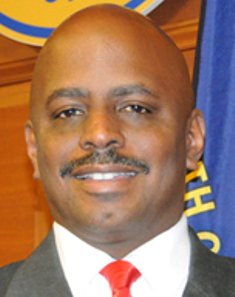
Rich Tran had no political experience before being elected as Milpitas’s mayor two years ago. His first term has had some rough spots, and we explore how he has adapted to the job.

Q: At the April 4 meeting in 2017, what were you trying to accomplish by saying you wanted your city manager’s performance review to be put on the public meeting agenda?

A: I can’t say too much about it because there’s current litigation. If you look at what happened there on the dais, it is really a policy battle that’s happening when you’re listening to myself and the city attorney. It’s like a rugby match and I’m in a scrum with the city attorney. I got so much love for Chris Diaz, our city attorney. He might be listening to this–

Q: Hello, Chris Diaz, Esquire!

A: Yeah! I’m scoring my freedom of speech and my democratic rights to place an item on the city council agenda. I’m definitely following the rules and doing things appropriately. I was looking to do a performance evaluation of our former city manager.

Q: I get that, but your line of inquiry made the city attorney visibly anxious. He’s saying, “as a council you can do whatever you want. I’m just saying as your attorney, I think it’s a terrible idea legally.” What about that was unconvincing to you?

A: I felt like I wasn’t getting the truth so much as I deserved it. I wasn’t looking to discuss anybody’s performance in public.

Q: What’s the distinction between that and placing the performance review on the agenda though?

A: I want the item on the agenda so we can decide if we’re gonna do the performance evaluation or not. That’s it.

2016_Rich_Tran
Milpitas, CA Mayor Rich Tran

Q: On October 3 of last year, your council was considering a censure policy for council members. When Councilmember Bob Nuñez said that he had concerns about people following the rules–and singling you out specifically–how did you feel about that?

A: We never had a censure policy here in my city. Not in its 64 years. Councilman Nuñez wanted to bring one about so that in the event that I screwed up or something, he can censure me. Everybody has concerns about me, Michael. They call me the “outspoken mayor.”

Q: What does that mean?

A: Because I talk about things. I don’t accept things that shouldn’t be accepted. Councilman Nuñez was concerned that I was communicating with the community too much. The funny thing is, no one’s ever been censured. It’s like he’s waiting for me to slip somehow.

Q: It’s interesting because they did have the opportunity to, but they instead chose to send you a letter of disapproval chastising you for your conduct outside of the meetings–and that was all four council members. You said, “that goes to show Milpitas has the dirtiest petty politics in all of Santa Clara County.” What, from your point of view, is the root of the problem?

A: It’s an election year. I’m an independent leader. It’s definitely sad. You read the rebuke that was sent my way–the residents are pissed off that the city council’s playing these silly games.

Q: I get that they may not like you because of who you are. Can you think of some mistake you made as mayor that you would be willing to say is a mistake?

A: Definitely. I don’t have a great background in politics. It was only four years ago that I moved back to my hometown from Manhattan. I was going to NYU for my master’s degree. I had no job, no car, I was living out of the back of my uncle’s house–

Q: Sorry, are these all the mistakes?

A: No, I’m just telling you the lead-up. Getting into politics, I didn’t really know much. You asked me what my mistake was: I think to be misunderstood.


Follow Mayor Rich Tran on Twitter: @mayor_richtran

#169: Van Buren, AR 9/24/18

Mayor Bob Freeman swung around to the front of the council dais and glanced down at his notes momentarily before turning to the two women at his side.

“In July of this year–make sure I’ve got this correct,” he instructed them, “–in July of this year, y’all had gone to a movie?”

“Yes,” replied each woman in turn.

“When you came outside, you noticed there was a gentleman–or, you noticed there was a truck that the engine was revving?” the mayor continued.

“Yes, sir.”

“Yes.”

“So you went to the truck–”

“We actually went around the truck,” one woman jumped in to steer the story in the correct direction. “I looked over because it was revving up so much. The gentleman had slumped over and I knocked on the window trying to see if he could hear me. He was unresponsive.”

Screen Shot 2018-09-27 at 10.28.29 AM.png
(S)heroes!

She indicated to the good Samaritan next to her. “I had her go get somebody to help. I went around to the driver’s side. Luckily it was unlocked. I pulled him out. She helped me with CPR.”

“You applied CPR,” Mayor Freeman picked up again now that the details were ironed out. “Revived him. Between your actions, you saved his life.”

After the photos and as the mayor plopped down in his seat, he remembered one other brave soul in the room.

“Alderman Swaim had knee replacement one week ago today and he’s here tonight. That’s why he did not stand for our pledge and we’ll say that’s okay!”

Alderman Alan Swaim raised a ringer and quipped: “I did not kneel either!”

That prompted a huge laugh from the room–perhaps from the topical humor and perhaps a window into Swaim’s own views on kneelers.

Screen Shot 2018-09-27 at 10.29.35 AM.png
Truly presidential

There was something eating at Mayor Freeman. He started off inauspiciously enough by describing a meeting with the county sheriff’s department.

“Last Monday night, [I] went to the Facilities Commmitee meeting because they were discussing the rates that they charge municipal governments for inmates,” he explained. “Our rate has been $10 a meal. We haven’t actually paid $10 a meal until the last year and a half because we haven’t had inmates in the jail.”

He continued, “they are looking at raising that rate. I asked for an opportunity to see the numbers. We sat there through the committee meeting and we left and were later informed that they had gone ahead with an ordinance to raise the rate to $50 a day.”

The mayor frowned deeply. “What disappoints me is the fact that I asked to see the number and that was just ignored. There’s a piece of me that feels I’m being taken advantage of because I am a lame duck. ‘We can do it because the mayor’s leaving anyway.'”

“I’m not!” piped up Alderman Jim Petty to reassure the mayor whose team he was on.

Screen Shot 2018-09-27 at 10.31.03 AM
Stick together!

After Mayor Freeman had vented, it reminded Alderman Darral Sparkman of something.

“Chief, I just wish you’d tell your officers–those deputies or whoever it is run up and down this highway do not turn on their lights, and they drive at light speed!” he railed. “We have been hit nearly three times!”

“Are you talking about our officers?” Mayor Freeman quizzed.

“No, the sheriff!” Sparkman exclaimed. “These guys never turn the lights on!”

It seems like the bad blood with the sheriff’s office runs deep in Van Buren. Let’s hope they clean up their act in time for the next mayor.

Interview #104: Prairie Village, KS Council Member Tucker Poling (with podcast)

This podcast interview is available on iTunesStitcherPlayer FM, and right here:

A whirlwind of activity has buffeted the Prairie Village council–starting with the onset of live streaming earlier this year and ending in an aborted council meeting earlier this week. Council Member Tucker Poling describes his at-times-incredulous reaction to some of the developments.

Q: I am talking to you in the third week of September, which means you had a council meeting a few days ago. How did that go?

A: It went about as well as council meetings go when nobody shows up!

Q: What?!

A: I had a nondiscrimination ordinance on the agenda and suddenly, the few hours before the meeting, we had four council members text or email the city manager and say that they couldn’t make it. Therefore, we did not have a quorum and we could not meet and hilarity did not ensue. I was not happy about it.

Q: You know Prairie Village and you know these council members. I don’t want it to sound like I’m blaming you when I say: should you have known this was coming?

A: I will say no. In my knowledge, it’s never happened before in this way. It’s been very rare we have more than one absence. At the time, I–let’s say I “lost my chill” a little bit, as the younger people say. I had no chill on that evening! [laughs]

Q: [laughs] Well that sounds perfectly “dope” and thank you for not being “extra” despite your lack of “chill.” And–I’m sorry, there’s something else that’s bugging me. Can you explain what was before you council on August 20 of this year?

A: That was Councilman Ron Nelson’s proposal for us to adopt the principles of the convention to end all discrimination against women. All Ron was asking for was a resolution saying that we support equity and equality for women and girls.

ShowImage
Prairie Village, KS Council Member Tucker Poling

Q: On August 20, the first thing that happened was that council members argued against the resolution. How did you feel about what you heard?

A: I felt mind-numbingly confused and disappointed. I was flabbergasted that this was controversial. We had people in an open, public meeting talking about conspiracy theories about the UN [United Nations].

Q: The resolution was not passed and sent back to staff on a vote of 7-5. Of the six council members who canceled at this week’s meeting for your anti-LGBT discrimination proposal, how many of them also voted to shoot down the anti-gender discrimination proposal?

A: All of them.

Q: Some of them were suspicious of the UN, and I guess I get that a little. It does feed into the caricature of middle America. But others were arguing that “all lives matter,” right? That, “why can’t we have a nondiscrimination again men too?” And others seemed to think there was no inequity in Prairie Village. I’m curious, if your council meeting had happened on Monday, would you have expected that same argument to come up about sexual orientation?

A: Yeah, there definitely would have been those same objections. “We don’t have any discrimination in Prairie Village. This is all ‘political.'” Which is just very confusing to me because the idea that the human condition does not apply in Prairie Village and all the flaws that we have as human beings somehow don’t apply in nice, upper class communities like ours–that’s pretty blind in my view.

Q: It occurred to me that people who said, “if we pass this, it’s just an admission that something is wrong here”–ironically, by not passing it, it gathered all this attention and people asking, “what is wrong with the Prairie Village council that they can’t pass this?” It had the opposite effect.

A: That’s exactly right. It’s bizarre that people think that by not acknowledging something, that’s just going to go away. And people are not going to notice that you’ve chosen to not acknowledge that equity issues exist everywhere.


Follow Council Member Tucker Poling on Twitter: @TuckerForPV

#168: Northville, MI 9/17/18

It was a historic day in the Northville council chamber–in the sense that history was the number one topic.

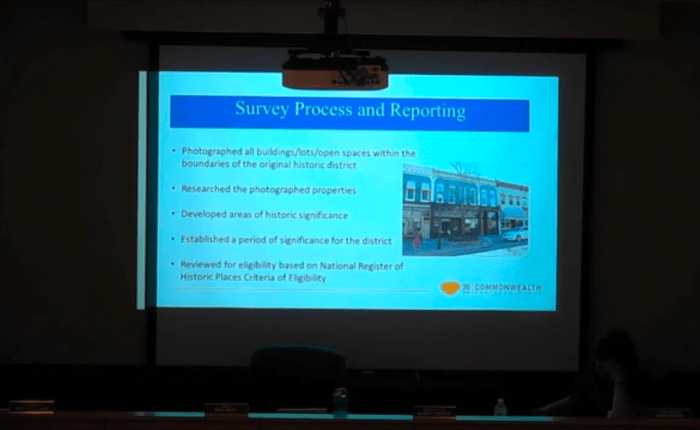
“It’s kind of prestigious to be on this,” prefaced a visiting architectural historian, flipping through a slide show about Northville’s spot on the National Register of Historic Places.

She flashed a boot-shaped map onscreen. “This is what the Historic District looks like when we started. The goal is to have the local and National Register districts match.”

Ah, who doesn’t love an audit! In this case, instead of sifting through hundreds of pages of documents, she sifted through hundreds of…buildings?

“We photographed all of the buildings, over 400. We developed historic significance–all of the things that make Northville Northville.”

Screen Shot 2018-09-20 at 9.28.16 AM.png
You’re gonna need a bigger list.

The historian cautioned that not all Northville memorabilia made the cut. “It has to be cultural,” she warned. “The hand of man has to be felt on it. That’s why rivers aren’t in a district, but a bridge would be.”

She gestured to a blank space in the center of the map. “This the ball field. It doesn’t have any history from over 50 years ago. It’s just a piece of ground, so that can’t be cultural.”

“What about the six mills that were there?” interrupted Mayor Pro Tem Nancy Darga.

“Are they there now?” the historian shot back.

“Their footings are,” retorted Darga.

“Well then,” the historian replied slowly, “that would be archeology. That’s not something that’s covered.

The mayor pro tem was horrified.

“Northville started on that ball diamond,” she insisted. “It’s because there was a mill there. We now just took the beginning of Northville out of the Historic District!”

Screen Shot 2018-09-20 at 9.29.07 AM.png
For shame!

The historian refused to back down. “Do you want to have archeology? I don’t think you can have archeology just for one plot. It’s gonna be the whole district.”

The consequence of that? “Anybody who wants to put in a new garden may have to consider” what lies below.

No one was eager to turn Northville into an excavation site for stegosaurus bones, so the baseball diamond issue was closed.

“Maybe I’m missing something here,” Darga said after a pause, “but we established a local Historic District in 1972. But now we’re trying to establish a NATIONAL–”

“You already have a national district,” interjected the historian. “We’re trying to make sure the boundary represents what’s here today. You don’t want to lose your district. And the Park Service will do that. They will de-list districts.”

This historic preservation business is ruthless. I imagine archeology is a cakewalk in comparison.

“I got a little lost,” Mayor Ken Roth admitted as the lights turned on and the projector turned off. “Our Historic District is listed…?”

“It’s both. It’s listed on the National Register of Historic Places and it’s a local Historic District,” the historian patiently reiterated.

“Okay.”

“The person who is the head of the National Register list is called the ‘keeper,'” she said.

“Seriously? The keeper?” Mayor Roth exclaimed. “That’s a real title?!”

“Yes! It’s much sought after,” she assured him.

Screen Shot 2018-09-20 at 9.31.45 AM.png
Where do I apply?

The council thanked the historian and switched to their regular business. The mayor requested a motion to approve the agenda. But suddenly, once he got it–

“All right, we will move on,” the mayor charged ahead before others on the dais stirred to halt him. He had forgotten to take a vote on the motion.

“I’m sorry. That was tricky,” he apologized, grinning. “We need the keeper!”

Podcast Recap: Second Anniversary Special

It’s an exciting week because we just wrapped up the second year of the City Council Chronicles podcast! In the past year, our episodes covered

3 countries 🌍

22 American states 🇺🇸

3 Canadian provinces 🇨🇦

And you can listen to the special anniversary episode on iTunesStitcherPlayer FM, and right here:

anniversary2-2
Year two guests

Other stats from this year include:

  • 52% of guests were men and 48% were women

  • 76% of guests were council members and 12% were mayors

  • One-fifth of guests came from California and Ontario

While you are exploring past podcast episodes, take note of our special programming:

“Tear It Down,” an eight-part story about one small-town government plagued by mistrust and poor decisions.

“Best Thing, Worst Thing,” a yearlong documentary series exploring cities and towns in North America.

“A Higher Expectation,” one person’s account of how city council meetings can be meaningful.

One more thing: please support City Council Chronicles and the podcast by learning more about our sponsor, Dig Deep Research. They assist local governments in obtaining grant money and are eager to hear from potential new clients. Find out how they can help you today:

DigDeepLogo-1

Month in Review: August 2018

If ever there was a time to start following City Council Chronicles, it was August. And I’ll give you one hint why:

International #CityHallSelfie Day.

That’s right, we picked the top 10 city council selfies and showcased them to the world! But we had plenty of other serious news to cover, too. Have you heard of the mayor with a rat infestation?

Or the seven city council members who blocked an anti-discrimination measure?

That is some pretty serious fare. But you can also find more lighthearted segments with the council member who reenacted a medical drama and a role-playing exercise for teen engagement.

To engage yourself in a whirlwind of activity, check out the August Month in Review.

And if you aren’t a big reader, you’re in luck, because we’ve got images galore like this one:

Screen Shot 2018-09-02 at 9.50.58 AM.png

Interview #103: Louisville, KY Council President David James (with podcast)

This podcast interview is available on iTunesStitcherPlayer FM, and right here:

David James is a longtime Louisville Metro councilman who became president this year. We talked about an odd twist to the oath of office, how council members spend money in meetings, and about the sexual harassment proceedings against a former councilman.

Q: On January 11 you became the new council president. And I hope you’ll forgive me when I say that the more interesting part of that meeting was when your clerk was sworn in a few minutes later. This was part of the oath:

Do you further solemnly affirm that since the adoption of the present constitution, you have not fought a duel with deadly weapons, nor have you sent or accepted a challenge to fight a duel with deadly weapons, nor have you acted as a second in carrying a challenge?

How big of a problem is dueling in Kentucky that it has to be part of the oath?

A: Apparently back in the day it was a huge problem in the state of Kentucky and they have left that as part of the oath that everybody takes throughout the state, I guess for historical and cultural purposes.

Q: You used to be a police officer. How many times would you break up a duel by saying, “hey. Hey! If you don’t cut it out, you’ll never be sworn in as a municipal officer!”

A: It never happened! I don’t think anybody would listen to me anyway.

Q: We could talk about dueling all day, but this program is about city council meetings. The Louisville Metro council is a smorgasbord of intrigue that makes the Minneapolis city council look like the Branson board of aldermen! Can you explain what “neighborhood development funds” are?

A: Each council member receives $75,000 a year in neighborhood development funds that they get to assign for different purposes. Whether that is to help a nonprofit, or if that’s to put in lighting in a railroad underpass, or if that’s to fund some other organization doing good work in the community.

217734_149531901781225_1735090_n
Louisville, KY Council President David James

Q: So if you had an organization that, say, produced quality audio content about city council meetings and they wanted to apply, and there was a council member or even council president who supported that cause, how would I–I mean, that organization, get some of that easy cash–I mean, neighborhood development money?

A: You apply for the grant. You have to list your board members and what you’re going to do with the funding. And it’d be up to the council member to introduce it and council would vote on it yes or no.

Q: In the meetings, when council members distribute money through NDFs, it’s like a slowed-down version of an auction. Is it that spontaneous when it happens in a meeting?

A: People have already signed on for X number of dollars by the time it gets to that point. They come to the council meeting as a last opportunity to join in on that. Once we have voted on it, you can’t add any more money to it. It’s the last opportunity.

Q: It’s like going door to door as a Girl Scout selling cookies, and your mom just gets the rest of the orders at her office that day to backfill it.

A: That’s it. There you go.

Q: There is this overtone of salesmanship in these NDFs and it can take the form of guilting people into spending money.

A: Oh, absolutely.

Q: I get that this is politics and you have to be a bit of a cheerleader, but does any of this seem more theatrical than it needs to be?

A: No, not really. You’re just advocating for the particular cause that you believe in.


Follow Council President David James on Twitter: @CouncilmanJames

#167: Oskaloosa, IA 9/4/18

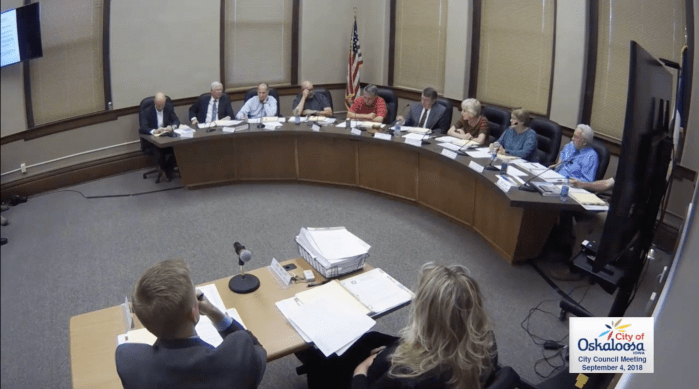
A flurry of confusion threatened to derail public comment after a man with a ponytail and shorts leaned into the microphone and quietly began his remarks.

“I came in tonight to speak about the resolution to sell–”

“We can’t hear you!” interrupted one council member.

“Speak up a little more,” coached another.

“Hey, Kyle! That microphone doesn’t work. That’s just for the tape,” shouted a third over the crosstalk.

The man at the lectern swung the microphone away from his face and restarted his statement, prompting another fusillade of instructions from every possible direction.

“Let’s get you on TV!”

“We’re still gonna want you to speak into it.”

“We still want you to speak into it so that people at home–”

“Gotcha,” the man responded calmly to cut off the furor. “It’s on TV, too? I didn’t know they still recorded this.”

“You’re live right now!” exclaimed a council member, causing the audience to burst out in laughter, with some smiling knowingly at the camera staring them in the face.

“Cool,” the man nodded. “I was behind the camera like a decade ago.”

Screen Shot 2018-09-06 at 11.08.34 AM.png
Oh, how the lenses have turned!

Moving into the substance of the meeting, Mayor David Krutzfeldt outlined a tricky scenario that stemmed from a meeting several weeks prior.

“The city council discussed the potential sale of several city owned properties,” he prefaced, one of which was 207 North G Street. “An appraisal of the property had been completed with a value of $33,000.”

“In August,” he continued, “staff received a letter requesting to purchase the lot for $10,000. His justification for offering less than the appraised value is that there are significant costs to make the lot developable.”

“At this time, the motion is to set the public hearing.”

City manager Michael Schrock cautioned the council, “it’s not always about the dollar amount. It’s about the plan and the concept. He’s presented a letter saying, ‘hey, I know you have this. Will you sell it to me?’ We’ve done that before.”

Screen Shot 2018-09-06 at 11.10.05 AM.png
The Art of the Deal

“We don’t have to make a decision in two weeks, do we?” quizzed Council Member Steve Burnett.

“No,” replied Schrock. “We’re required to hold a public hearing for any disposal of property. Say, ‘okay. Anybody that’s interested, come on in.’ You could have a third party show up, which we’ve had before. We had people basically outbidding each other in the audience.” Some council members chuckled at the imagined chaos.

Schrock clarified: “that wasn’t ideal.”

“So the public hearing–Wendell would be there with his bid and somebody else could show up and bid on it as well?” an incredulous Council Member Bob Drost reiterated.

“But we’re asking for more than dollars,” interjected Council Member Tom Walling, attempting to tamp down the expectations of a free-for-all in two weeks. “The more complete the proposal is, the higher the likelihood something gets approved that night.”

Screen Shot 2018-09-06 at 11.11.13 AM
Bring blueprints, people

There was a minor commotion from the back of the room. The mayor raised his eyebrows. “Wendell, if there’s something you think the council needs to know–?”

The man with the plan was all at once at the lectern. “I’ve been here for six and a half, almost seven years. I don’t plan on going anywhere else. It makes sense to me to try and control my investment,” he announced firmly–perhaps firmly enough to scare off the competition.

With that, the hearing date was set. May the bidding begin!

Interview #102: Jefferson City, MO Mayor Carrie Tergin (with podcast)

This podcast interview is available on iTunesStitcherPlayer FM, and right here:

Carrie Tergin is famous for her “selfies with the mayor” and is therefore the foremost authority to appraise our International #CityHallSelfie Day Top 10 List. On the podcast, we welcome her back to talk about city hall art, and then discuss one time her own council meeting took a series of unexpected twists.

Q: Mayor, where would you like to start?

A: I have to tell you, these top 10 selfies are just exquisite. We have Waldo, Florida and it was his first selfie! Mayor Louie Davis, to share your very first ever selfie on #CityHallSelfie Day–and he may or may not know this–the requirement is that he’s gonna have to send regular selfies. He can’t just do the one. We wanna see that continue, so don’t disappoint me.

Q: I am inspired that it is never too late to start taking selfies!

A: Absolutely. And the “Where’s Waldo?” I mean, you can do so much with that. Number eight, we have Cary, North Carolina. I have to say, I’m going to give this a number two on Mayor Tergin’s list. Why? Because she has a Snapchat filter. Wow! And a bitmoji on top of it. If you don’t know what either one of those are, you’re gonna have to get with the program!

Q: Has Jeff City ever had a Snapchat filter to your knowledge?

A: Oh, as a matter of fact we have. Shame on me for not taking a selfie with it. Uh-oh. That’s our challenge: figuring out how can we elevate our selfie game? Congrats, Lori. You are my number two choice.

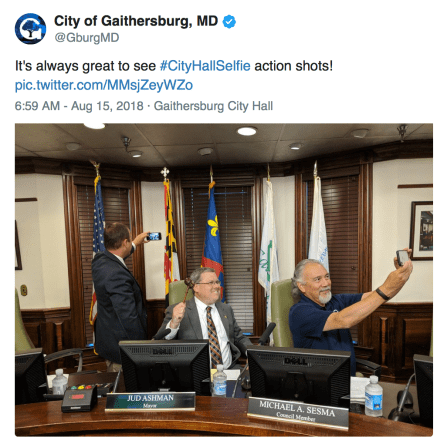
A: This next selfie in Maryland, which is the multi-angle selfie–a selfie within a selfie within a selfie, so basically the “infinity” city hall selfie–that would be my number one. I mean, you can’t hide. When you talk about transparency, when you talk about open government, I don’t know how you can get any more open than that. If you look in there, you’ll just be looking really to infinity to see all of the infinite selfies that are shown in this picture. Really good job on all the action.

Q: I appreciate all of your critiques. I think everyone who entered this competition was a winner, even though they didn’t know I was turning it into a competition! We do have to get back to the serious business of council meetings in Jefferson City. On March 5, I noticed that you could not have a meeting due to the lack of council members. When did you find out that was the situation?

A: Well, sitting there waiting for the council meeting to begin and looking at the clock and starting to say, “where is this councilman and that councilman? Is everybody okay?” And then realizing that “oh, this person did say they were going to be out of town.” At the time I thought, what do you want me to do? You want me to sing? You want me to entertain you? We’ve got everybody here, so how do we have an entertaining time without actually conducting any city business?

Carrie_Tergin_MUG_t755_h1f43f7b56c24e46f1697509bc706c7070b84ccda
Jefferson City, MO Mayor Carrie Tergin

A: That particular night, though, we were also waiting on the crew for the U.S.S. Jefferson City. We have a submarine that is named for our city. We had crew members that were in from Hawaii visiting their namesake city. They had planned to stop by that evening. The cool thing was, even though we had no official business, we were able to spend quite a bit of time with the crew members, have them talk about their experiences. We were able to focus that entire time on our military and all they do for our country. In that moment of panic that “we don’t have a quorum and what are we going to do,” it was almost like it was meant to be, really. It was one of those moments that turned out to be one of my favorite council meetings ever.


Follow Mayor Carrie Tergin on Twitter: @CarrieTergin