Somewhere out there, a city council meeting is happening. And you're not watching it. But I am. Each week, I bring you the highlights, lowlights, and weirdlights from places you don't live.
To see which city councils are doing well and which ones are way behind the times, take a look at the February Month in Review.
And if you heard that nothing innovative ever comes out of a city council meeting, I implore you to read about this little girl’s revolutionary new homeless shelter:
Andrea Reimer has been a councilor since 2008 and has witnessed a significant rise in points of order at her council meetings. We talk about why that is, as well as why some speakers acknowledge indigenous territory.
—
Q: In the Vancouver council meetings, I noticed a lot of people acknowledge that you are on native territory. Are you obligated to do that?
A: We have a formal protocol that the chair of the meeting needs to acknowledge we are on the unseated homelands. But it’s up to each speaker to decide how they want to engage with that. It would be a rule for the mayor or myself when I’m chairing. For Vancouverites, though, who come to speak to council, it’s totally up to them. Many people do make that acknowledgement.
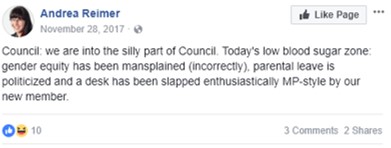
Q: You posted this last year:
Is blood sugar any different now than it was when you got on council in 2008?
A: The main goal of the chair is to get people out of that room by 3:30 in the afternoon. If they don’t, we hit the low blood sugar zone. We do have a brand new council member who just joined us in October who has introduced some activities such as slapping desks. We see that in our parliament–I don’t know if you guys do that in your national government. But we generally don’t do that at municipal council because we’re sitting maybe ten feet away from each other at most. We don’t really need to slap tables to signal that we’re happy or unhappy with something!
Q: I have not seen a city council raise the volume of points of order that I see in Vancouver. Why do you think that is?
A: On my first term of office, 2008-2011, I think we might have had one point of order in the entire three-year period. Then one of the individuals was elected and suddenly we skyrocketed up in number. And then another one, Councilor [Melissa] De Genova, got elected in 2014 and she can do that many before lunch in some meetings. So I think it’s just, different councilors have different styles. Your president’s really into Twitter. We have a councilor who’s really into points of order.
Vancouver, BC Councilor Andrea Reimer
Q: I heard that last year, a lady fainted in your public comment. Is that true?
A: Oh, yeah. We’ve had a few. We’ve had fainting. We had a medical emergency. We had a fire once while I was chairing. I was the only one who didn’t notice it because it was happening behind me!
Q: Has anyone called point of order on that fire?
A: You know, it’s funny. Those were never points of order! We actually completed the council meeting outside. I’m such a stickler for rules because I’d hate for all of the decisions to be overthrown because some procedural breach happens. I made us go outside and formally adjourn the meeting correctly.
Q: During a public hearing about a proposed development in Chinatown, I heard there was some poor behavior. What did you see that concerned you?
A: It sounds like there was some attempts to intimidate [speakers] either verbally or in one case, physically. We definitely heard booing. Probably the most difficult moment for me was we had two members of the Musqueam nation, one of the three indigenous nations, who came up to the microphone to speak and they were booed by a crowd that had used indigenous issues to try and justify their case. It had such a deep-seated disrespect for the issue. I talked to the organizers and they’ve since reached out to the individuals involved on the Musqueam and I understand there has been reparations made. They’ve apologized.
Follow Councilor Andrea Reimer on Twitter: @andreareimer
Right away, McMinnvillians knew something special awaited at the top of the council meeting–almost as special as me calling them “McMinnvillians.”
“Because we’ve had a last-minute change in agenda, we’re going to ask for Chloe to come up and speak to us for about ten minutes,” announced council President Kellie Menke, “on the matter of a prototype that she has built.”
The 11-year-old Thomas Edison took her seat at the witness table in the vast gulf between the council dais and the audience.
“Could somebody help her get the microphone just a little closer?” requested Menke, noticing that the mic was not prepped for a much shorter human than normal.
“I am here as a support for Chloe,” clarified the woman to her left. “I’m her teacher.”
Field trip!
“This project started in my language arts class. We watched a video on CNN for kids. There was a woman in San Francisco who created a mobile shower unit for the transient population,” explained the teacher. “We were talking about one day very soon, they’re gonna be the leaders of McMinnville.”
So, like any teacher looking to stimulate young minds, what did she do?
“I offered extra credit for anyone who came up with a creative solution.”
Chloe launched into a breakdown of her brainchild–a concept simple to understand, easy to visualize, and with a catchy name.
“The Wheel-A-Bed would be like a small–not necessarily a house, but like a shelter,” she described. “The idea is to make a small, about 7′ x 2′ x 2′ box-like shelter with a hollow inside. It would consist of a blanket or small mattress and small microwave for cooking food. The light bulb would be an LED light. The shelter would be solar powered.”
7′ x 2′ x 2′? That seems rather…casket-sized. But as Chloe pointed out, better this than a real casket.
“Homeless people need a shelter to keep them away from thieves, diseases, rain, criminals, and I think you get my point,” she said. Like a shrewd salesperson, she did momentarily acknowledge the device’s weakness.
“One con is the fact that the Wheel-A-Bed does only fit one person. It would be hard to think of just one way to fund a project like this. I know that my aunts, uncles, and grandparents would probably love to donate.”
“May she come up to show you her prototype?” inquired her teacher.
“Oh, we’d love to see it! Yes!” gushed council President Menke.
Tiny House? More like “Slender House.”
Chloe walked slowly across the room, holding up the shoebox-sized model with wheels.
“Very creative!” “Very nice!” complimented the councilors.
“Good job, mom and dad!” exclaimed Menke.
It was certainly a unique prelude to a council meeting. But this isn’t San Francisco, after all. I don’t see how McMinnville–the Paradise of the Pacific Northwest–could benefit from Chloe’s alternative sleeping chamber.
“I can understand the resistance of having RVs, campers, and cars parked in people’s residential neighborhoods, but the people living in these vehicles are still considered homeless,” pleaded the next commenter. “They are still people but are choosing a different lifestyle than most.”
“I’m also here to speak to the RV ordinance,” admitted another woman. “I am really concerned about the fines.”
Hmm, maybe the Wheel-A-Bed is more relevant than I thought….
“On March 21, we are going to allocate a certain portion of our workshop time to vehicular camping,” President Menke reminded everyone.
Well, Madam President, I know an 11-year-old visionary who I hope you invite!
Dylan Bressey is in his first term on the Grande Prairie city council and he came to my attention for obvious reasons. We talked about all the work he puts into his council meeting recaps, plus he gives prospective council commenters some advice on how to keep things relevant.
—
Q: I noticed that during your swearing in, unlike other councilors you did not say, “so help me, god” nor did you put your hand on a religious text. So, sir, are you excited that you are going to hell?
A: [Laughs] You know, it’s actually quite the opposite. I’m a member of the clergy and something that I’m very conscious of is I’m very uncomfortable with religious politics. I really intentionally asked not to take my oath on a Bible, taking seriously Jesus’s words not to do that.
Q: Interesting. That hasn’t brought you any bad luck or hellfire since then, has it?
A: Well, it hasn’t yet, but we’ll see what my eternal destiny might hold because of it.
Q: On February 10, someone tweeted at you
The safety of children must be a priority of this council.Also Dylan you information you provide to the residents of GrandePrairie on your Facebook feed is fantastic . #BresseyForMayor
To which you responded, “I disagree about the hashtag, but council feels a lot like school, so I could get behind #bresseyforvaledictorian.” In what way does your council feel a lot like school?
A: Every week it feels like I’m getting hundreds of pages of documents that our administration is asking us to read. I’m digging through online databases. And I’m even writing a lot of papers. I do a lot of blogging. So I really am treating this like school.
Q: On your website, you really set the bar high for what city council members can do to explain everything about their jobs to their constituents. This thing is an encyclopedia for what, why, and how the city council does its business. How long does it take you to write up a summary of a given council meeting?
Grande Prairie, AB Councilor Dylan Bressey
A: As I’m processing it, I’d say it takes me probably an hour and a half to just do the writing. And then I get somebody to proofread it, I tweak it, I post it on the website.
Q: Some council members tweet out their feelings about council meetings. Others put it on video. I’m sure there’s at least one guy in Vermont who uses puppets or something. What is the advantage in writing out, beat by beat, the proceedings of a council meeting from your point of view?
A: I really don’t like this thing we have going on today where we seem to talk about less and less information more and more passionately whenever we talk about government. It really helps me learn the materials. There’s been quite a few times where I’m writing a blog post and I get halfway through and I realize as I struggle to explain it that I don’t really understand what I just wrote. So I have to study again, call, ask a few questions.
Q: Part of your website is the FAQ. You offer to give people tips on preparing a presentation for council. Let’s say I’m a homeowner in Grande Prairie and my problem is–this being Canada–my neighbors are playing Celine Dion loudly at 4 a.m. and throwing empty maple syrup bottles on my lawn. I want the city to fine them. How do I convince the council to take this problem seriously?
A: Well, I think you’ve already got a good start there. You’ve got a clear problem and you’ve even got a solution you’re suggesting to us. Something we struggle with is sometimes people aren’t able to clearly frame their concern and how they’d like the city to act on it. And that’s hard for us to take a cue from. So coming in with specifics is good.
Follow Councilor Dylan Bressey on Twitter: @DylanBressey
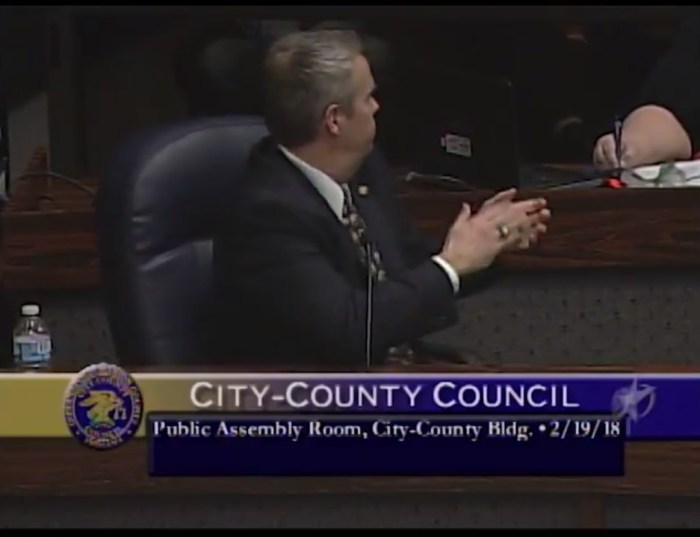
The meeting of the City-County Council of Indianapolis-Marion County (a.k.a. the “Most Hyphenated Council” in the country) began in the most democratic of fashions: with applause for pretty much everybody.
“I’d like to introduce an Orange Township resident, active guy in the community, good friend,” Councilor Michael McQuillen announced, leading the claps for his man in the audience.
Taking a step up from “active guy,” Councilor Scott Kreider introduced two firefighters. Claps.
Not to be outdone, Councilor McQuillen grabbed the mic again. “We have a former city-county council member in the audience.” More claps.
“I want to acknowledge this month being Black History Month,” cut in Councilor LaKeisha Jackson, “and that we give a round of applause for Black History Month.” Raucous claps.
I like this warm-up!
With no one being able to top Black History Month, the councilors settled in for the business portion of the meeting. But suddenly, Council President Stephen Clay dropped a bomb so large it could have leveled a less-emotionally prepared council chamber.
“In an effort to preserve this institution and advance the people’s agenda, Councilor [Vop] Osili and I have agreed to the orderly transfer of power,” Clay read emotionlessly from his prepared statement.
“My letter of resignation from the office of the president will be presented tonight. I will call upon Democrats and Republicans to support this transition,” he warned sternly, “thus averting any political filibustering.”
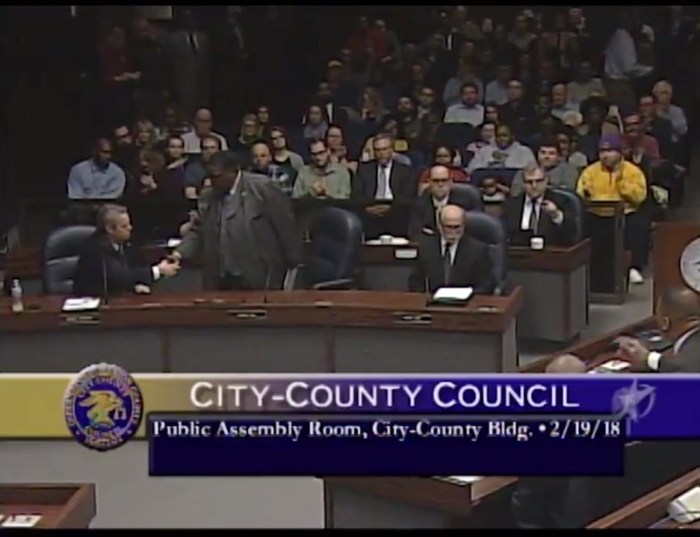
Picking up the gavel in preparation to slam it, Clay noted, “I give the gavel to the parliamentarian.” The chamber applauded one last time as Clay stood up, shook hands, and departed for greener pastures–or whatever you’d call the place where the rest of the councilors sit.
I hardly knew you.
But even this orderly transfer was thrown into momentary disorder when Councilor Leroy Robinson raised his eyebrows and his hand. “Shouldn’t the vice president receive the gavel as opposed to the parliamentarian?” he quizzed.
A constitutional crisis was averted as the parliamentarian calmly agreed. Vice President Zach Adamson hustled over to the chair and opened the floor for presidential nominations.
“I nominate Councilor Vop Osili,” announced Councilor Maggie Lewis.
“Are there any other nominations?” asked the parliamentarian to silence. “The effect of closing nominations with only one candidate will have the effect of electing Councilor Osili as president.”
With no one disputing the outcome, it was official. The new president strode to his seat and with a reassuring smile, delivered a message best characterized as: “there’s a new sheriff in town.”
“Our council has shaken the confidence of our constituents.” He paused. “But that was yesterday. It is time for us to get back to business. And we will start with the next item on the agenda.”
Crack. The. Whip.
With a calm, steady hand steering the ship, the rest of the meeting proceeded with only minor hiccups.
“Madam Clerk, can you set the, uh…?” Osili backtracked after forgetting to open the voting machine. “All right, let’s go!”
A few minutes later, “proposals numbers 56 and 57 were referred to the Metropolitan Economic Development Committee,” Osili read, glancing up from his notes to the chair of the committee.
She was nowhere in sight.
The council patiently waited while someone rushed to fetch Councilor Jackson. Within minutes, she reappeared, power walking back to her seat.
“I apologize Mr. President,” Jackson blurted. While the old president might have chewed her out six ways from Sunday, President Osili remained serene. As he might say, some councilors shake the confidence of their constituents.
Khalid Bey is dissatisfied in many ways with how the Syracuse Common Council operates. It is not transparent to the public and even he gets little notice about what transpires in the council chamber. We discussed the parts that are getting better, but also the parts that aren’t going to change anytime soon.
—
Q: Councilor, I want to read you this tweet:
Sometimes, Syracuse Council meetings are like watching people play a new board game where no one really understands the rules.
A: I think unfortunately it may be pretty accurate. One of the concerns I’ve expressed in the past relative to council meetings is there is more politics involved and not as much good government. I always make the statement that politics disturbs good government. I’ve also made an effort to push for a charter review to reduce some of the ambiguity. There’s just some things that I think need to be made black and white so that the people understand the discussion that is going on in the chambers.
Q: If the Syracuse Common Council meetings were a board game, which would they be?
A. Monopoly
B. Jenga
C. Hungry, Hungry Hippos
A: I would probably say Jenga.
Q: So you have to be really careful because at some point it could all come tumbling down?
A: That’s right!
Q: Not only does Syracuse not video stream its meetings, but I did not see your meeting minutes online either. When I called the clerk’s office, they told me those documents are only available in their office in a physical book of council minutes. Why has the common council allowed this situation to continue?
A: Well, it’s interesting because I’d be surprised if most of the councilors even know that. Because I didn’t know that. I think oftentimes what you’re dealing with is certainly the city being a little behind the times. And we’re talking from a technological perspective. But also, established custom gets mistaken for rule. And sometimes these established customs have to be brought to the attention of the council and others for them to change. So I appreciate you bringing that to my attention because I will tell you: I did not know that.
Syracuse, NY Councilor Khalid Bey
Q: How often are you surprised about what you’re asked to vote on in a council meeting?
A: We get the agenda book less than 24 hours before we’re obligated to come and discuss it intelligently. This is an unfair advantage to the council. This council takes a beating from the media and the public because it often appears ill-equipped–which it most certainly is–having to speak intelligently on something that it just received less than 24 hours. In comparison to somebody from the administration who may have had it for weeks and months.
Q: Do you think the news coverage of the common council has to be thorough precisely because there is so little official documentation of what happens?
A: I think so. Certainly one of the things that people talk about is when they go live stream, the behavior of some of the councilors will change. That is true. That is an unforutnate thing because I need them to see the behavior they don’t know about.
Q: What behavior do you wish or hope will go away once there are cameras in the meetings?
A: I’ll speak for me. When I push legislation, they respond sometimes as if they’re doing me a favor. So I always try to make the case to them, listen: if you have a distaste for me, fine. But it’s not about me. You’re doing work for the people. And sometimes the responses sound as if you’re doing favors for me. If you watch them, that’s exactly what it looks like.
Follow Councilor Khalid Bey on Twitter: @khalidbey
“If you’re not able to hear or see, there’s another area here you’re welcome to stand,” pointed Mayor Jeff Harrington as he wrangled the packed sea of onlookers.
“Since we have a full council chambers,” the mayor advised potential comment-givers, “keep them short to two or three minutes.”
He didn’t mention anything about keeping it civil. But amazingly, it seems he didn’t need to.
“First of all, thank you. I know you guys are all volunteers,” the first commenter showered praise on the leaders. “I am here to respectfully request another public forum discussing the 1918 Building.”
She continued, “I have an online petition with over 800 signatures. I have handwritten signatures of over 2,000,” a staggering 27 percent of the city’s population.
No wonder the room was overflowing–everyone was three degrees of separation from someone who signed a petition!
Right out of a Jimmy Stewart movie, residents quietly stood up one by one, strode to the microphone, and gave impassioned defenses of the 1918 Building. These included the logical:
The current city hall is in decline. The roof is leaking and documents are being stained and ruined. [The 1918 Building is] the strongest, most well-built building in our city. It has a community identity and represents our heritage.
They included the short-and-sweet:
I agree totally with what has been so gloriously stated!
And they included this heartfelt testimony from a woman who adored the haunted house inside:
“I walk into this building and these people have done nothing but treat me like family. They give me and my husband a place to belong,” she said as her voice shook slightly. “It’s not easy for people to admit that they don’t mesh well with our community. So standing here and saying that in front of a whole entire city’s worth of people is a blow to my ego.”
Council members leaned forward on their elbows. The mayor jotted down a note.
“Even though it’s unconventional and it’s scary–‘ooh, it’s a crazy idea and we scare the children.’ Well, yeah, that’s the purpose of it!” she insisted. “We see little children come through and they’re terrified and I don’t have any problem dropping my character and say, ‘hey, I’m a mommy, too. Touch my face, it’s real!'”
If it gives kids nightmares, it’s worth saving in my book.
Per the rules, the crowd remained silent, but it was obvious where the popular opinion lay in the room. Mayor Harrington gripped his pen.
“I really want everyone to know how much I appreciate the level of comfort you have speaking to this city council,” he smiled.
But sadly, the council that had been so receptive and attentive would not last to the stroke of midnight.
“It pains me to announce the next item,” winced the mayor, “but item 10 is the consideration of council member resignation for Joe Peterson. So I would entertain a motion.”
There was silence as no one volunteered to make the motion. Once everyone realized what was happening, laughter broke out.
“You’re not getting out of here!” one person shouted to Peterson.
“I will make my motion!” Council Member Peterson hollered.
Council Member Dani Gurley whipped her head around. “Can you do that?!”
“He’s a city councilman, he can do whatever he wants!” observed Council Member Mike Thompson.
But who would take his place, inheriting the massive conundrum of the 1918 Building?
“The precedent has been set many years ago,” Mayor Harrington explained. “We’ve asked applicants to make an application and then we’ve taken those applicants to a board of past mayors to review. They made a suggestion to me. I bring that here.”
Ah, secret society stuff. I love it. Who did the Illuminati endorse this time?
“I’d like to appoint Chris Wood to the vacant Ward 4 position,” he said, gesturing to Wood in the audience. Everyone turned to look.
“I am very proud to be a member of the council,” she called out.
“And you know: new council members bring the cookies,” warned Council Member Thompson.
Derek Silva is in his second year as the Ward 4 councilor in Middlesex Centre and is a staunch advocate for video streaming his council meetings. He is leading the charge to get it done this year! Plus, we discuss whether his meeting time of 4 p.m. is a deterrent for potential councilors.
—
Q: Derek, you listen to the podcast so you are well aware that there is one HUGE problem with Middlesex Centre council meetings that I’ve talked about on here many, many times. And that problem is, say it with me–
(unison) Q: –video streaming. A: The Ward 3 Strangler.
Q: Wait, sorry, did you say the “Ward 3 Strangler?”
A: I said video streaming. What’s the Ward 3 Strangler?
Q: Uh, sorry, I misheard you. But yeah, video streaming. There is no audio visual evidence of your council meetings. What are your views on this travesty?
A: Part of the issue has been cultural. We do get a few folks at council meetings, but certainly past councils didn’t see it as a priority. I’m happy to report that in our search for new digital agenda software, staff is also using that opportunity to look into video streaming. I’m confident that for the next council session starting in December, live streaming will be there, maybe sooner.
Q: That is fantastic. Normally when I ask people that question, they’re like, oh it’s important…and I never hear from them again. But you’re saying you have a time! When you campaigned in 2014, you mentioned that streaming could be done at a cost under $1,000. How did you arrive at that figure?
A: I arrived at that $1,000 figure understanding that we are a small municipality. For the prices at the time, I didn’t see the need to invest a whole ton of money in getting a camera and start live streaming to YouTube. My direct comparison was to the city of London [Ontario], which bought multiple cameras which would automatically pan and tilt and zoom to the person speaking. And they were paying a private company to host the server. You keep adding all these extra layers and you realize this costs $40,000-$50,000. My point was, something is better than nothing, so let’s do something.
Middlesex Centre, ON Councilor Derek Silva
Q: In November, Deputy Mayor Aina DeViet asked for a list of start times of other municipalities in Ontario. Why did she want this? Are you guys having problems with your meeting start times?
A: Aina said that she had multiple people express an interest in running in the election this year. Which is great because in 2014, the only contests that Middlesex Centre had were in Ward 4 and for the school board trustees. Aina had been hearing from people who said, I’d love to run for council but Wednesday at 4 p.m.? Not gonna happen. I get that. Not exactly the most convenient time.
Q: Do you think there’s anything else scaring people away other than the meeting start time?
A: I think it’s a variety of reasons. If it was just attending meetings, I imagine lots of people would’ve run for office. But there are lots of people who aren’t built for a very customer service-type role in a lot of ways. It’s been said a lot lately, but there is definitely this misperception about what level of influence municipal politics has over your life. Municipal government has a much, much bigger influence and yet gets far less [of] pretty much everything.
Follow Councilor Derek Silva on Twitter: @DerekSilva
The first city council meetings probably began in Ancient Mesopotamia, but here we are 6,018 years later and they are still going strong! We rung in the new year with the inauguration of fresh council members and some unconventional suggestions from the old ones.
In perhaps the biggest event of 2018, I gave the annual State of the City Council Meetings address to a joint session of Congress. While I feel bad that they all had to return a few days later for some other “state of the” something, I got my message across loud and clear: I, too, can read a teleprompter.
For the address, the reviews, and the podcast interviews, do not wait another year to check out the January Month in Review.
And if someone tells you that January was just a so-so month for council meetings, you tell them, “when else are you gonna hear a councilor say the phrase, ‘Brawls Deep?'”






 City Council Chronicles