Interview #123: Philadelphia, PA Councilman Derek Green (with podcast)

This podcast interview is available on iTunesStitcherPlayer FM, and right here:

Derek Green is a former city council employee and a current at-large Philadelphia councilman. We explore some of the quirky council traditions and the more heated public comments of the last year.

Q: I am shocked to learn that for Philadelphia city council members, attendance is not mandatory. People can vote on bills and resolutions despite having left a meeting. How do you feel about this practice?

A: That is something that’s been allowed over the years in order to record your vote on a matter. I think it gives an opportunity for someone to leave their vote based on the fact they reviewed what’s coming up for a vote and they support the issue and feel comfortable in letting their vote be reflected on the record.

Q: What if someone amends a bill midway through the meeting? Are absentees obligated to vote yes on that, even if it’s a terrible idea?

A: If they leave their vote as aye on all bills and resolutions, that is their vote. If they have a concern, that is something that more likely than not, they will not record their vote in that regard. I think once you become an elected official, your vote is one of your most important things. You need to be judicious in how you give your vote on matters.

Q: Because of the way the chamber is set up, council members have their desks facing away from the lectern for public comment. And I have seen instances where council members are either not in their seats or are facing away from the speaker. I have not personally seen you ignoring commenters, but in general, do you think this behavior is disrespectful? And if so, do I need to come in there and start confiscating cell phones?

A: Whenever we go to public comment, I always turn my chair toward the speaker. I think it’s important to listen to what people have to say. There are times when you are in a session, sometimes you may have a relative or family member contact you with an emergency. Or there can be times you’re trying to deal with some legislation and getting information. I don’t know what my colleagues may be looking at on their phones, so I can’t speak for them.
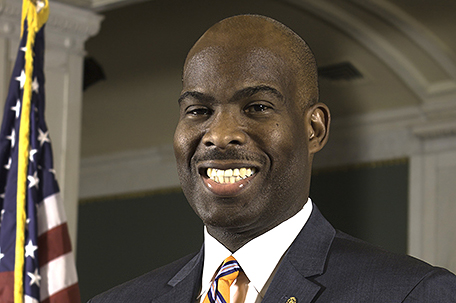
local_05-01-16e.jpg
Philadelphia, PA Councilman Derek Green

Q: I want to highlight one oddity of the Philadelphia council proceedings. To introduce legislation, the clerk physically unrolls printed legislation after a courier walks it from a council member’s desk to the front. I think I speak for everyone when I say: do you guys not have e-mail?

A: Yes, we do have e-mail. However, there are certain things that are done ritualistically. This is a practice that has occurred over the years. In years past, a resolution or a bill that was being circulated to other members of council used to be delivered to that office. Over time that moved from being done physically to being done electronically. But part of the dynamics of city council has been the process where the document that actually has the written language is presented from the sergeant at arms to the chief clerk.

Q: This past fall, you and other council members sponsored a resolution to name a street after former Mayor Wilson Goode. However, Mayor Goode had one major blemish on his record: in May 1985, a bomb was dropped during a police operation to remove a militant group S.W.A.T.-style. Several people were incredulous that a street would have Wilson Goode’s name on it. How extensively had you considered this reaction before it hit the council floor?

A: We have a number of prominent people in the history of this country that–we’re having this debate right now. Woodrow Wilson with the League of Nations, which became the United Nations, has done a lot to promote peace. But also, he had very strong racial views. These historical figures had perspectives, have taken measures and done things to demonstrate leadership, but have also done other things that causes concern.

Q: The difference between the Wilson Goode street naming and the others you mentioned is that the debate in the other cases is whether to remove names from public structures where the people have not lived up to our modern expectations of what morality and racial justice are. In your case, you were reverse engineering it. You were taking someone with an imperfect record and then elevating them.

A: You also have those who say we should not remove other people who have been elevated because the full context of what they’ve done has not been debated. You have some who are adamant in saying, “this is part of our history and we cannot remove our history.”


Follow Councilman Derek Green on Twitter: @CouncilmanDerek

Interview #121: Salt Lake City, UT Council Member Charlie Luke (with podcast)

This podcast interview is available on iTunesStitcherPlayer FM, and right here:

A historic council chamber. Mayor’s question time. And colorful, sometimes impassioned public commenters. These are the hallmarks of Salt Lake City’s council meetings that Council Member Charlie Luke walks us through.

Q: There is an aspect of your meetings that we don’t find in too many American councils: “questions to the mayor.” Why does this happen in your meetings?

A: Tradition. I don’t know when that practice started. It’s been rather hit and miss with mayors actually attending. A lot of times when they are there, we’re just happy that they are there. We’ve just been following the tradition.

Q: At the mayor’s question time of September 18, 2018, council members were upset that the mayor was not present to answer questions about the controversial Inland Port. Isn’t it unfair to say that the mayor doesn’t show up to answer questions when in fact your council oftentimes has nothing to ask her?

A: Absolutely not because most of our questions are going to be related to the items at hand. Especially when there is an issue where there is substantial council disagreement with the administration, there would have been questions for the mayor. That’s where a lot of the frustration was.

Q: So would it not be more realistic for the mayor to show up to the contentious issues, where maybe council members have given her a heads-up in advance that there will be questions, rather than expect her to come to every meeting just out of tradition and sit through silence while no one asks her anything?

A: We have roughly three formal meetings a month. In my opinion, it is not unreasonable for the mayor to attend those meetings. If we were having multiple meetings a week, I think your point would be valid. I don’t think it is asking too much for the mayor of the capital city of Utah to take an hour out of her agenda to sit through our meeting.

387631_158861697556245_975855060_n.jpg
Salt Lake City, UT Council Member Charlie Luke

Q: One year ago, your fellow council members–and you especially–were all set to fund 50 new police officers for Salt Lake City. Would you briefly explain why you wanted those extra cops while I go back to the car and run your license?

A: The response times for non-emergency crimes have been increasing steadily over the past few years. We knew that what we were tasking them [police] with was unsustainable. If we were going to get those response times down, the only way we could do it would be to add more officers.

Q: For half a year, there was an extraordinary amount of people–mostly young, but not always; mostly black and latino, but not always–who spoke up meeting after meeting against the police officers. Their message to you was that A.) more cops don’t mean better safety, B.) we and our communities actually don’t feel safe around police, and C.) you, the all-white city council, have a distorted experience with police that is not our reality. Your reaction to that is what?

A: Nationally, there have been issues with police and racial issues around the country. In the seven years I’ve been on council, we’ve worked closely with the police chief to better train our officers to deal with de-escalation. I’m not discounting what any of them have said. My life experience as a middle-aged white male is much, much different from people of color, women, and others. I’m not ever going to discount what they’re saying. But I am going to go off of numbers and what we’re looking for as a city.

Q: I don’t think that any of the commenters ever said explicitly that this increase in officers was emblematic of racism or white supremacy. But the message clearly was, “the city uses the police to intimidate and in some cases kill us.” I know that you strongly support the additional officers, but can you think of anything that would have to happen with the police in Salt Lake City for you to believe the argument they were making?

A: It’s not that I don’t believe the argument. I do believe that there is legitimate fear and concern. All I can do is try to improve the situation. I can’t go back and fix things that have historically happened. Since we do have to have law enforcement, let’s make them as best-trained as they can possibly be.


Follow Council Member Charlie Luke on Twitter: @CharlieLukeSLC

Interview #120: Clawson, MI Councilmember Susan Moffitt (with podcast)

This podcast interview is available on iTunesStitcherPlayer FM, and right here:

Susan Moffitt experienced an eventful first year on council in which chickens took center stage! She discusses how people’s backyard pets made the news and how the city is casual in some ways about its procedures.

Q: There is a majorly important subject that exploded in your council’s face last year. I’m talking about backyard chickens. Walk me through how Clawson pecked its way into the spotlight on the chicken issue.

A: Historically, although the city had ordinances that prevented having backyard chickens, the practice was sort of allowed. Citizens told stories of neighbors reporting them and the ordinance enforcer going, “yeah, it’s okay that we have chickens.” Someone in the city had a rooster and that led to some complaints. There was a directive to take care of the rooster, which was misinterpreted to mean, “let’s start enforcing the chicken ordinance.” Chickens used to be a barnyard animal. Now they’re kind of pets. So when letters went out saying you’ve got 90 days to get rid of your chicken, they interpreted it as: “you have 90 days to get rid of your pet.”

Q: Were you angry that you had to resolve a crisis that seemed to be created by previous councils and current city employees deciding to have zero tolerance all of a sudden?

A: I don’t think angry is the right word. Never should our citizens be blindsided; but having had that happen, we had a bunch of citizens engaged. It was great that so many people came out.

Q: You seemed to be very pro-chicken from the start. Other council members over the course of multiple meetings said, “well, at first I thought no on the chickens, but now I’m a maybe, and actually now I’m a yes.” Why do you think they ended up joining you? Did it have anything to do with the fact that people showing up to defend their chickens were normal people who looked and sounded like you all and used their chickens for companionship in a very relatable way?

A: I think that had a lot to do with it. People had those personal connections. Ninety-five percent of the people want chickens and five percent don’t want the chickens. The people that don’t want it, they don’t want it on principle. We’ve been able to refute all of their arguments. If you don’t want chickens, don’t have them. But you can’t reach into your neighbor’s yard and decide whether they’re gonna have them.

MoffittHeadShot.jpg
Clawson, MI Councilmember Susan Moffitt

Q: I’m sure you recall your recent meeting of January 2 when Councilmember Paula Millan objected to a vote to confirm the mayor’s appointees because the charter said the council was supposed to receive their resumes–and you did not receive them. How blindsided did you feel?

A: Not only was I blindsided, but the mayor was blindsided. What I don’t understand is if she felt she should have received something prior to the meeting, why she waited until five minutes before the meeting started to request it.

Q: How worried do you get about the city’s image and the confidence people have in the government when one council member waltzes in, pulls out their phone, and reads the section of the charter that you all are not following?

A: That’s one piece in all of the activities that we do. If they’re upset about it, they have the opportunity to talk to us. There’s a lot of pieces of our charter that are old or outdated. I always have concerns about following a law for the law’s sake. One of the things about our city that’s unique is that we have a sense of moving forward without being overly concerned about the laws on a regular basis–evidenced by the fact that we had a chicken ordinance that was prohibiting chickens and it wasn’t enforced for years and years. That’s how Clawson has been governed for a long time for good or for ill. The citizens seem to not be upset by those kinds of things.


Follow Councilmember Susan Moffitt on Twitter: @Moffitt4Clawson

Interview #119: Kingston, ON Councillor Mary Rita Holland (with podcast)

This podcast interview is available on iTunesStitcherPlayer FM, and right here:

Mary Rita Holland is in her second term as Kingston District 7 councillor and she describes the training that new councillors just received, accommodations for children in the meetings, and the choice she regrets from her first term.

Q: The Kingston city council recently started a new four-year term and one of your brand-new councillors, Robert Kiley, wrote in the Kingstonist, “Speaking of meetings, that’s how we finished our orientation: in a mock meeting, with funny motions, like establishing a public kale bar, which articulated step by step what happens around the Horseshoe.” Were you at that practice council meeting?

A: I was. We focused on introducing some new food options, including real dairy products, at our council meetings. Currently we use powdered coffee whitener for members of the public and for staff and councillors. One of the motions for debate was whether we should move toward real dairy.

Q: What was the final outcome of that debate?

A: We voted in favor of real dairy products in our council meetings and I think we also voted in favor of the recommendation for a kale quinoa bar. That was a little less contentious. We do want to see more people come to our meetings, so the better quality the coffee and milk, hopefully the better the attendance!

Q: On April 7, 2015, you proposed having childcare for certain public meetings. What is this revolutionary, socialist utopian idea of yours?

A: I am a single parent, but I was aware of the fact that I was probably the first member of council in a situation like this–where if our meetings went really late and I had a babysitter, that was a problem for me. So it seems like there are a number of barriers for younger members of the public to participate in our democracy. I thought by introducing childcare at meetings, it might mean that for those families who wanted to get out and participate, they could do that and they could feel very comforted that their children were having a good time in the room next-door.

44181459_2047520235309428_2015158196691271680_n
Kingston, ON Councillor Mary Rita Holland

Q: I want to take the listeners to June 13, 2017. This was the start of what ended up being a 10-hour meeting over two days about a “third crossing”–a third bridge over the Cataraqui River. Right up top, Councillor Peter Stroud attempted to curtail that by moving that the staff presentations get cut so the question time could start sooner. The council defeated that idea. I understand that Councillor Stroud stepped out. Would you describe to me what you recall?

A: He stepped out of the room. I stepped out at the same time, although that was not coordinated in advance. But we had the same rationale for getting rid of that briefing: we’d already heard the information more than once. We thought the time would be better spent hearing from the public. In a bit of an act of protest, we both left the council chamber.

Q: What did you do?

A: I found Councillor Stroud standing at the front entryway. The two of us stood there at the door and complained a bit about the motion losing. We were frustrated with how the entire vote and decision had been proceeding all along. We were talking about it in the entryway. That didn’t seem wise and we don’t really have a private room for our own discussions at city hall. He said, maybe we should go across the street to the pub and chat a bit more.

Q: Did anyone come up to you while you were in the pub and say, “hey, wait. There’s a council meeting and you’re councillors, so…what?!”

A: No. Of course I had it in the back of my mind that it wasn’t wise to be leaving the building, but I guess given the fact that I knew I had to go back to that meeting and be composed, I thought it made a bit of sense to go and calm myself down a bit. It turns out there were members of the media in the pub. When I went back to my seat in the council chamber, there was a tweet going around about the fact that we had left.

Q: Reflecting on that tweet, do you think that take of “walking out on the job” was an accurate one?

A: Yeah, and I’m laughing about it a little bit today but that turned out to be a very difficult time. I care a lot about public engagement and the public trust and I want people to not be cynical. When I realized that this would make people cynical about politics, that it was a bigger deal than getting out for a breath of air, I felt really awful about it. I should have stayed.


Follow Councillor Mary Rita Holland on Twitter: @MaryRitaHolland

Month in Review: December 2018

In the final month of 2018, we were fortunate enough to experience some of the most thrilling, most breathtaking council meetings of the year.

It was in December that we learned about the city council that was abruptly slashed in half by a higher power.

And it was in December when we heard from a city commissioner who essentially sat through a Trump rally and received heavy criticism.

Naturally, it was also difficult to escape the holiday cheer–like the city council that honored the best home decorations of Christmas 2018.

To look under the tree and see which December council meetings we wrapped for you, peek at the December Month in Review. (And check your stocking for the podcast.)

And if you are pondering why these people are dressed so festively, educate yourself by clicking here:

Screen Shot 2018-12-19 at 5.34.38 PM

Month in Review: November 2018

Turkey. Cranberry sauce. Council meetings?

In November, there was plenty to be thankful for in municipal governance, as we witnessed several provocative council meeting moments worth reviewing.

Remember the city council that grew some “jacket envy” after seeing a group of international visitors?

Or the city that was running out of space to list its sports victories?

Surely you recall the council member who brought Donald Trump into a meeting in a bigly way?

But it was also a month for fresh ideas for how to run a council meeting. For example: conduct a racial equity training. Or have high school students present new policies.

To see what we served up on the Thanksgiving dinner table, visit the November Month in Review.

And if you are curious about whether anyone has raised the roof in a council meeting, this guy answers that question:

Screen Shot 2018-11-02 at 9.20.46 AM

Podcast Recap: A Council Christmas Carol

This Christmas, we are celebrating the third year in a row that City Council Chronicles (and our other project, Tear It Down) has made the ELGL Top 100 Local Government Influencers list! We are very thankful for the award, and you can read more about the other 99 honorees on ELGL.org.

Simultaneously, you can listen to our holiday-themed podcast episode on iTunesStitcherPlayer FM, and right here:

CCCXMAS

On this episode, you will hear excerpts from these full interviews:

1. Interview #109: Calgary, AB Councillor Jyoti Gondek (with podcast)

2. Interview #114: Toronto, ON Former Councillor Joe Mihevc (with podcast)

3. Interview #112: Minneapolis, MN Council Vice President Andrea Jenkins (with podcast)

4. Interview #117: Boynton Beach, FL Vice Mayor Christina Romelus (with podcast)

As always, the podcast’s sponsor is Dig Deep Research. They assist local governments in obtaining grant money and are eager to hear from potential new clients. Find out how they can help you today:

DigDeepLogo-1

Interview #117: Boynton Beach, FL Vice Mayor Christina Romelus (with podcast)

This podcast interview is available on iTunesStitcherPlayer FM, and right here:

Christina Romelus is a first-term commissioner and current vice mayor who has experienced pirates in the commission chamber, commentaries on dog poop, and a vote to appoint a new commissioner. But one of the most difficult moments came in response to an idea she raised last year.

Q: On December 5, 2017, you proposed a sanctuary city policy, which basically said that local police will not be enforcing federal immigration law. We have covered sanctuary city debates in other councils. But in the case of Boynton Beach, you all easily had the most boisterous and most raucous public comment of anyplace I’ve seen. How did that make you feel?

A: It reminded me that the First Amendment is alive and well [chuckles]. One of the things that we as America pride ourselves on is being the land of the free and the home of the brave. We provide opportunities. People who come here trying to escape tyranny, they sometimes find worse treatment than they had back home. I’ve never robbed anybody. I’ve never beat up, murdered, stolen anything. Yet when people find out I’m an immigrant or hear the term “immigrant,” that’s what their mind gravitates to.

Q: Mmhmm.

A: The proposal that I was trying to have that night when it turned into a sanctuary city discussion–which is what I never intended for it to be–it was a fruition of the decree that President Trump was cancelling temporary protected status for individuals from countries like Haiti, Honduras, Venezuela, I believe. Those points of view never even got out of my mouth. The second “sanctuary cities” was blared out, it just became an all-out attack on me.

Q: We heard one man say you should be impeached or removed. That is new for me in a sanctuary city debate. What struck me was how personal it got in Boynton Beach. Why do you think that was the direction it took?

A: Half of the people in that room were not Boynton Beach residents. It literally almost became like a Trump rally in chambers. The entire chambers was filled with people with signs–“build the wall!”

Screen Shot 2018-12-14 at 6.14.08 PM.png
Boynton Beach, FL Vice Mayor Christina Romelus

Q: How surprised were you that all of your other commissioners and the mayor rejected your proposal on grounds of “law and order?”

A: Having you replay this is all raw for me all over again. That night was not an easy night for me. I believe in the Constitution. I took an oath as well to protect and defend the Constitution. And I do that. But we have a duty to protect those who can’t protect themselves. When a black person was considered three-fifths of a person, that was in the Constitution. Was it right to uphold that then? That’s political speak, I feel, for cowering away from the conversation. It was the most politically-savvy way to look like “I’m obligated, my hands are tied,” not necessarily because it’s the right thing to do.

Q: There was a recess after this topic and the commission meeting continued. I noticed you were not there for the remainder of the meeting. Why was that?

A: I could not remain in a room filled with that much hate aimed at me. I could not sit on a dais with people who did not even take the time to consider the reasons or to hear out the arguments why I brought up the conversation. I was not in the right state to continue with that meeting. I actually had somebody escort me home from our police department because that’s how unsafe I felt.


Follow Vice Mayor Christina Romelus on Twitter: @romelus_c

Interview #116: Richmond, BC Councillor Alexa Loo (with podcast)

This podcast interview is available on iTunesStitcherPlayer FM, and right here:

Alexa Loo is a former Olympic athlete and current city councillor who has witnessed a pull-and-tug over the maximum size of houses on Richmond farmland. She explains what the root of the issue appears to have been for some people.

Q: I must congratulate you on being newly inaugurated to a second council term. Whose idea was it for the men and the women to take separate oaths of office?

A: What ended up happening is the men ended up sitting on the one side of the room and the women sat on the other side. It just worked out that way. On the women’s side, we even sit in alphabetical order. And that wasn’t planned either.

Q: So is this going to be like a seventh grade dance with the boys on one side and the girls on the other for the next four years?

A: Yes! It is what it is.

Q: On your island, you have something called the agricultural land reserve. About 39 percent of Richmond is farmland. Why were some councillors concerned about how long that would last?

A: There had never been a cap or a limit on the size of house that you could have on agricultural land. House sizes started to get bigger. There were starting to become applications for things as big as 40,000 square feet. You can put a skating rink in 40,000 square feet.

Q: In a meeting, your council decided to put a cap on the size of a house on farmland to around 11,000 square feet. I don’t know a lot about farming, but I’m assuming that with my bedroom, my children’s bedroom, my tractor’s bedroom, my wheat thresher’s bedroom, and the bedroom for my livestock–even with bunk beds I’d be pushing it with 11,000 square feet.

A: Well, a wheat thresher is so big, you can’t even drive it on a standard road, so–

Q: I would need a really big bedroom is what you’re saying?

fFq1wGpb_400x400
Richmond, BC Councillor Alexa Loo

A: You would. There’s a whole bunch of rules that still protect the farmland, so at some point, does it matter if they have a three-car garage or a four-car garage? Does it matter if you have six bedrooms or five bedrooms? Why is it anybody else’s business what they’re doing?

Q: The fact is some people were unhappy with the limit. They thought 11,000 square feet were way too many–

A: And there’s a lot of people that don’t want a proliferation of South Asian people living on farmland.

Q: Their outrage was specifically aimed at limiting a racial or ethnic group from building these houses?

A: Typically those are the people building it. It’s easy to go after the size and shape of things if you know it’s gonna stick it to that group, I think.

Q: You referred in council meetings to the “good old boys” and fairness. Why in the meeting did you couch your language like that?

A: Because standing up at a council meeting and calling other people racist is a bold and dangerous move. Throwing names around like that–we’re not allowed to call people names.

Q: Were there any other councillors who felt the way you did about the racial aspect?

A: Oh, everybody’s well aware of it. The 23,000 square foot house that had been built, it had been built by a Caucasian person in Richmond. And he had a bowling alley in it. So when people are like, “what do you need a big house for?” He needs a bowling alley, apparently. But nobody seemed to have a big problem with it. They were more in awe at the time. But now if somebody else builds one, there’s a problem around it.


Follow Councillor Alexa Loo on Twitter: @alexaloo