Interview #74: Juneau, AK Assembly Member Jesse Kiehl (with podcast)

This podcast interview is available on iTunesStitcherPlayer FM, and right here:

Jesse Kiehl works for the Alaska legislature by day and serves on the Juneau assembly by night. On the podcast, he promises that the era of live-streamed meetings is dawning, explains a few uniquely-Alaska issues, and recounts a disturbing incident that happened mere feet from an assembly meeting.

Q: Jesse, I don’t care if you do live in Alaska and I don’t care if you can see Russia from your house. I–well, actually, CAN you see Russia from your house? That would be pretty boss.

A: We’re a little too far away.

Q: Oh. Well, ahem, I don’t care if you CAN’T see Russia from your house. Why can I not go online and see the Juneau assembly meetings?

A: Because we’re cheap! There is an individual who has been voluntarily putting those up online now for about eight, nine months. He is a businessman and is interested in competing for a contract to do that. I agree with you, Michael. It’s time.

Q: Do you have any idea when is the earliest we could see the new video system? 2018? 2019?

A: It wouldn’t surprise me if we got started in the early summer.

Q: Well, you’ve got to get your beach body in shape. Does that scare you?

A: I do not have–nor will I ever have–a “beach body.”

Q: Fair enough. This being Alaska, I want to talk about the Alaska-specific things people might find in your assembly meetings. For example, in your September 2017 meeting, a bunch of people showed up angry about a bear who was shot by police. How often do issues like this come up–that city councils in the lower 48 probably are not dealing with?

A: Most of the issues really are the same. I suppose people who have raccoons get in their garbage are a little more worried about rabies from a bite instead of mauling. But otherwise, it’s about the same.

jesse
Juneau, AK Assembly Member Jesse Kiehl

Q: At the June 6 meeting, apparently there was some shouting outside the chamber and the mayor called a recess to have people investigate it. I think you were one of those who walked out of the room. Do you remember what happened?

A: There’s a public restroom on the other side of the chamber and there was a domestic violence incident–ah, let’s call it what it was: a guy beat up his girlfriend just outside the restrooms. There was shouting and thumping. We jumped up and the only person who got up faster than me was [Assembly Member] Jerry [Nankervis, a former police officer]. Unfortunately, she was not interested in police protection or a ride to our domestic violence shelter and that’s really hard. You intervene in hopes that people will get the help they need. But that time, they didn’t.

Q: When you’re sitting there in the meetings, you’ve got 33,000 people that you want to make life better for. But when it’s just one person who is not susceptible to persuasion or to you as an authority, I’m sure it’s quite a contrast and made you feel somewhat helpless.

A: [Sigh] Seeing and hearing something like that during a meeting sure keeps you grounded. It keeps you focused on the ways we make life better–or fail to–and the impacts those have on people who don’t have the level of comfort that all of us on the assembly do.


Follow Assembly Member Jesse Kiehl on Twitter: @JesseKiehl

Interview #72: Hamilton, ON Councilor Matthew Green (with podcast)

This podcast interview is available on iTunesStitcherPlayer FM, and right here:

Even though he’s only in his first term, Matthew Green has very sophisticated views on the mechanics of city council meetings. We explore his strong pro-video streaming beliefs and the plague of long-windedness.

Q: You sometimes Facebook Live stream your speeches from the dais. You talk a fair amount at council meetings, so how do you decide what moments are worthy of Facebook Live?

A: When I started, the old-school model was councilors would give inside information to mainstream media in exchange for favorable coverage. I found that in not doing that, my positions at council were miscommunicated or misrepresented. I remember getting upset about it. I had a media expert, she said to me, “don’t get mad at the media. Become the media.”

Q: Hmm.

A: Facebook is a hyper local medium and so I choose Facebook to communicate to my residents.

Q: Have you ever watched a Hamilton council meeting online through the city’s website?

A: It is horrible.

Q: Right?!

A: It is terrible. An incident happened in council chambers and I wanted to open an investigation. In doing so, I looked at our live stream and realized our live stream did not cover major sections of the whole chamber. So I had to [freedom of information request] my own city to get the security footage to provide me with the incident I believed I saw. We’re very fortunate [to have] an independent journalist. He runs a live stream called “The Public Record.”

Q: Yeah.

mgreen
Hamilton, ON Councilor Matthew Green

A: He has built a reputation for himself in capturing the circus that is often city hall: the inappropriate comments, the workplace toxicity, or some of the decorum issues. He creates a prism in that people are aware that he’s there and sometimes, I think, it raises the decorum and the level of discourse because they know they’re being recorded. When there’s no media present, we sometimes say the zaniest things.

Q: It’s curious you mention decorum because on everything I’ve seen, the Hamilton city council behaves relatively well. Again, maybe it’s because he’s there recording, but what are some of the issues you’re referencing?

A: One of the governance challenges we have, in my opinion, is that we don’t have a strong chair role. We rotate the chair, which allows councilors from month to month to use that position as a bully pulpit. It provides a situation where chairs will allow councilors to speak at length or speak in very harsh and personal terms to staff, which should be shut down.

Q: Are you ever worried when you become the chair that people will have similar reservations about the job you’re doing?

A: I’m actually comfortable chairing meetings. We’re not THAT bad. It’s really a conversation around time. We’ll have four or five of us who monopolize all of the time. In the technology of our microphones, they’re supposed to shut down after five minutes.

Q: Mmmhmm.

A: The idea is that if I’m the chair, I don’t want to shut you down at five minutes. So I let you just go! I do that with the understanding that sooner or later you’re going to be the chair and I’m going to have an issue that I want to go on. It’s a bit of nudge-nudge, wink-wink that I think is problematic. But we’re all guilty of it.


Follow Councilor Matthew Green on Twitter: @MGreenWard3 

Month in Review: October 2017

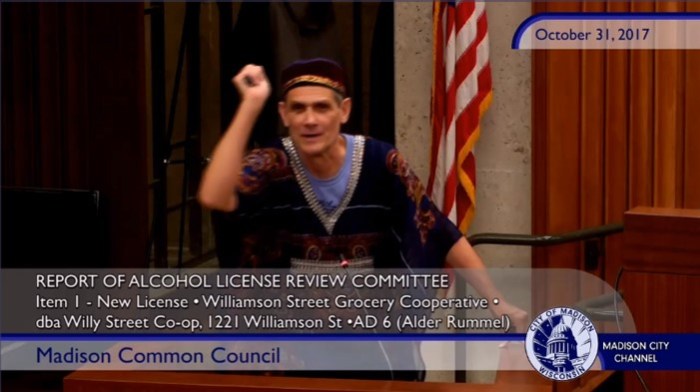
October is an exciting month because you can always count on at least one city council to really get into the Halloween spirit. Sure enough, Wisconsin delivered. But there were plenty of other highlights, including a sudden competition between two cupcakeries and a mayoral field trip that I may have been invited to.

The podcast was also busy, as we heard from a former Scottish Highland dancer, a city manager who remembered the ejection of one council member, and a robot-heavy episode of our “Best Thing, Worst Thing” project. Look at the highlights in our October Month in Review.

And if you still aren’t convinced that last month was any different from the other 11 months of the year, THIS wizard-priest will cast a spell on you:

mad2

Special Feature! Best of “Best Thing, Worst Thing”

This past year, I had an AMAZING experience. I visited 12 cities and towns across North America for the “Best Thing, Worst Thing” project. The idea was simple: see as much of the city as I could, talk to as many people as I could, and ask them all the same two questions.

What is the best thing about this place?

What is the worst thing about this place?

Answering those questions can be surprisingly difficult, but it was important for me to hear about individuals’ values and experiences with their communities. I learned that a small city in conservative western Kansas thinks of itself as “progressive.” I learned that diversity in Toronto is much heralded, but also has a dark side. And I was present for a medical emergency in the desert outside Las Cruces, New Mexico.

tor
Butter tart bake-off in Toronto, ON

The goal was to find out what cities are doing well to make their communities livable for residents. Then, to find out what people want that their cities aren’t providing now.

You can listen to all 12 episodes on the project page. And this week, I bring you the highlights in a special audio episode about the best of the “Best Thing, Worst Thing.” This “best of” is available on iTunesStitcherPlayer FM and right here:

pgh
Robotics camp in Pittsburgh, PA

If you liked what you heard, please give the podcast a five-star rating on iTunes and like our Facebook page. There are other big projects in the works, so keep checking back!

Shout-out #3: Richmond, VA

Longtime readers may remember that earlier this year, I reviewed a Richmond, Virginia council meeting and discovered something highly unorthodox: a city council host who did pregame and postgame commentary.

rva1.jpg

The man is Dick Harman. He has anchored the Richmond council meetings for nearly 30 years (one year down, 29 more to go for me, by the way). Nowhere else have I seen a city council with its own Dick Harman, which came as genuine news to freshman Councilwoman Kristen Larson, who I interviewed on the podcast after her very first meeting in January.

Fast forward to this week. The Richmond city council surprised Dick Harman by naming the media gallery in the council chamber after him!

But it was in Councilwoman Larson’s comments that she recalled her initial realization that a city council host was special and unique to Richmond, and then proceeded to call Dick Harman “special and unique” to Richmond:

Thank you for the shout-out and congratulations to Dick Harman! He is, of course, welcome to come on the podcast anytime and tell me where the skeletons are buried. And other city councils are highly advised to recruit their own council commentators during this Golden Age of Live Streamed Council Meetings in which we are living.

Why should Richmond have all the talent?!

Interview #71: Port Moody, BC Mayor Mike Clay (with podcast)

This podcast interview is available on iTunesStitcherPlayer FM, and right here:

We covered a lot of ground in this interview with Port Moody’s Mike Clay. For instance, where does the mayoral title “Your Worship” come from and does he like to be called that? We also listen to some beautiful music and time travel back to 1913 to reenact a city council meeting.

Q: In Canada, people refer to mayors as “Your Worship.” Where does this term come from?

A: I don’t know. It must come from Old English somewhere. It was probably from the House of Lords or something. I don’t like the term. I don’t like people referring to me that way. The funniest thing that ever happened was I had a conversation with the archbishop one time and he asked how he was supposed to refer to me. I said, “well, you’re supposed to refer to me as Your Worship, but I don’t think we’re going to ask you to do that!”

Q: [Laughs] Is there a more secular term you’d want to be called?

A: In council, I prefer Mr. Mayor or Mayor Clay. Something much simpler and less snooty.

Q: Port Moody started video streaming council meetings while you were mayor. Do you since have any regrets about what you’ve said live on TV?

A: The good thing about capturing people in the moment is it’s raw. It might be emotional but you read council minutes [and] the legislative diaries and stuff, you don’t get any sense for what’s really going on. Without the video in the past, my interactions with different politicians–people say, “I was really fighting for that!” And I think, “I was there. I don’t think you really were.” So it might be interesting for people to say, “yeah, you know what? They really were fighting for it. I watched that on live stream.”

Q: Yeah.

A: I have WARDROBE regrets, but other than that….

mikeclay.jpeg
Port Moody, BC Mayor Mike Clay

Q: [Laughs] What do you think about where council meeting technology is headed?

A: I think there’s opportunities to throw certain things up to a public vote, a mini-referendum. If it’s issues that aren’t life or death–if somebody said, “I think we should paint it blue,” and someone else said, “I think it should be green,” why don’t we throw that out for a public discussion and a vote right there online while we’re doing it? It might not be serious engagement, but if they joined in for that part of the conversation, maybe they’ll hang around for other parts as well.

Q: You do remember our election in 2016 where there was some MINOR propaganda by a FEW million Russian Twitter and Facebook bots. Are you worried the Russians could also hack your insta-polls?

A: Well, for now until we know that we have locked down security, [we’d be] taking it for opinion polling.

Q: Here is something weird I found: in 2013, the centennial of Port Moody, you reenacted the first-ever council meeting from 1913. Whose idea was that?!

A: Wow, I don’t know whose idea it was. I think it was a great idea. It got so funny during the meeting I could barely contain myself from breaking up laughing! It turned out we had some impromptu comedians on our council. How much of it was made-up? Most of it. But it was reflective of the way people think things were in those days.


Follow Mayor Mike Clay on Twitter: @MikeEClay

Interview #70: Mountain View, CA Councilmember Margaret Abe-Koga (with podcast)

This podcast interview is available on iTunesStitcherPlayer FM, and right here:

Mountain View is home to Google and to a very polite city council. Margaret Abe-Koga served two terms on the council, took two years off, then was elected again in 2016. She talks about the negative stereotypes she faced initially, how people treated her during her year as mayor, and her positive experience phoning in to a council meeting from home.

Q: It’s interesting–a lot of European cities do what Mountain View does, where the mayor is not elected separately, but a council member has the position for a year and it rotates. One thing I heard is that when you’re only mayor for a year, you don’t get as much respect. What do you think about that?

A: I definitely felt more respect. A former council member in Palo Alto who served as a county supervisor said one time how very few people know what a county supervisor does. But everybody knows what a mayor is because every city in the world has a mayor. There was that recognition. I was vice mayor to Tom Means and I had to fill in for him oftentimes. But when I would call and offer to show up, sometimes I would get declines because I was ONLY the vice mayor!

Q: Do you think that council members who talk for too long have been a problem in the meetings? Or does everyone hate a chatty council member until you bring up something THEY care about? Then all of a sudden, they don’t think it’s so bad to talk for ten minutes about it.

A: I think everybody starts out thinking that chatty council members are challenging but I would say we all at some point have been that chatty council member. When I first started, I actually had folks come up to me and say, “why don’t you talk more?” I did feel like I had to speak up just to speak up. The public noticed when I didn’t say much.

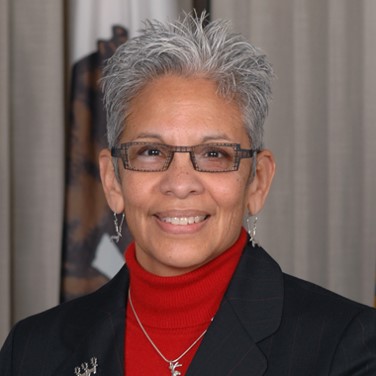
mak.jpg
Mountain View, CA Councilmember Margaret Abe-Koga

Q: When citizens said that to you, did you read anything into that? About you being a young person, a woman, an Asian person–how they were projecting their ideas of how you should present yourself onto you?

A: Yes. I had folks who thought I was nice and sweet. Some thought I was too sweet to be an elected leader. That was what one of the newspapers said about me, so they didn’t endorse me. [I’m] fairly petite, Asian, I smile a lot, but there definitely were stereotypes. When I became mayor, I had a hate e-mail saying, “you folks are overrunning the city. Go back to where you came from.” I frankly, unfortunately, expected that to happen.

Q: I should point out, you were the only Asian person on the city council. It’s hardly an overrun!

A: [Laughs]

Q: That makes me think about the rotating, one-year term for the mayor and I guess that’s a virtue of everyone having the chance to be mayor at some point. You get to try out a “nice” style. You know you’ll get your shot.

A: That’s true. It ties into the politeness of our council. The fact that we take turns is a very polite way of handling it….The downside is [the term is] short, but if you’re not doing a good job, it’s only a year!


Follow Councilmember Margaret Abe-Koga on Twitter: @margaretabekoga 

Interview #69: Daly City, CA City Manager Pat Martel (with podcast)

This podcast interview is available on iTunesStitcherPlayer FM, and right here:

Pat Martel has been working in government for over three decades and has seen a looooooooooot of council meetings. Plus, she served as president of the ICMA and got to hear from other city managers about their council concerns. We talk about how to ensure civil meetings and, if necessary, whether she would take a bullet for her council.

Q: As ICMA president, did any city managers e-mail or call you and say, “I am really struggling with my council meetings. What advice can you give?”

A: I have been asked that question. We recognized in ICMA that these are issues our members are struggling with. We have had sessions on this very issue–how to have civil meetings. There’s a need for us to solicit input [from the public], but it’s not useful input if we allow that to digress into yelling and screaming. Having the mayor understand that their role is to facilitate the discussion, but when it gets out of hand, to put a stop to that…it’s not infringing on anyone’s free speech to cut off conversation if it becomes uncivil.

Q: Mmm.

A: It’s also important for the city staff to clarify issues that the public may misunderstand. Or, worse yet, to try and identify the “fake news” on which people are basing their comments.

Q: Just for clarification, did any of the recommendations from that session include listening to the City Council Chronicles podcast?

A: [Laughs] No, but come to think of it, it should have! I have found listening very valuable.

Q: Thank you for saying that!

patmartel.jpg
Daly City, CA city manager Pat Martel

When did you accept the reality that as city manager, you are sometimes the face of unpopular proposals at council meetings?

A: I learned that a very, very long time ago. The position of city manager is a lightning rod for those who don’t agree with certain proposals. It’s not personal. Although council members and the public can make it personal. I think that oftentimes, council members who want to take me on on a particular issue see that the level of information I have exceeds what they have [and] they take it personally. My job is not to stand up to them. It’s to educate them about how things really work. I am really glad to meet with my council members before a meeting to go over things so I don’t have to present information to them in a meeting that will put them in a position where they look like they’re not very knowledgeable.

Q: In June 2014, the council was deciding whether to locate a cell tower in the city. After they voted in favor, a man rushed onto the dais and stood six inches from council members, jabbing his finger in their faces and yelling. How worried were you?

A: I was very worried. That’s one of the reasons why the police chief or one of his captains is always in attendance.

Q: If the chief was out of the room and an incident happened, would you take a bullet for your council?

A: I guess it would be my job to throw myself in front of that onslaught! While I don’t wear a badge, I have a sufficiently directive voice. I think I could probably calm someone down enough, so I would do it.


Follow City Manager Pat Martel on Twitter: @DalyCityManager

Interview #68: Boise, ID Council Member Lauren McLean (with podcast)

This podcast interview is available on iTunesStitcherPlayer FM, and right here:

In a first for City Council Chronicles, this week’s podcast guest gets her own piece of artwork to hang at city hall! I talk to Boise’s Lauren McLean about how her past as a dancer prepared her for council meetings. Plus, we spend a good while reliving the crowded council meeting from 2012 about an LGBT nondiscrimination ordinance with a surprise ending.

Q: I heard that you did competitive Scottish Highland dancing until you were 20 years old. What are the similarities between Scottish Highland dancing and the Boise city council meetings?

A: Oh, good question! Let’s see…you have to be super nimble, have lots of energy, a good sense of timing…

Q: Mmhmm.

A: …and want to win.

Q: Nice. Has someone asked you that question before?! That was remarkably fast.

A: No! I just made it up right now.

Q: [Laughs] I love it! Your council has met in several places. What has been your favorite?

A: I really love our current chambers. We have this great piece of local art behind us that is an artist’s version of what Boise is to her. I love looking at the piece, turning around and looking at it occasionally when we’re in longer hearing nights. At one point, it disappeared for about a week. That’s when I realized how much our council members really liked the piece because we got it back right away.

Q: If I were to draw something inspired by this interview, would you hang that up?

A: Um, I might hang it up in my cubby at city hall. I’m so excited to see what I’m going to have up in my cubby/cubicle!

IMG_2320.jpg
Hang it!

Q: On November 13, 2012 you were over at the state capitol. You had hundreds of people there to speak on a non-discrimination ordinance based on sexual orientation. For the first hour-and-a-half, this massive room, plus overflow, had to sit through a mundane set of hearings about planning and zoning. If you could do it again, would you get to the juicy stuff right away?

A: Actually, I’m going to say [pause], I think we would make them sit through it again! It’s the only time we can get an audience that big that sees all the things we deal with.

Q: Most people outside Idaho think of it as a place with potatoes and people who don’t like gay people. Were you worried that by having a hearing on television about this topic, the image viewers would see is one anti-LGBT person after another? Or, even worse, one gay-hating potato after another?

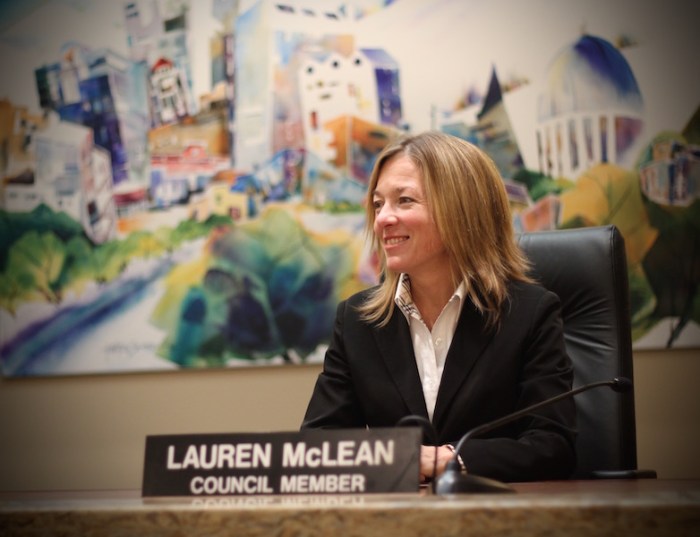
Lauren-City-Council1
Boise, ID Council Member Lauren McLean

A: I wasn’t worried at all. I know our city. The image many people outside of the state have of Idaho is very different from the reality. Really progressive, vibrant, fast-growing cities and universities.

Q: Yeah, and the mood at times was actually pretty light. The mayor didn’t allow clapping, but he did let people do “spirit fingers.” Did the spirit fingers last beyond that one meeting?

A: They did! You don’t see them in council meetings, but when the proponents of the measure came back after the ordinance was passed, [the spirit fingers] came up again. It’s something that I see often in Boise now amongst council members and others–it’s lived on.


Follow Council Member Lauren McLean on Twitter: @laurenmclean