Interview #84: Vancouver, BC Councilor Andrea Reimer (with podcast)

This podcast interview is available on iTunesStitcherPlayer FM, and right here:

Andrea Reimer has been a councilor since 2008 and has witnessed a significant rise in points of order at her council meetings. We talk about why that is, as well as why some speakers acknowledge indigenous territory.

Q: In the Vancouver council meetings, I noticed a lot of people acknowledge that you are on native territory. Are you obligated to do that?

A: We have a formal protocol that the chair of the meeting needs to acknowledge we are on the unseated homelands. But it’s up to each speaker to decide how they want to engage with that. It would be a rule for the mayor or myself when I’m chairing. For Vancouverites, though, who come to speak to council, it’s totally up to them. Many people do make that acknowledgement.

Q: You posted this last year:
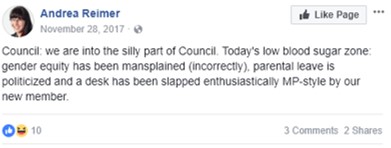
sugar

Is blood sugar any different now than it was when you got on council in 2008?

A: The main goal of the chair is to get people out of that room by 3:30 in the afternoon. If they don’t, we hit the low blood sugar zone. We do have a brand new council member who just joined us in October who has introduced some activities such as slapping desks. We see that in our parliament–I don’t know if you guys do that in your national government. But we generally don’t do that at municipal council because we’re sitting maybe ten feet away from each other at most. We don’t really need to slap tables to signal that we’re happy or unhappy with something!

Q: I have not seen a city council raise the volume of points of order that I see in Vancouver. Why do you think that is?

A: On my first term of office, 2008-2011, I think we might have had one point of order in the entire three-year period. Then one of the individuals was elected and suddenly we skyrocketed up in number. And then another one, Councilor [Melissa] De Genova, got elected in 2014 and she can do that many before lunch in some meetings. So I think it’s just, different councilors have different styles. Your president’s really into Twitter. We have a councilor who’s really into points of order.

andrea.jpg
Vancouver, BC Councilor Andrea Reimer

Q: I heard that last year, a lady fainted in your public comment. Is that true?

A: Oh, yeah. We’ve had a few. We’ve had fainting. We had a medical emergency. We had a fire once while I was chairing. I was the only one who didn’t notice it because it was happening behind me!

Q: Has anyone called point of order on that fire?

A: You know, it’s funny. Those were never points of order! We actually completed the council meeting outside. I’m such a stickler for rules because I’d hate for all of the decisions to be overthrown because some procedural breach happens. I made us go outside and formally adjourn the meeting correctly.

Q: During a public hearing about a proposed development in Chinatown, I heard there was some poor behavior. What did you see that concerned you?

A: It sounds like there was some attempts to intimidate [speakers] either verbally or in one case, physically. We definitely heard booing. Probably the most difficult moment for me was we had two members of the Musqueam nation, one of the three indigenous nations, who came up to the microphone to speak and they were booed by a crowd that had used indigenous issues to try and justify their case. It had such a deep-seated disrespect for the issue. I talked to the organizers and they’ve since reached out to the individuals involved on the Musqueam and I understand there has been reparations made. They’ve apologized.


Follow Councilor Andrea Reimer on Twitter: @andreareimer 

Interview #83: Grande Prairie, AB Councilor Dylan Bressey (with podcast)

This podcast interview is available on iTunesStitcherPlayer FM, and right here:

Dylan Bressey is in his first term on the Grande Prairie city council and he came to my attention for obvious reasons. We talked about all the work he puts into his council meeting recaps, plus he gives prospective council commenters some advice on how to keep things relevant.

Q: I noticed that during your swearing in, unlike other councilors you did not say, “so help me, god” nor did you put your hand on a religious text. So, sir, are you excited that you are going to hell?

A: [Laughs] You know, it’s actually quite the opposite. I’m a member of the clergy and something that I’m very conscious of is I’m very uncomfortable with religious politics. I really intentionally asked not to take my oath on a Bible, taking seriously Jesus’s words not to do that.

Q: Interesting. That hasn’t brought you any bad luck or hellfire since then, has it?

A: Well, it hasn’t yet, but we’ll see what my eternal destiny might hold because of it.

Q: On February 10, someone tweeted at you

To which you responded, “I disagree about the hashtag, but council feels a lot like school, so I could get behind #bresseyforvaledictorian.” In what way does your council feel a lot like school?

A: Every week it feels like I’m getting hundreds of pages of documents that our administration is asking us to read. I’m digging through online databases. And I’m even writing a lot of papers. I do a lot of blogging. So I really am treating this like school.

Q: On your website, you really set the bar high for what city council members can do to explain everything about their jobs to their constituents. This thing is an encyclopedia for what, why, and how the city council does its business. How long does it take you to write up a summary of a given council meeting?

dylan.jpg
Grande Prairie, AB Councilor Dylan Bressey

A: As I’m processing it, I’d say it takes me probably an hour and a half to just do the writing. And then I get somebody to proofread it, I tweak it, I post it on the website.

Q: Some council members tweet out their feelings about council meetings. Others put it on video. I’m sure there’s at least one guy in Vermont who uses puppets or something. What is the advantage in writing out, beat by beat, the proceedings of a council meeting from your point of view?

A: I really don’t like this thing we have going on today where we seem to talk about less and less information more and more passionately whenever we talk about government. It really helps me learn the materials. There’s been quite a few times where I’m writing a blog post and I get halfway through and I realize as I struggle to explain it that I don’t really understand what I just wrote. So I have to study again, call, ask a few questions.

Q: Part of your website is the FAQ. You offer to give people tips on preparing a presentation for council. Let’s say I’m a homeowner in Grande Prairie and my problem is–this being Canada–my neighbors are playing Celine Dion loudly at 4 a.m. and throwing empty maple syrup bottles on my lawn. I want the city to fine them. How do I convince the council to take this problem seriously?

A: Well, I think you’ve already got a good start there. You’ve got a clear problem and you’ve even got a solution you’re suggesting to us. Something we struggle with is sometimes people aren’t able to clearly frame their concern and how they’d like the city to act on it. And that’s hard for us to take a cue from. So coming in with specifics is good.


Follow Councilor Dylan Bressey on Twitter: @DylanBressey 

Interview #82: Syracuse, NY Councilor Khalid Bey (with podcast)

This podcast interview is available on iTunesStitcherPlayer FM, and right here:

Khalid Bey is dissatisfied in many ways with how the Syracuse Common Council operates. It is not transparent to the public and even he gets little notice about what transpires in the council chamber. We discussed the parts that are getting better, but also the parts that aren’t going to change anytime soon.

Q: Councilor, I want to read you this tweet:

How accurate is that observation?

A: I think unfortunately it may be pretty accurate. One of the concerns I’ve expressed in the past relative to council meetings is there is more politics involved and not as much good government. I always make the statement that politics disturbs good government. I’ve also made an effort to push for a charter review to reduce some of the ambiguity. There’s just some things that I think need to be made black and white so that the people understand the discussion that is going on in the chambers.

Q: If the Syracuse Common Council meetings were a board game, which would they be?

A. Monopoly

B. Jenga

C. Hungry, Hungry Hippos

A: I would probably say Jenga.

Q: So you have to be really careful because at some point it could all come tumbling down?

A: That’s right!

Q: Not only does Syracuse not video stream its meetings, but I did not see your meeting minutes online either. When I called the clerk’s office, they told me those documents are only available in their office in a physical book of council minutes. Why has the common council allowed this situation to continue?

A: Well, it’s interesting because I’d be surprised if most of the councilors even know that. Because I didn’t know that. I think oftentimes what you’re dealing with is certainly the city being a little behind the times. And we’re talking from a technological perspective. But also, established custom gets mistaken for rule. And sometimes these established customs have to be brought to the attention of the council and others for them to change. So I appreciate you bringing that to my attention because I will tell you: I did not know that.

khalidbey
Syracuse, NY Councilor Khalid Bey

Q: How often are you surprised about what you’re asked to vote on in a council meeting?

A: We get the agenda book less than 24 hours before we’re obligated to come and discuss it intelligently. This is an unfair advantage to the council. This council takes a beating from the media and the public because it often appears ill-equipped–which it most certainly is–having to speak intelligently on something that it just received less than 24 hours. In comparison to somebody from the administration who may have had it for weeks and months.

Q: Do you think the news coverage of the common council has to be thorough precisely because there is so little official documentation of what happens?

A: I think so. Certainly one of the things that people talk about is when they go live stream, the behavior of some of the councilors will change. That is true. That is an unforutnate thing because I need them to see the behavior they don’t know about.

Q: What behavior do you wish or hope will go away once there are cameras in the meetings?

A: I’ll speak for me. When I push legislation, they respond sometimes as if they’re doing me a favor. So I always try to make the case to them, listen: if you have a distaste for me, fine. But it’s not about me. You’re doing work for the people. And sometimes the responses sound as if you’re doing favors for me. If you watch them, that’s exactly what it looks like.


Follow Councilor Khalid Bey on Twitter: @khalidbey

Interview #81: Middlesex Centre, ON Councilor Derek Silva (with podcast)

This podcast interview is available on iTunesStitcherPlayer FM, and right here:

Derek Silva is in his second year as the Ward 4 councilor in Middlesex Centre and is a staunch advocate for video streaming his council meetings. He is leading the charge to get it done this year! Plus, we discuss whether his meeting time of 4 p.m. is a deterrent for potential councilors.

Q: Derek, you listen to the podcast so you are well aware that there is one HUGE problem with Middlesex Centre council meetings that I’ve talked about on here many, many times. And that problem is, say it with me–

(unison) Q: –video streaming. A: The Ward 3 Strangler.

Q: Wait, sorry, did you say the “Ward 3 Strangler?”

A: I said video streaming. What’s the Ward 3 Strangler?

Q: Uh, sorry, I misheard you. But yeah, video streaming. There is no audio visual evidence of your council meetings. What are your views on this travesty?

A: Part of the issue has been cultural. We do get a few folks at council meetings, but certainly past councils didn’t see it as a priority. I’m happy to report that in our search for new digital agenda software, staff is also using that opportunity to look into video streaming. I’m confident that for the next council session starting in December, live streaming will be there, maybe sooner.

Q: That is fantastic. Normally when I ask people that question, they’re like, oh it’s important…and I never hear from them again. But you’re saying you have a time! When you campaigned in 2014, you mentioned that streaming could be done at a cost under $1,000. How did you arrive at that figure?

A: I arrived at that $1,000 figure understanding that we are a small municipality. For the prices at the time, I didn’t see the need to invest a whole ton of money in getting a camera and start live streaming to YouTube. My direct comparison was to the city of London [Ontario], which bought multiple cameras which would automatically pan and tilt and zoom to the person speaking. And they were paying a private company to host the server. You keep adding all these extra layers and you realize this costs $40,000-$50,000. My point was, something is better than nothing, so let’s do something.

derek
Middlesex Centre, ON Councilor Derek Silva

Q: In November, Deputy Mayor Aina DeViet asked for a list of start times of other municipalities in Ontario. Why did she want this? Are you guys having problems with your meeting start times?

A: Aina said that she had multiple people express an interest in running in the election this year. Which is great because in 2014, the only contests that Middlesex Centre had were in Ward 4 and for the school board trustees. Aina had been hearing from people who said, I’d love to run for council but Wednesday at 4 p.m.? Not gonna happen. I get that. Not exactly the most convenient time.

Q: Do you think there’s anything else scaring people away other than the meeting start time?

A: I think it’s a variety of reasons. If it was just attending meetings, I imagine lots of people would’ve run for office. But there are lots of people who aren’t built for a very customer service-type role in a lot of ways. It’s been said a lot lately, but there is definitely this misperception about what level of influence municipal politics has over your life. Municipal government has a much, much bigger influence and yet gets far less [of] pretty much everything.


Follow Councilor Derek Silva on Twitter: @DerekSilva 

Interview #80: Peachtree City, GA Mayor Vanessa Fleisch (with podcast)

This podcast interview is available on iTunesStitcherPlayer FM, and right here:

If you were riding on Peachtree City’s 100 miles of golf cart paths this week, you might have noticed Mayor Vanessa Fleisch and I talking about her council meetings. We discussed the one thing her council does extremely well, but also her tumultuous years of meetings as a council member alongside a controversial former mayor.

Q: I do have to compliment Peachtree City for having a surprisingly detailed set of minutes from all of your meetings. Not only are they detailed, you have the minutes going all the way back to 1959! Do you think your council has primarily focused on the minutes instead of the video?

A: Oh, without a doubt because according to the state of Georgia, the minutes are actually the legal part of it. The video and the audio are extra and something we do try to provide. Unfortunately, yes, we’ve run into glitches with some of the video and getting it right with our contractor. By law, it’s the minutes that are the important part.

Q: Hmm, I see. By the way, one of the things the city council did at its first meeting in 1959? Have the mayor call the post office and say, “hey, we exist now.”

A: [Laughs] Well that’s good because we still don’t have a postmaster and it’s been almost 60 years! So maybe you can help us with that.

Q: We might as well get to the stuff that the mainstream city council meeting podcasts are not talking about. How would you describe relations on the council under former Mayor Don Haddix?

A: I think it was a rather strange relationship, particularly during the council meetings. That is something that I think we’ve come a long way and are far more efficient with our meetings now.

vanessa
Peachtree City, GA Mayor Vanessa Fleisch

Q: At the July 21 meeting in 2011, there was a resolution for the censure of Mayor Haddix. That included a vote of no confidence and a request for his resignation. The mayor’s complaint was the censure had been added the night before and he hadn’t had appropriate time to write a rebuttal. Do you recall if he was blindsided with that and if that was kind of the point?

A: I do not recall that specifically. I do know by law, when we do make changes to the agenda, it has to be done 24 hours in advance. I can’t imagine he was totally blindsided. We move far more professionally now. That was a difficult period for the city.

Q: How much of the censure was about protecting the city’s image and then how much was it about your professional discomfort with a coworker?

A: There was a concern that we were continually on the front page of the paper with some of the issues at our meetings. It’s very difficult to get things done when you have continual upheaval at your council meetings. A lot of it was to protect the city in general because there’s a lot of consequences to the public airing of discord at these meetings, when there’s a lack of professionalism. It was more about the city–34,000 people is what I think about every day.

Q: You were not really inside the “ring of fire” in those meetings. Was your experience different from those of the other council members?

A: There were a lot of fireworks at the meetings and I didn’t think it was very productive to have just one more person entering into the fray. So yes, I stayed out of a lot of it.


Follow Mayor Vanessa Fleisch on Twitter: @vanessafleisch

State of the City Council Meetings Address 2018

sotu

FOR IMMEDIATE RELEASE–This evening, City Council Chronicles Editor Michael Karlik gave the second annual State of the City Council Meetings address to a joint session of Congress. Reports are that nearly all senators stayed awake and a stunning nine of ten House members did not walk out. By any measure, it was a success. Below is a rush transcript and audio of the entire speech, which is also available on iTunesStitcher, and Player FM:

Mr. Speaker, mayors, council members, Mom: ever since this project began in April 2016, we have chronicled the city council meetings of over 200 cities on four continents in eight countries. And none of them were sh*tholes.

Now, some have questioned my ability to chronicle that many city councils. But I assure you, as someone who is 6’3″ and 239 pounds–239? Is that what we’re going with, Doc? Great–and 239 pounds, I am in perfect health. I could easily do this for another four to eight weeks before I get bored and start reviewing Star Wars instead or something.

But I do not keep watch over the world’s city council meetings by myself. My team of unpaid interns with questionable citizenship status work 18 hours a day reviewing footage, checking Robert’s Rules of Order, and not finding out what OSHA is. And—do not clap for them! Justice Breyer, DO. NOT. Anyway, I am thankful for my interns and as soon as I find out what college credit is, I will consider giving it to them.

Speaking of being thankful, tonight we have some esteemed guests in the gallery. Sitting next to the First Lady is past podcast guest Andy Richardson, city councilman in Charleston, West Virginia, who has since announced that he is running for mayor. Good luck, Councilman. And remember, you’ll always be the mayor of my heart.

Next to him is Lauren McLean, council member in Boise, Idaho who, surprisingly, was elected her council’s president this year. Council Member McLean was a former Scottish Highland dancer, so she’s no stranger to unusual moves.

And finally, we have Fresno, California Council Member Esmeralda Soria, who appeared on the podcast back in December as council vice president, but totally and expectedly became council president this month. But get this: outgoing President Clint Olivier tried to pull a fast one on her by simply not handing over the gavel until she called him out.

When Council Member Soria appeared on the podcast, we talked about her council’s tradition of giving a parting gift to the outgoing president.

***

In case you were wondering, Clint Olivier received a watch and a Captain America portrait. And because he made it into this speech, I am also sending him a check for $10,000–what’s that? My horse lost at the track? Okay, scratch that. I am instead sending him, uh, let’s see…these, oh, these note cards that I am reading off of. So yeah, collectors items. Please clap.

Ladies and gentlemen, one brand new feature we rolled out this past year on the podcast was the Listener’s List–where anyone anyplace in the world could send me hot tips on city council hanky panky. We receive dozens of calls on the hotline each minute, so if you can’t get through, send your scoop to presssecretary@whitehouse.gov or through the City Council Chronicles Facebook page. One Listener’s List item became its own podcast episode last year, and it involved a marriage proposal in Flower Mound, Texas.

***

Thank you, Jimmy. And thank you, Mr. Mayor, for keeping my secret. You know, the one involving, uh, herpes. The State of the City Council Meetings address is typically a time for good news. But because I am standing in Congress, where you cannot swing a dead cat without hitting someone with the competence of a dead cat, let’s get into that weird sh*t. Huh?! Senator McCain, you know what I’m talking about!

I spoke with recently retired Councilor Alberto Garcia of Westminster, Colorado about a bizarre month-and-a-half his city council spent dealing with one colleague who had a score to settle.

***

I meant every word of that. Stand back! I’m soaked in deer urine. I don’t get much out of it, but it’s fun for the deer. Folks, normally the biggest threat a council member has to deal with is being yelled at by an angry public commenter. Oh, and bees. Bees are the silent killer. But in December, Lord Mayor Lesley Alexander of the city of Bristol walked me through a terrifying encounter she once had with a council saboteur.

***

That is why I never travel anywhere without my team of snipers. Plus, my own Colt .45. Stand back! It is loaded and soaked in deer urine. The deer was a little nervous but the gun enjoys it.

Well, I see the hour is getting late and half of the South Carolina delegation is falling asleep–and not the good half. I’m kidding; there is no good half. Let me finish this address by reminding everyone that city councils are human. They cannot solve all problems, and that limitation can be frustrating and depressing. Nowhere was that better illustrated than in Juneau, Alaska, when I talked with Assembly Member Jesse Kiehl. I leave you, the nation, and the world with this story of when councils fall short.

Interview #79: Amarillo, TX Councilmember Elaine Hays (with podcast)

This podcast interview is available on iTunesStitcherPlayer FM, and right here:

Elaine Hays is a freshman council member–as is everyone else on the Amarillo city council. We talked about the changes they made, the coaching they are receiving, and what she is still getting used to.

Q: At your swearing-in on May 16, 2017, I noticed two things. First, were you aware that your son was standing behind you during this, the most important moment of your life, CHEWING GUM?!

A: No, I was not aware of that. I know that his posture made him look more like a security guard, that his siblings certainly gave him a hard time about!

Q: Mmhmm. The other thing I noticed was that Amarillo’s city council has five members, including the mayor. On May 16, how many of you were sworn in for your first council term ever?

A: All five of us.

Q: That’s right, Amarilloans wanted to drain the sw–hold on. Are you in a swamp?

A: We are dry. We are more of a desert area. So draining the swamp, we would take some extra water.

Q: Well, Amarilloans wanted to drain the des–okay, let’s put a pin in that metaphor. Is there anything that was really surprising to you about the way your council does things?

A: One of the things that surprised me was just the record keeping and the documents that–I’m sitting right now looking at this pile of material that stretches across my office that I’m required to keep for a certain time. If I make notes of anything, I have to keep that in case somebody wants a record of, “what was she writing? What did she make a note on?” I make a lot of notes. You cannot even delete junk clutter mail that comes to your official account. You just keep it all in there.

elaine
Amarillo, TX Councilmember Elaine Hays

Q: Something your council changed right away was the setup of the room. Before the council meetings, you guys have a work session. The council before you sat in a line on the dais as usual. However, you sit on the floor at tables close to the audience. Why would you leave your natural habitat?

A: Due to the open meeting laws in Texas, you can’t discuss amongst yourself except in a public meeting. Coming from a private industry background, that was a huge difference. The frustration–when you are sitting up on the dais, you are side-to-side. You don’t have those face-to-face conversations. We wanted to have more of a boardroom/conference type of conversation. I knew [the mayor] was going to suggest that and I was supportive of it.

Q: Your mayor, Ginger Nelson, brought in a coach to turn you guys into lean, mean, municipal governance machines. Why did she do this? Were things not going smoothly?

A: It was not to smooth things out. It’s education.

Q: As part of the coaching, you’re on the second chapter of Boards That Make a Difference. Have you read anything so far that’s applicable to your council meetings?

A: Our past council was very divided. It was very public. It’s been a complete switch: now there have been concerns where, “y’all have so many 5-0 votes.” One of the things from that book that I found interesting: “when you think alike, but you think differently.” With our board, I would say that we think alike in our value system. But we are going to think differently in how we get there.


Follow Councilmember Elaine Hays on Twitter: @ElainesEco

Interview #78: Nashville, TN Councilman Colby Sledge (with podcast)

This podcast interview is available on iTunesStitcherPlayer FM, and right here:

Colby Sledge is the District 17 councilman and a former reporter on the Nashville Metro Council. There is a smorgasbord of procedural features in the Music City that you won’t find in most American city councils–primarily because of the size. Plus, we talk about the many ways in which Nashville’s council exercises politeness.

Q: Most city councils have seven members, nine members–but Nashville has 40 council members. And you all sit at individual desks on the chamber floor. The Tennessee state senate has 33 people, so you have more members than half of your state’s legislature! What are the advantage and disadvantage of having that many council members?

A: Yeah, it’s always a fun thing to throw out whenever we’re at conferences or speaking with lawmakers in other cities, to get “that look” when we tell them we have 40 members. It is a product of when the city and county merged more than 50 years ago. Everybody got to keep their jobs!

Q: Sure.

A: We have the third-largest municipal council in the country behind New York and Chicago. I think the advantage is definitely constituent service. You are expected, as a council member, to know pretty much everyone in your district. Disadvantage is, as you imagine, it can get unwieldy sometimes.

Q: You have a lot of public hearings. You don’t take public comment in the meetings, but you have hearings where people raise their hands in the gallery if they are in favor of or opposed to a bill. I haven’t seen this hand-raising thing before. What are you looking for, exactly?

A: We’re primarily looking for folks who are opposed. Because there are so many zoning bills that we handle, we’re trying to get a sense if there is still dissent within the community. It encourages council members to have meetings before it comes to public hearing. The worst-case scenario is you have a lot of people who are opposed; it kind of reflects poorly on the council member because he or she may have not done all the prep work.

ColbySledge.jpg
Nashville, TN Councilman Colby Sledge

Q: I have heard of the concept of “councilmanic courtesy” in Nashville. Essentially, it’s “I’ve got something in my district that I’d like approved. Please do it for me and I’ll vote for the next thing YOU need in your district.” How many times since you’ve been on council have you received councilmanic courtesy?

A: That’s a good question. I think it’s a product of our size. The vast majority of zoning bills–I can’t even think of one that I didn’t [receive courtesy]. If I made a compelling case for a rezoning, most of the time, council members were for it. There’s no written rule that says we’re supposed to be offering this. But when you have a legislative body that’s this large dealing with land-use issues, it tends to be the unwritten rule. I try to think about how it’s going to affect my constituents. If there’s little to no effect, I feel comfortable supporting it.

Q: There is no such thing as councilwomanic courtesy because you don’t have councilwomen in Nashville. You have “council ladies.” What kind of “Gone With the Wind” tradition is that?!

A: [Laughs] I will say that my predecessor in District 17 was a woman and I probably almost always called her “council lady.” It’s really up to each member’s preference.


Follow Councilman Colby Sledge on Twitter: @Sledgefor17

Interview #77: Westminster, CO Former Councilor Alberto Garcia (with podcast)

This podcast interview is available on iTunesStitcherPlayer FM, and right here:

Alberto Garcia prefers “recovering councilor” to “former councilor,” which is appropriate because he had a lot to recover from. We talked about the two explosive issues of his final year in office: trash hauling and divisive comments by one of his colleagues.

Q: Alberto, we are talking two months after your council term ended, meaning you can say whatever you want. No, consequences, baby! Tell me–and please use as many F-bombs as you’d like–what is something you’ve been keeping bottled up inside about the Westminster council meetings?

A: If I was on council, I would go with the, “we have a wonderful team. We have great staff.” And all that is true.

Q: But….

A: But I cannot begin to describe to you how long these meetings were. I can tell you, many times that was not absolutely necessary. Sometimes you just say, “come on, we’ve talked about this for two hours. Let’s vote!” There is a cartoon I saw once in which Donald Duck and Porky Pig run for city council. Donald Duck wins. Then in his very first council meeting, he looks up at the clock and it’s 2 a.m. And the mayor says, “now on to agenda item number two.” And that is how I felt frequently!

Q: [Laughs] Well, Westminster has audio, but no video, of its council meetings. So I have no idea what your council chamber looks like, but let me attempt to describe it based on what I’ve heard. If I say anything that’s not accurate, please stop me right away.

A: Sure.

Q: Here we go: fully-nude can-can dancers. Burmese pythons. Air thick with hookah smoke. Heads of councilors who lost reelection mounted on the wall–

A: I’m still waiting for you to say something inaccurate.

Q: Perfect. Are you going to talk to your former council colleagues about getting on the same page as every other civilized municipality–plus Hoboken–and video steam these meetings?

A: I am going to raise this issue in the coming days about why we insist on staying in the past and not showing full transparency.

alberto
Westminster, CO Former Councilor Alberto Garcia

Q: One of the big issues from earlier last year was how the city was thinking about switching to a single trash hauler instead of the 13 or so trash hauling companies that operate now. Were you surprised that Westminster residents were massively protective of their garbagemen?

A: In the four years I was on council, that’s the thing that surprised me the most. I did not realize people’s affinity went: their parents, their children, and their trash hauler.

Q: How hard was it for you, the government, to focus on the facts when people were showing up to the meetings channeling Ayn Rand, talking about liberty and economic freedom?

A: I think that was our biggest mistake: “this is the right thing to do. It’s about sustainability, protecting our environment.” We had to go back to the very beginning and try to convince people that recycling is even necessary! This is a community that does not like change. There is a fear of change.

Q: One of your colleagues, Bruce Baker, made controversial comments during several meetings in a row. If you had been in his position, ideological outlier on a council, would you have adopted his approach?

A: Something I admire is that Councilor Baker did not mind voting no. If I was on a council, I would not take his tactics of attacking my colleagues. If I did not get the outcome I wanted, I would still feel comfortable voting no.


Follow Alberto Garcia on Twitter: @AlbertoinWesty